
Oasis are undoubtedly one of the biggest bands of the 1990s. With iconic singles like “Wonderwall” and “Don’t Look Back in Anger,” they helped define the Britpop phenomenon and bring it to the international stage. Yet behind the extraordinary success lay a turbulent relationship between the band’s two central figures, brothers Noel and Liam Gallagher. Their relationship was marked by bitter arguments and public feuds, leading to the band’s explosive end in 2009 and its prolonged estrangement that lasted more than a decade.
Recently, I went to the premiere of the new documentary Don’t Look Back in Anger in which Noel uncharacteristically reflected on his own shortcomings, confessing, “I have a fatal flaw. I can’t forgive people.” I will explore the story of the Gallagher brothers, the enduring music of Oasis, and the transformative power of forgiveness and reconciliation.
Noel and Liam Gallagher were born in Manchester, UK, to Irish immigrants Peggy and Tommy Gallagher in 1967 and 1972, respectively. Both were baptized at St. Bernard’s Catholic Church in Burnage, Manchester. Tommy was a raging alcoholic and often abusive, with Noel recalling in the documentary Supersonic (2016) that his father had “beat the talent into him.” In 1982, Peggy left her husband, raising the children alone while working several jobs as a housekeeper, nanny, and school cook.
The brothers developed a reputation for trouble early on, with Noel expelled from school at fifteen. Around this time, he discovered music, particularly the Smiths, whose appearance on Top of the Pops sparked his musical ambitions. He subsequently became a roadie for Madchester band Inspiral Carpets. Liam, however, was more interested in football, and, as the youngest, had been relatively shielded from their father’s abuse. His focus changed following an alleged hammer attack by a student from a rival school. He became obsessed with the Stone Roses and John Lennon.
Liam joined the band The Rain with schoolmates Paul “Guigsy” McGuigan, Paul “Bonehead” Arthurs, and Tony McCarroll. Liam suggested changing the band’s name to Oasis after noticing it on a tour poster in his brother’s bedroom. Noel attended one of their early performances. Impressed by what he witnessed, he joined in 1991. Noel brought his formidable songwriting and business acumen, complementing Liam’s raw, brash, and arrogant persona. In 1993, the band caught the attention of Creation Records founder Alan McGee following a poorly attended show in Glasgow. McGee signed them on the spot, recalling the following year, “This group, Oasis, are the one recent thing that made me go ‘I still believe in rock ’n’ roll.’ I saw them last year, and it was a complete fluke. . . . Seeing them is what seeing the Stones must have been like in the early days. Brutal, exciting, arrogant.”
“Forgiveness doesn’t necessarily mean forgetting what happened, it means deciding not to carry it with you anymore. It means looking forward, not back.”
Oasis released Definitely Maybe in 1994, which became the fastest selling debut album in British history at the time. Featuring “Supersonic” and “Live Forever,” the album heralded the band as the kings of Britpop. “Live Forever,” written partially as a tribute to their mother, Peggy, was Noel’s response to the nihilism of American grunge. Reflecting on its inspiration, he recalled, “I remember Nirvana had a tune called ‘I Hate Myself and Want to Die’ and I was like, I’m not —— having that. . . . I can’t have people coming over here on smack, —— saying that they hate themselves and they wanna die. That’s —— rubbish. Kids don’t need to be hearing that nonsense.”
The following year, Oasis released (What’s The Story) Morning Glory?, featuring the now iconic “Wonderwall” and “Don’t Look Back in Anger.” The album sold more than 300,000 copies in its first week in Britain and propelled the band to international fame, achieving multi-platinum status in the US. In 1996, Neil Strauss wrote in The New York Times, “In Britain the band reigns unchallenged as the most popular act since the Beatles. There is an Oasis CD in roughly one of every three homes there; last month, the band drew 250,000 people to Knebworth, north of London, for the biggest outdoor concerts in the country’s history.”
Oasis had become a cultural phenomenon. Yet their Beatles-like success stood in stark contrast to the increasingly petulant relationship between the Gallagher brothers. Their volatile arguments—fueled by alcohol, drug use, and resentment—repeatedly tested the band’s resolve to continue. During the Morning Glory recording sessions, one notorious confrontation saw Noel strike a heavily intoxicated Liam with a cricket bat. The band came to an end in 2009, with Noel announcing his departure on the band’s website, “It’s with some sadness and great relief to tell you that I quit Oasis tonight. People will write and say what they like but I simply could not go on working with Liam a day longer.”
In the following years, Noel and Liam pursued solo careers while their resentment and estrangement deepened. Their animosity played out publicly in a succession of witty insults. Noel once quipped, “I liked my mum until she gave birth to Liam,” and “I don’t listen to Liam’s albums because I can’t stand his voice. . . . I think it’s unsophisticated music. For unsophisticated people. Made by an unsophisticated man.” Liam was equally scathing, describing Noel as “the angriest man you’ll ever meet” and likening him to “a man with a fork in a world of soup.” Despite constant speculation about a reunion, Noel was adamant, “There will never be a reunion with my brother Liam.”

The Gallagher brothers’ story echoes various famous sibling conflicts in the Bible: Isaac and Ishmael, Jacob and Esau, and perhaps most notably, the brothers in Christ’s parable of the prodigal son. Noel was the dutiful brother, writing the majority of Oasis’s songs and often holding the band together, while Liam played the prodigal, bringing his volatile energy, unpredictability, and appetite for sensational headlines. For more than fifteen years, their estrangement continued, leaving the media, fans, bandmates, and family wondering whether they would ever speak again.
It’s uncertain what prompted it, but on August 27, 2024, Oasis announced their reunion: “The guns have fallen silent. The stars have aligned. The great wait is over. Come see. It will not be televised.”
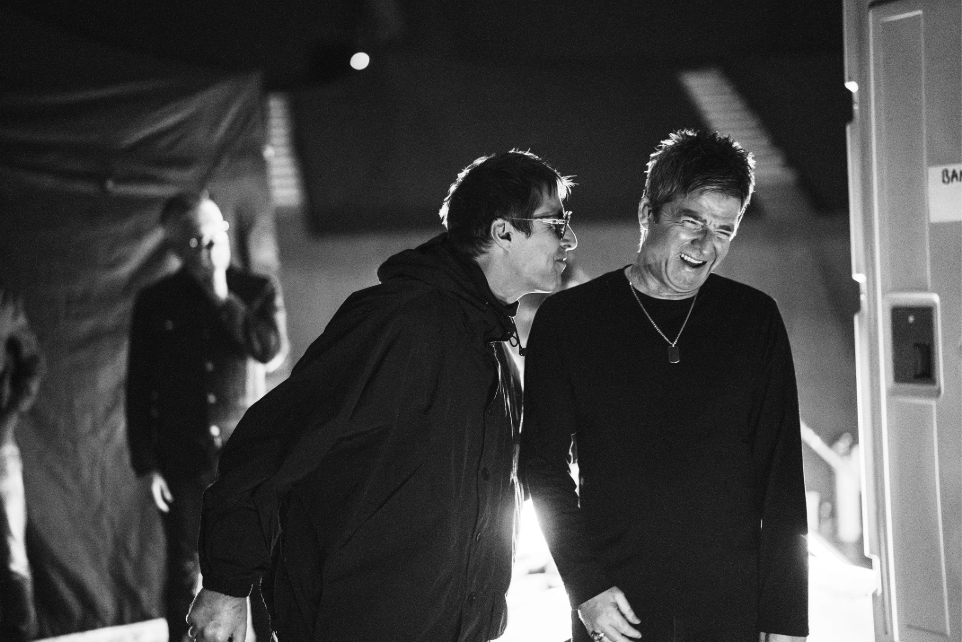
The new documentary Don’t Look Back in Anger, conceived by Peaky Blinders creator Steven Knight and directed by Will Lovelace and Dylan Southern, offers an intimate glimpse of the brothers’ unspoken reconciliation.
The film opens with a montage of fifteen years of insults and speculation before bringing the audience into an Oasis rehearsal room. Noel deftly directs the band through their old songs, eventually asking, “So when is Liam coming in?” The answer: “Tomorrow.” When Liam arrives, the brothers briefly acknowledge each other and get down to the business of rehearsal. Knight reflects,
In that huge moment when Liam arrives on the first day for the first time the brothers are going to perform together for over fifteen years, there isn’t a high-five, a hug, or even a word between them. . . . And the relationship builds as they’re doing the actual work. And that’s what I love about it and why I think people get it and feel the emotion—because you’re feeling the emotion they’re not expressing.
The documentary frames this understated reconciliation through a homily on forgiveness delivered by Fr. Luke Bradbury, a priest at St. Bernard’s Catholic Church in Burnage where the Gallagher brothers were baptized and their mother Peggy remains a devoted parishioner. Coincidentally, on the only day the filmmakers were able to film at the church, Fr. Bradbury was preaching on Matt 18:21–35. He beautifully connects the Catholic call to forgiveness with the reunion shows taking place in Cardiff, presenting Noel and Liam’s reconciliation as a source of inspiration for anyone carrying the pain of a broken or wounded relationship.
We are called to forgive in light of pain, not because it’s no longer present.
The homily begins with Peter asking Jesus, “Lord, if another member of the church sins against me, how often should I forgive? As many as seven times?” Jesus replies, “Not seven times, but, I tell you, seventy-seven times.” Over a montage of Oasis fans congregating at the show, Fr. Bradbury continues,
Forgiveness is hard; it costs us something. But if we refuse to forgive, we imprison ourselves, we carry bitterness, anger, and shame. Forgiveness doesn’t necessarily mean forgetting what happened, it means deciding not to carry it with you anymore. It means looking forward, not back. So let me ask you today: Who do you need to forgive? A friend? A sibling? A parent? Maybe even yourself?
It’s poignant that Fr. Bradbury makes the crucial distinction that forgiveness is not the same as forgetting. This is one of the most important lessons in Noel and Liam’s very human story. Their reunion doesn’t erase fifteen years of resentment. Forgiveness is framed as an act of liberation. This is perhaps a more subtle point of Christ’s teaching: We are called to forgive in light of pain, not because it’s no longer present.
This calls to mind Christ on the cross. He innocently endured the greatest suffering that humanity can inflict upon a person, yet from the cross he cries out, “Father, forgive them, for they know not what they do.” Forgiveness does not deny the reality of suffering, instead it is the call to affirm love in spite of suffering and injustice.
The Catholic understanding of reconciliation goes much deeper than simply making peace. It is the restoration of communion—with God and with others. In the sacrament of reconciliation, we acknowledge our sins, seek forgiveness, and are restored to communion, allowing us to return to the Eucharist and participate in the sacramental life of the Church. Reconciliation opens the door to what St. Paul called the theological virtues: “Faith, hope and love. But the greatest of these is love.” And as Christ perfectly demonstrated through his sacrifice on the cross, love is the ultimate destination.
Fr. Bradbury’s homily is a beautiful, heart-rending, and unifying moment in musical documentary history. It reminds us that reconciliation must ultimately be lived through action, not just in words—or even songs. Perhaps no Oasis song could provide a more fitting soundtrack to the brother’s reunion than “Don’t Look Back in Anger,” also the documentary’s title. The song was written by Noel in 1995 and became their most iconic song. It took on a greater significance after the Manchester Arena bombing in 2017, when it became a rallying cry of solidarity and defiance. Only three days after the terrorist attack, a huge crowd gathered in St. Ann’s Square and spontaneously broke into a rendition of the song following a minute’s silence for the twenty-two victims. The moment transformed a pop song into an anthem of healing and forgiveness. It is almost as if, after more than a decade of conflict and insults, the Gallagher brothers could finally begin to live up to the words of their own anthem.
The song and the Gallagher reunion suggest the power of music and celebrity to bring generations together in something approaching a spiritual experience of unity. Throughout the documentary, fans can be seen crying and even praying at Oasis shows, and describing how Oasis’s music gave them hope during difficult times in their own lives, while others recount how the brothers’ reunion inspired them to reconnect with friends and family. If Liam and Noel can forgive each other, so can we. The reconciliation has become more than the reunion of a ’90s rock ’n’ roll band—for people the world over, it became a catalyst for hope and inspiration amidst a world marred by sin, conflict, and division.
As a lifelong Oasis fan, I know that for me personally, seeing the Gallagher brothers live again on the recent tour was a beautiful and unifying experience. I went with my father and two of my three younger brothers. It was an emotional moment, especially given the fact that I had experienced periods of estrangement within my own family. When Noel walked up to the microphone and the piano intro began, I remember putting my arms around my father and brothers and all of us screaming at the top of our lungs:
Don’t look back in anger,
I heard you say . . .