
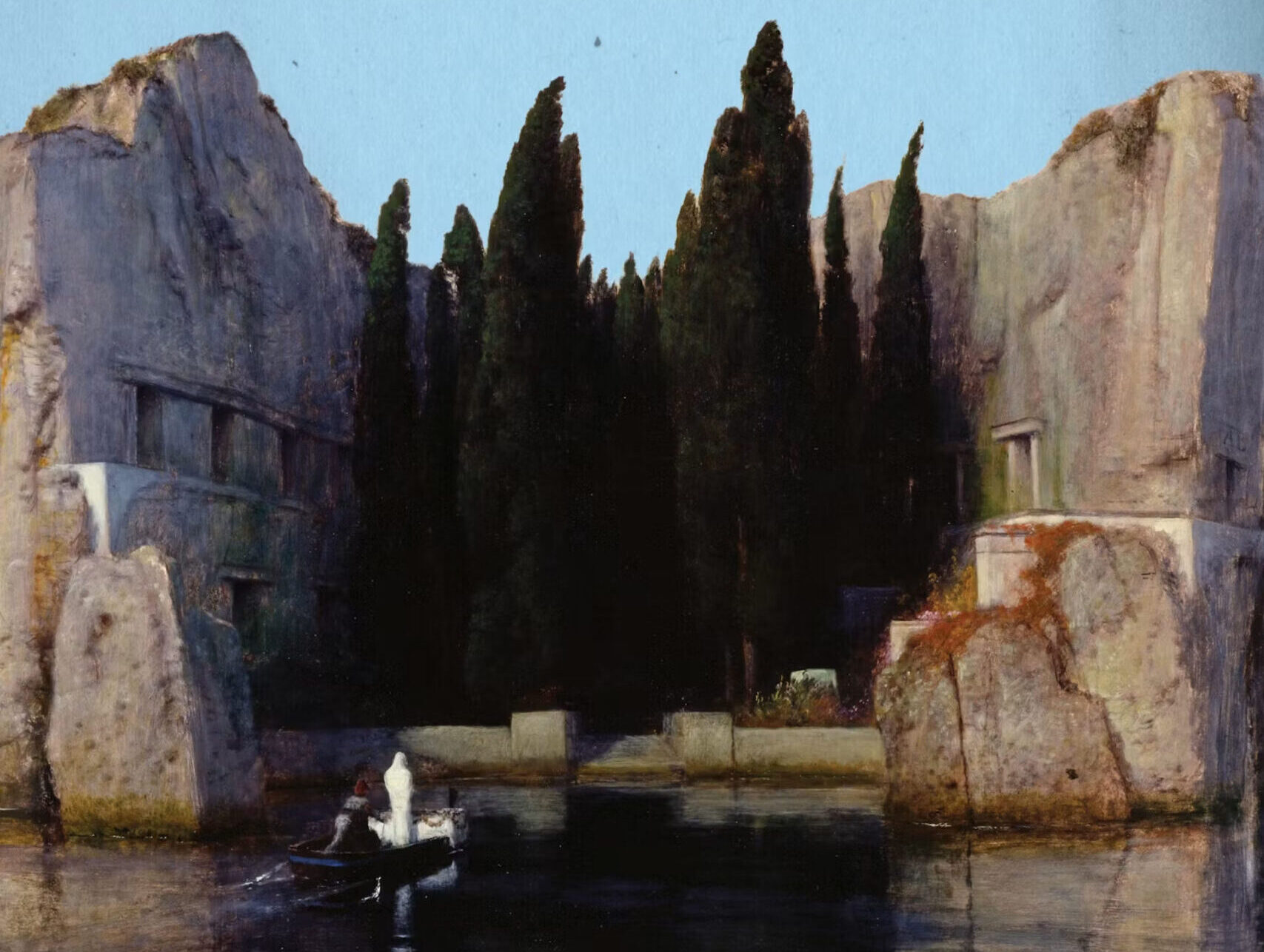
Most novels provide a sense of unity by means of illusion. What seems to be one story is actually at least two stories and often more. At the minimum level of complexity, we have a foreground story—the immediate action—and a background story, which helps to illumine and deepen and interpret the events that are unfolding in the narrative present. The newest offering from Matthew Gasda, Stranger Beauty, follows this predictable pattern to unpredictable places.
The point-of-view protagonist, M, a retired but still young playwright, inhabits a technodystopia in the year 2038. The problem of mortality has been solved (at least for the well-off and at least in cities), and AI models oversee and optimize all the most intimate day-to-day logistics. The drama of life is now not whether the body will survive but whether the spirit will. Shorn of purpose, M meditates on the sources of his current life and finds at least one of their taproots back in the year 2023, in the pages of old journals he kept while making the decisions whose consequences he now lives.
The journals plunge the reader into a quasi-hypnotic, aphoristic meditation on the continuity of human identity over time, while the 2038 foreground plot develops into a timely examination of the nature of human creativity against so-called AI “generativity.” The flashes of epiphany are called into question by the final outcome, and that outcome implicitly asks: Is this “newer thing,” the machine simulacrum of consciousness, simply one more feature of the world outside our heads? Is it a beneficent presence seeking entrance and hospitality, one to which we owe xenia, welcome of the stranger? Or is it instead a Trojan horse, leviathan, panopticon, Chthulu, Dave, Borg: a dream-monster we must either evade or slay before it eats us alive in the name of a false communion?
Much has already been said of this, and most readers’ sentiments will be entrenched in one camp or another. By placing his foreground action in the future, Gasda skillfully threads the needle so that readers will have to face not our own present situation but that of a possible, and for now counterfactual, future.
It will be news to precisely no one reading this piece that, in our time, technologically sophisticated humanity stands in conflicted relation to its own biology.
That narrative strategy effects another skillful and necessary evasion too: Because of Gasda’s prior success as a playwright, whatever he writes is far too often interpreted by commentators as though it were some kind of skeleton key for a scene, a social movement, or even a generation. Here I intend to ignore, just as Gasda bypasses, that noisy yet nebulous context and take this work on its own conceptual and technical terms. It becomes easier to do this with Stranger Beauty than with any of his previous works because for once Gasda is writing not about “the moment” but about whatever in the human is also timeless.
As Daniel McInerny observes in Beauty and Imitation, “One of the chief ways a culture puts its customs into question is through storytelling.” It will be news to precisely no one reading this piece that, in our time, technologically sophisticated humanity stands in conflicted relation to its own biology. Gasda picks up on this conflict and profoundly puts it into question, especially where the conflict cuts across relationships between men and women. A preoccupation with human generativity, in both the physical and spiritual senses, pervades the plot. Sexuality is therefore inescapably present. Yet in contrast to Gasda’s previous novel The Sleepers, sexuality is presented here more implicitly and subtly, less explicitly and exhibitively. For this reason, many Christians—whose conceptual language Gasda’s protagonist freely borrows even as it remains unclear whether he counts himself one of them—may find this novel worth engaging. It will still strain the comfort zones of some, who others may consider its repetitious hints and whispers of skin and sense extraneous to the plot.
They are, however, not extraneous. What is revealed by these brief vignettes—glimpses rather than scenes—is not so much the compulsive and self-regarding nature of most nonmarital coupling (although that also comes to the surface). Still more, they presence the very real sense in which the “marital act” even prior to marriage or without intention of fidelity truly makes two one so that the subsequent uncoupling of their human concerns and questions becomes at best a bloodletting, at worst an irreducible impossibility.
What stands out about Gasda’s treatment of this motif is that he gets to the heart of both the real sadness and real joy of eros and its irreducible orientation toward fruitfulness. Even though M and his then-girlfriend-now-wife, S—, or Sophia (“her name means gnosis”), do marry and raise a child together, by the time of the foreground (2038) action, their relationship has fallen apart. They remember the vivid frisson of their low-commitment days, yet they cannot recapture it under the current conditions of their life. These conditions, in turn, have less to do with the supposedly dulling effects of a vow of fidelity (M at one point confesses to a powerful, marrow-deep craving for stability) and far more to do with their technological, economic, and aesthetic milieu.

Gradually, it emerges that M has sold away his previous body of creative work to an AI company to train its models in exchange for dubious technodystopian benefits whose nature is only slowly and partially revealed. Gasda draws a direct, explicit parallel between M’s creative impotence and its literal, physical analogue following this decision. Sophia, as a spouse, remains compelling and continues to long vocally for her husband; she, it’s implied, is flourishing from the effects of life-extension treatments that may also be, to some extent, the cause of M’s malaise; but, again, the bodiliness—or disembodiment—of their connection is not incidental to the story. It is key to understanding what a machine is not and will never be.
That important meditation is, unfortunately, not especially well served by the choppy, aphoristic form which the novel’s extended middle section is delivered. These shard-like reflections are taken from M’s secret journals which themselves echo, probably on purpose, Gasda’s own “Writer’s Diary” available both on Substack and in print form.
Often incisive as observations and frequently freighted with important detail whose disclosure affects how, the diaristic sections nevertheless carry less weight as fictional rendering because they are so fragmentary and so disconnected from the moments of embodied life that promoted them. The reader is not always given to understand, even, whether the sensory stimuli they describe are being experienced, remembered, or merely imagined.
That is to say, these aphorisms are already to some extent mechanized, and M’s jealously guarding them from the machine—the only part of his oeuvre he didn’t sell in his Faustian deal—may be superfluous, too little too late.
To be clear, this is not a criticism of the “Diary” itself, which provides minute slices of thought and experience that, in themselves, are often quite compelling. I follow the “Writer’s Diary” avidly and often find individual lines sympathetic or illuminating, but when transposed wholesale and at great length into novelistic structure, their form can’t fully deliver the integrated texture of sustained experience that narrative prose requires in order to produce a full, willing suspension of disbelief. The reader remains alert to the man behind the curtain, positioning M, Sophia, Ruby, Kairos, and their other connections and contacts in tableaux vivants from which the sense of imminent movement, meaningful action, only intermittently emerges.

This effect of the dis-integration of form may be deliberate, as it puts the fictional M in a weaker position characterologically to oppose or resist the encompassing forces that bear in upon him. If deliberate, though, it must be noted that this choice results in the rendering of a character who constantly tells us we must resist disembodiment and dehumanization but who cannot show us what an effective resistance would look like. In itself, this is not objectionable. The fates of fictional protagonists only sometimes suggest models for action; other times, they imply warnings of danger. But if M offers a warning, it is a particularly hopeless one, suggesting that if even this protagonist with all his privileges is incapable of putting up a decent fight, no more will we be. If it is a promise of future technovitalist glory, it does not make that glory more appealing.
The novel’s concluding sequence, hypnotic and nearly hallucinatory, raises central questions of what is real and what is illusory, even as, despite flashes of gorgeousness, its overall effect lacks coherence. This decoherence, too, may be purposeful, though it is disorienting. Perhaps we ought to feel disoriented; we ought to notice our disorientation. We ought to realize that we are, like M, “mangled by the digital machinery [we] both use and [are] used by.” Maybe that is the point.
A novel like this one has a value for its ability to provoke awareness: awareness of the perilous deciding moment that may already have passed; awareness of the self’s inevitable conflicts over how to meet what comes next. It is also interesting for its willingness to stretch our sense of what counts as, or belongs in, “a novel.” In art, experimentation drives forward and pushes the limits of what we can possibly say, but sometimes it does so at the risk of saying nothing or of committing fruitless self-contradictions. Ambiguous art can confound our shallow, unexamined expectations; it can demand reflection on realities we may otherwise feel hesitant to own; it can just as easily lead us into a labyrinth out of which there is no independent exit, only rescue.
The productive disorientation found in Stranger Beauty reveals the counterproductive confounding, the confusion of identity, that lies at the heart of the problematic ethics of AI use in creative contexts: Is the “speaker,” “Kairos,” a real machine model speaking for an invented character (M) who mirrors the real artist (Gasda)? Or an invented machine voicing the invented character (M) who perhaps speaks, or perhaps does not speak, for the real artist? Gasda’s mimesis of our habit of naming our machines raises further questions still: Does the chosen name, Kairos, indicate that the machine aspires to guide us toward transcendence—or that it usurps our capacity for transcendence?
The productive disorientation found in Stranger Beauty reveals the counterproductive confounding, the confusion of identity, that lies at the heart of the problematic ethics of AI use in creative contexts.
The text does not provide definitive indications. The plot’s conclusion could be thought to support either answer, or both. Perhaps we need this ambiguity, this invitation to read against the grain so completely that we may have to ask which way the grain even runs in the first place. Perhaps it is necessary. For excellent narrative art often does not so much steer us toward a definitive set of answers so much as it provides us with substance and space to pose needed questions more articulately. This chameleonic shifting, this ability to reflect one facet of truth and now another without committing to any interpretation of either, has its merits, if limited ones.
And yet, and yet—I think, now and often, of an assertion made by a minor character toward the end of Joshua Hren’s novel Infinite Regress. Observing the life of another character who cannot free himself from the différance of an endless recursive loop of self-questioning questions, this character pronounces that his intellectual friend has not in truth attained enlightenment but only a bijou residence inside a “small and shitty hell.” By deferring meaning and decision endlessly, this minor character (like so many other souls caught in the digital flotsam) drifts around and around a tantalizing lazy river, constantly thirsting for the water of life but never able to find a drink, forever asking “What is truth?” but never able to arrive at the True. Maybe Gasda, too, by letting us watch M ride around and around his own lazy river of rumination and reflection (and regret?), wants to bring his readers to that point of utter abandonment where we must demand a decisive answer or be lost entirely. Maybe.
But is this not becoming a pileup of too many maybes? In all this shipwreck of bodies and meanings, the reader may be forgiven for asking, as Hopkins asked over another wreck: Where, where was a, where was a place?
This is why I mean it as only ambiguous praise when I say that the last words of Gasda’s novel leave behind a haunting and apparently deliberate uncertainty. Today’s intellectuals have, for the most part, been trained to desire and expect inconclusive conclusions in the name of openness: not to be, as Girard says repeatedly in A Theatre of Envy, naively “taken in by representation.” The ending of Stranger Beauty rightly refuses readers the comfort of superficial interpretations, sparks the desire to cling to what remains deeply valid when fluidity reigns and appearances deceive, and yet offers no hint of where to seek a compass for the search.
The truth Stranger Beauty helps us to see, then, is just the nature of our moment’s carefully poised illusion, the shape of the bubble we all now live inside. What it does not show us, what perhaps no novel can show us, is what will remain stable when that bubble inevitably pops.