
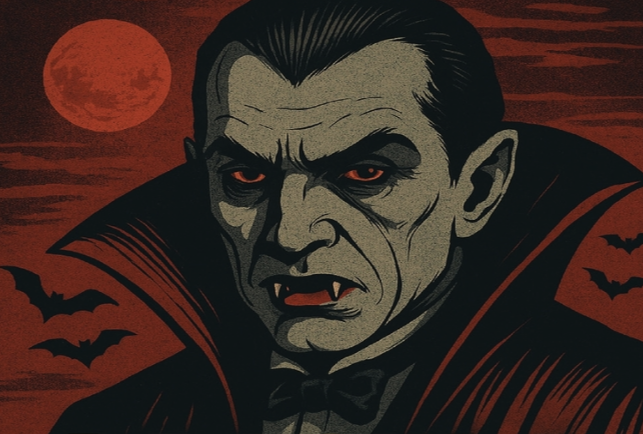
Dracula is a name that has struck fear into the heart of Western culture for over a century. Dracula’s story has been told and retold innumerable times through novels, comic books, and perhaps most notably, films like Nosferatu (1922), Dracula (1931) and Bram Stoker’s Dracula (1992). Much of the enduring mythology of the modern vampire owes its origins to Bram Stoker, whose masterful synthesis of folklore, history, and Gothic literature gave the world its most iconic incarnation of the parasitic undead. Beneath the bloody horror and predatory eroticism lies a deeper exploration into the nature of evil, the limitations of reason and science, and the indispensable power of Catholicism to confront and overcome supernatural evil.
Abraham “Bram” Stoker was born on November 8, 1847, in the Clontarf suburb of Dublin, Ireland. Bedridden by an unknown illness until the age of seven, he developed a dark turn of mind, encouraged by his mother’s tales of Ireland’s cholera epidemic when people were mistakenly buried alive. After miraculously recovering, Bram excelled as an athlete at Trinity College and graduated in 1870. He began publishing fiction like The Crystal Cup (1872) and horror novella The Chain Of Destiny (1875). Notably, Stoker also wrote The Snake’s Pass (1890), which was partially inspired by the legend of St. Patrick expelling the serpents from Ireland.
Stoker’s career changed dramatically after he favorably reviewed Henry Irving’s performance in Shakespeare’s Hamlet. The young Bram became Irving’s devoted associate, and in 1878, Irving appointed Stoker as manager of London’s prestigious Lyceum Theatre. Stoker held the position for twenty-seven years and became acquainted with Oscar Wilde, Arthur Conan Doyle, and W. B. Yeats. That same year, he married Florence Balcombe, who later converted to Catholicism in 1904. Stoker himself remained an Irish Protestant throughout his life with interests extending into mesmerism and Freemasonry.
Stoker’s Count Dracula evokes a long literary tradition of diabolical figures from Dante’s Lucifer to Milton’s Satan to Goethe’s Mephistopheles. The aristocratic vampire archetype was first developed by Lord Byron’s personal physician John William Polidori and published in his tale, The Vampyre (1819). It was adapted into a play by James Robinson Planché and had its debut at Lyceum Theatre, the very theatre Stoker later managed.
Beneath the bloody horror and predatory eroticism lies a deeper exploration into the nature of evil, the limitations of reason and science, and the indispensable power of Catholicism to confront and overcome supernatural evil.
Yet the novel’s origins may lie in a far more intimate source. Some scholars have linked Dracula’s conception to a nightmare Stoker experienced in 1890. In the dream, Stoker was confronted by seductive and vampiric women who violently attempted to kiss his throat, only to be summoned away by a commanding and mysterious figure with a booming voice saying, “This man belongs to me!” The vision would later be recalled in the novel through Jonathan Harker’s confrontation with Dracula’s brides. The extent to which this chilling nightmare inspired the novel is uncertain, yet it offers a fascinating glimpse into the haunted imagination from which Dracula was born.
Later in 1890, Stoker travelled to Whitby, the Yorkshire seaside town that would become a key setting in the novel. There, he accumulated stories from the locals about ghostly shipwrecks and made extensive notes of the tombstones in St. Mary’s churchyard. He became a regular visitor to the local library where he read Emily Gerard’s The Land Beyond the Forest (1888), detailing the superstitions and mysterious folklore of Transylvania. The book documented local tales of “nosferatus” (undead vampires) and the means to repel and kill them, such as garlic, wooden stakes, extracting the heart, or decapitating the corpse—methods Stoker later incorporated into Dracula.
Stoker’s historical research appeared to have led him to Vlad III, referred to as Vlad the Impaler or Vlad Dracula, the fifteenth-century ruler of Wallachia known for his extreme cruelty and violence. Stoker’s research included William Wilkinson’s An Account of the Principalities of Wallachia and Moldavia (1820), linking the name Dracula with the Romanian word for “dragon” or “devil.” In the novel, the character Van Helsing speculates whether the Count and Vlad are the same person, and he references the aforementioned The Land Beyond The Forest, saying, “[Count Dracula] must indeed have been that Voivode Dracula who won his name against the Turk. . . . If it be so, then he was no common man: for in that time, and for centuries after, he was spoken of as the cleverest and the most cunning, as well as the bravest of the sons of the land beyond the forest.” In Dracula, Bram Stoker masterfully synthesized his nightmarish subconscious, the aristocratic vampire tradition, Transylvanian folklore, and the legend of Vlad the Impaler into a dark convergence of historical violence, predatory eroticism, and supernatural evil.
Dracula is an epistolary novel told through diary entries, letters, telegrams, and newspaper articles. The story begins with Jonathan Harker, a naive English lawyer who travels to Transylvania to assist the mysterious Count Dracula in purchasing property in London. At the Count’s remote castle in the Carpathian mountains, Harker discovers that Dracula is a nosferatu, an undead vampire who feeds upon human blood. Dracula leaves for England, where he pursues Harker’s loved ones. Harker joins forces with Dutch professor Abraham Van Helsing to hunt and kill Dracula.
As the novel progresses, the characters appeal to medicine for a cure to vampirism yet they discover that reason and science are insufficient to comprehend or defeat the power of Dracula. Their confrontation demands a deeper understanding of the spiritual world, where faith and God’s power become indispensable weapons. This tension is revealed in an exchange between the physician Dr. Seward and Professor Van Helsing, who challenges Seward’s conviction that reality is limited by scientific explanation:
(Van Helsing:) You are a clever man, friend John; you reason well, and your wit is bold; but you are too prejudiced. You do not let your eyes see nor your ears hear, and that which is outside your daily life is not of account to you. Do you not think there are things which you cannot understand, and yet which are; that some people see things that others cannot? . . . It is the fault of our science that it wants to explain it all; and if it does not explain it, then it says there is nothing to explain. . . . There are always mysteries in life.
[ . . .]
(Seward:) Do you mean to tell me that Lucy was bitten by such a bat; and that such a thing is here in London in the nineteenth century?
(Van Helsing:) My thesis is this: I want you to believe.
(Seward:) To believe what?
(Van Helsing:) To believe in things that you cannot.
Van Helsing exposes the limits of science to explain all phenomena—in this case, an undead vampire—yet he does not reject reason outright. From a Catholic perspective, the distinction is crucial. Faith is not the abandonment of reason, nor the belief in what is untrue, but the fulfillment of reason and the intellect’s ascent toward truth transcending mere sensory perception. The characters’ confrontation with the embodiment of evil cannot be resolved by reason alone; it demands the language, rituals, and sacraments of the Catholic tradition. In Stoker’s nightmarish vision, Dracula is more than a monster; he is the abominable counterfeit of eternal life, an inversion of light and holiness, a parasitic creature that feeds on the lives of others for pleasure and to sustain his power.
The characters’ confrontation with the embodiment of evil cannot be resolved by reason alone; it demands the language, rituals, and sacraments of the Catholic tradition.
As the story unfolds, the characters discover the extraordinary power of Catholic sacramentals and the Blessed Sacrament to repel the supernatural evil embodied by Count Dracula. In Chapter 1, Harker receives a crucifix from the local villagers as he journeys towards Dracula’s castle, a gesture of protection against the horrors awaiting him. In Chapter 16, Van Helsing repels the vampiric Lucy with a golden crucifix and uses the Blessed Sacrament to seal her tomb. Later, in Chapter 22, he places fragments of the Blessed Sacrament inside Dracula’s boxes of Transylvanian earth, sanctifying the soil and rendering it an unusable refuge for the vampire. Throughout Dracula, Stoker repeatedly demonstrates the power of Catholic objects and rituals to repel and protect from supernatural evil. Against the Count’s own satanic inversion of eternal life, the Blessed Sacrament stands athwart, confronting evil not through human reason alone but through the authority and power of God and his Church.
The Church’s history of confronting supernatural evil dates back to Christ’s expulsion of demons in the Gospels, and the formal rites of exorcism developed and codified over the centuries. The Second Council of Nicaea (787 AD) defended the veneration and holiness of sacred images, determining that
“the honour rendered to an image passes to its prototype” (CCC 2132). This principle is crucial to understanding the power of the sacred in Dracula. When the Count retreats from a crucifix, he is not confronted by merely wood and metal but by the truth the image points toward: Christ, whose death and resurrection have conquered sin, death, and evil.
The Blessed Sacrament takes this a step further. Whilst the crucifix is a sacred image pointing to Christ, the Blessed Sacrament is Christ himself, “For in the blessed Eucharist is contained the whole spiritual good of the Church, namely Christ himself, our Pasch” (CCC 1324). When Van Helsing wields the Blessed Sacrament against Dracula, he confronts evil’s embodiment with the living presence of Christ, the source of all love, beauty, and truth. This reflects the Catholic conviction that there is no greater power on earth than the Body and Blood of Christ.
While Count Dracula is the satanic inversion of eternal life, Christ is the very source. Dracula must consume the blood of the living to sustain his existence, while Christ gives his blood to gain eternal life for others. Dracula perverts love to possess and dominate, while Christ’s love liberates. Dracula’s immortality is a curse, but Christ promises eternal life with God in heaven. Dracula preserves himself at the expense of others, while Christ offers himself as the salvation for others. Dracula embodies death, but Christ entered into death and conquered it through his resurrection.
Dracula remains a quintessential and ubiquitous figure in modern culture synonymous with evil, vampirism, death, and dread. The novel offers a vision of the ultimate victory of light over darkness and the power of Catholicism to confront diabolical malevolence and sin. Stoker’s Dracula serves as a cautionary tale against the satanic promise of eternal life through profane and unholy means. It reminds us that Christ, who is “the way, the truth and the life,” is the source of eternal life and our hope of deliverance from evil.