
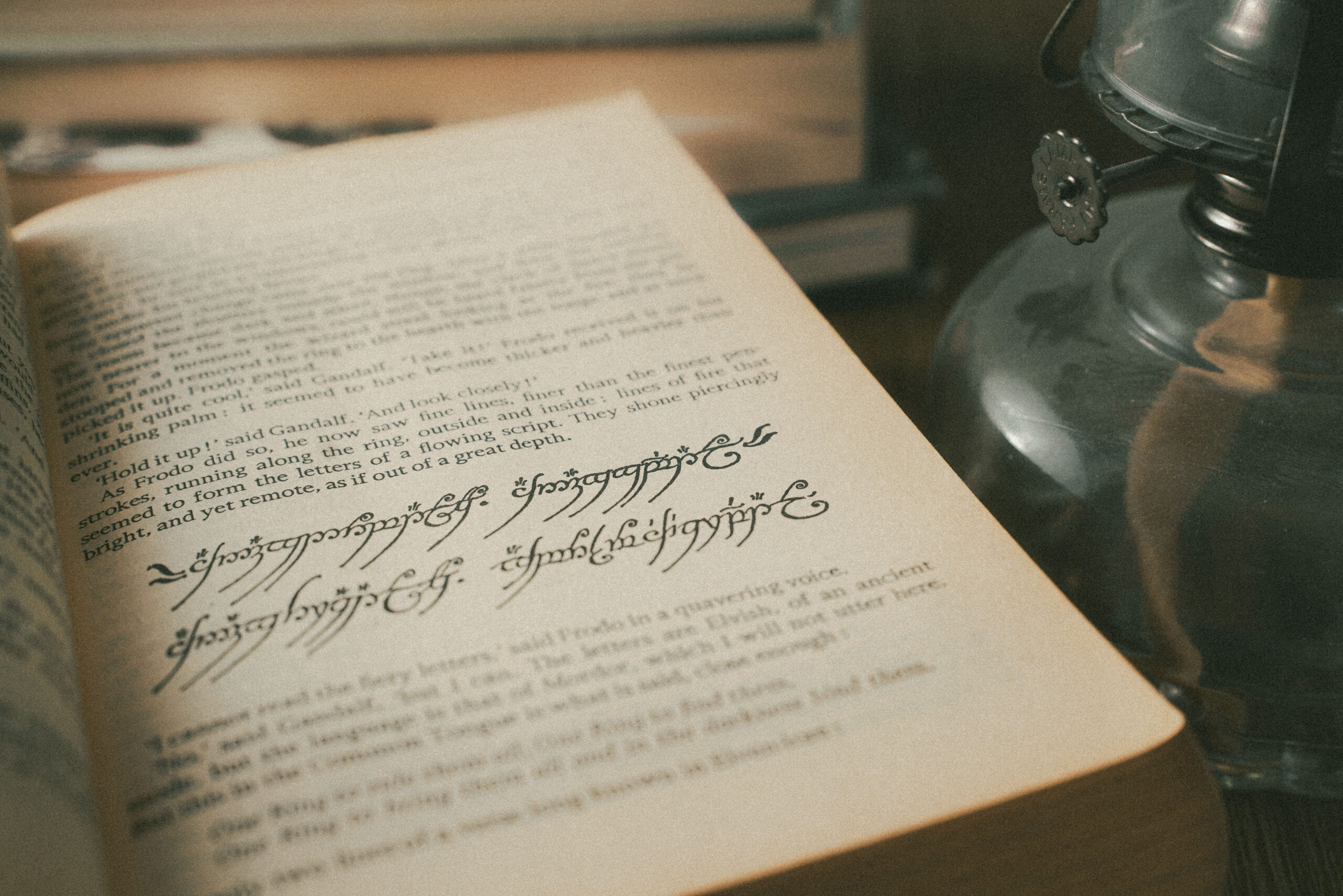
Beyond his much-beloved books, The Hobbit, The Lord of the Rings, and The Silmarillion, J. R. R. Tolkien was a poet, philologist, translator, and inventor of languages. His letters, collected in The Letters of J. R. R. Tolkien, are particularly illuminating, as they offer a glimpse of Tolkien as a writer—one who was often in need of precious, uninterrupted time to write. And though few of these letters are directed to other writers about writing, they reveal some important truths about the craft.
Writing Is Done in the Midst of Life
In many of his letters, especially to his publishers Allen and Unwin, Tolkien apologizes for delays in replying to them or giving them material. Often, illness, domestic obligations, or work duties overtook his writing time. In the case of publishing The Lord of the Rings, World War II also intervened. His major works have long gaps between them: The Hobbit came out in 1937 while The Lord of the Rings didn’t come out until almost 20 years later (1954/1955). The Silmarillion, which in large form predated both The Hobbit and The Lord of the Rings, was not published until after his death.
For those of us who write, Tolkien offers a realistic approach to the writing life. Very few of us will be completely free to write as much as we wish. We have families who need us, day jobs to attend to, and obligations to ourselves and others that come with living life. There is beauty in picking up our joys (be that writing or another form of creativity) in the odd hours; so too, there is beauty in the call to the sometimes sacrifice of pouring ourselves out in other ways. Indeed, perhaps that is what makes works like Tolkien’s so rich: The stories lived in him so long and accompanied him throughout his life.
Bring Your Family and Friends into Your Joys
Though writing is often a solitary art, Tolkien’s life demonstrates that our ideas can come to full fruition only when we allow others to enter into them. The Hobbit and The Lord of the Rings appeared before the Inklings, and Tolkien speaks of the debt of gratitude he owed to C. S. Lewis for his encouragement. The Hobbit became a long-form story Tolkien told his children, and he relied on his children, and the son of his publisher, Rayner Unwin, then a young boy, to offer their feedback on The Hobbit. During World War II, he sent parts of Lord of the Rings to his son, Christopher Tolkien, both to comfort Christopher and because Tolkien valued his opinion.
The stories lived in him so long and accompanied him throughout his life.
Allowing our families and close friends to hear what we are writing (or otherwise creating) invites them to participate more closely in our joys. It is also a gift to receive kindly perspectives on our creations from those who love us and want to see us grow in what we love. One illustrative detail is that Christopher felt strongly that Sam Gamgee’s last name should not be changed to “Goodchild” as Tolkien had intended; because of Christopher’s opinion, Tolkien retained Gamgee, telling Christopher in a letter of July 28, 1944, “I daresay all your imagination of the character is now bound up with the name.”
Language Matters
As his professorial life was dedicated to philology and the teaching of courses in Old and Middle English, Old Icelandic, and Medieval Welsh, and his first job after returning from World War I was for the Oxford English Dictionary, Tolkien cared deeply about words. He invented his own Elvish language, and a handful of his letters to his publisher are about language. For example, in multiple letters, he asks that translations of his works maintain the names of characters or place names, as each carries with it particular meaning and music.
In words, Tolkien found a particular beauty. In a letter to his aunt in 1961, he writes this about poems that would be included in a book of poetry, The Adventures of Tom Bombadil and Other Verses from the Red Book: “As for plenilune and argent, they are beautiful words before they are understood—I wish I could have the pleasure of meeting them for the first time again!—and how is one to know them till one does meet them? And surely the first meeting should be in a living context, and not in a dictionary, like dried flowers in a hortus siccus!” (Letter 234, p. 439).
One consideration for writers is our language. In a world where there is increasingly heavier reliance on technology to produce textual content, it is important to remember the music of our language’s meter and rhyme and maintain an awareness of the various languages that have shaped our own. These help create a tapestry of meaning that enriches the reader and increases the pleasure of reading.
Our pace of completing our projects may very well be nowhere near what we’d like it to be.
Honor Your Own Pace
Throughout his life, Tolkien was pulled in multiple directions, and as a result, a few of his projects, connected to his tenure at Oxford and his personal writing, were left unfinished. As Tolkien explains in a letter of March 20, 1967, to a correspondent asking after a project for which Tolkien missed the deadline, “The truth is I cannot do two things at the same time, nor anything perfunctorily. . . . I have tried to sit on two stools and of course slumped between them, and given no pleasure to anybody.”
Identifying himself as hobbit-like, it is likely the case that Tolkien may have been suited to a slower pace of life. His commitments to Oxford seemed to drain him (e.g., the tedium of meetings and marking exam papers), and the strain played out in poor health multiple times in his life. His acknowledgement that he could only do one thing at a time seems to be a hard-won piece of self-knowledge, as his life in letters shows a pattern of often being asked to give more than he had capacity for. He reminds writers and creators that our pace of completing our projects may very well be nowhere near what we’d like it to be. However, it is wisdom to acknowledge our capacity and its limits, and to honor them.
When Possible, Elevate Learning over Research
Tolkien seems to have become sensitive to the concept of research as it was carried out at the university level. As he says in a letter to his grandson Michael George Tolkien on October 28, 1966, “I am myself and have always been sceptical about ‘research’ of any kind as part of the occupation or training of younger people in the language-literature schools. There is such a lot to learn first.” Near the end of his life, when he was increasingly asked to contribute to researchers’ inquiries about himself as a writer, he would sometimes quote his own work, as he does in a letter from December 13, 1972: “See Lord of the Rings Vol. I, p. 272: ‘He that breaks a thing to find out what it is has left the path of wisdom’ (/or she) –Gandalf. I should not feel inclined to help in this destructive process.”
Tolkien seemed to believe that learning requires an acquisition process in which the student is first a receiver, as opposed to a seeker of information. In our own times, where research is most certainly the way by which most subjects are taught, Tolkien’s view seems a call for the savoring of knowledge, to, for example, memorize a poem or key passage of prose, instead of breaking it down for meaning. For writers and creators, Tolkien’s encouragement may require a shift in how we approach the world around us, not as something to be studied but approached with wonder.
Writing Is a Gift Given
Tolkien’s works are indeed marvelous and continue to enrich us today. He had the good fortune (though in later years, he may have found this debatable) of being celebrated for this work in his lifetime. It is touching, therefore, to hear him acknowledge himself as the transmitter of a gift in a letter written in autumn 1971. He says to his correspondent: “If sanctity inhabits his work or as a pervading light illumines it then it does not come from him but through him. . . . Of course The L.R. does not belong to me. It has been brought forth and must now go its appointed way in the world, though naturally I take a deep interest in its fortunes, as a parent would of a child.”
In the same letter, Tolkien notes the effects of The Lord of the Rings’ publication on his own life: “Looking back on the wholly unexpected things that have followed its publication . . . I feel as if an ever darkening sky over our present world had been suddenly pierced, the clouds rolled back, and an almost forgotten sunlight had poured down again.”
Every writer and creator is called to approach his or her craft with the humility born of wonder at the Creator who through and with us brings to birth our creative works. Tolkien shows us that though what we create is meant to be a gift given to others, it is also true that what we create shapes us, touching us with hope, light, and the courage to create again.
. . .
This writer would like to extend a special thanks to Jen Fulwiler. Her insights on the creative life and her book Your Blue Flame in particular served as valuable sources of inspiration.