
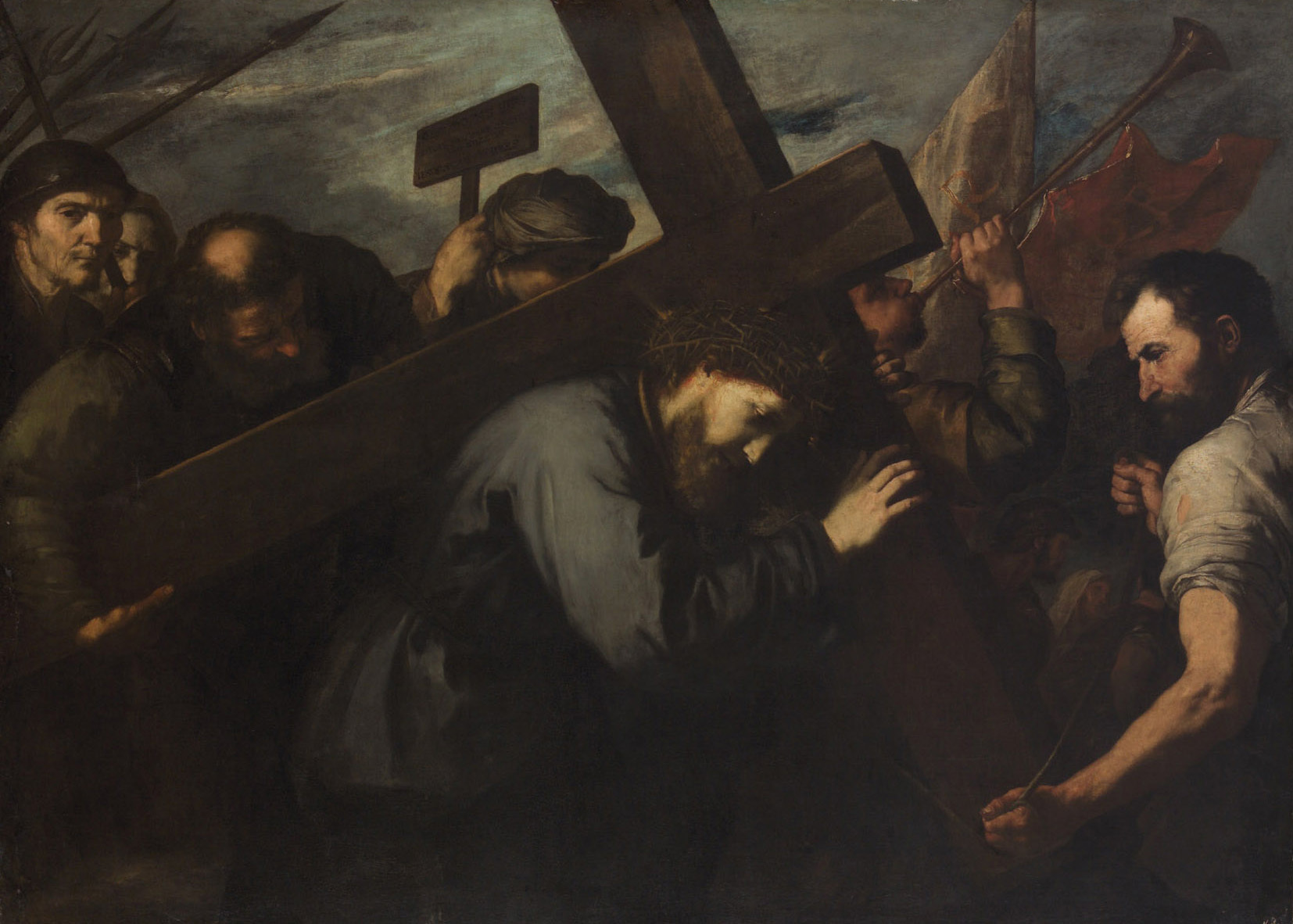
Holy Week carries with it a call to meditate on the mysteries of Christ’s passion, death, and resurrection. We do this through special liturgies, reading the passion accounts in the Gospels, and entering, perhaps more deeply, into our Lenten practices of prayer, fasting, and almsgiving. A beautiful accompaniment to this Holy Week might be the practice of reading poetry that engages with the Way of the Cross. What follows are a few poems to help us journey with Christ more intimately this Holy Week.
1. “Who is to say which is which / when the weight knocks us both to the ground— / me and him?” —John Paul II’s “Simon of Cyrene” in The Place Within
The final poem in the wonderful poem cycle “Profiles of a Cyrenean,” this poem focuses on the moment in which Simon is called to carry the cross with Christ. The poem begins with Simon desiring to “keep myself to myself” and ends with conversion: “You are accessible, broad: / all men are contained in you.” Like each of us on the road to deeper conversion of our hearts and minds to Christ, Simon declares, “I stand on a threshold, glimpse a new world.” This world is one in which Christ reigns—over not only our lives and circumstances but every life and circumstance that occupies this world. The poem is sweeping, calling us beyond our depths to meditate on what it means to draw close to Christ, to the profundity of this one moment of Simon’s life that, in this poem, dramatically shifts his perspective.
2. “Spiteful spear that break’st this prison, / Seat of all felicity, / Working thus with double treason / Love’s and life’s delivery” —Robert Southwell’s “Mary Magdalen’s Complaint at Christ’s Death”
Many paintings depict the despondency of Mary Magdalene, who stayed at the foot of the cross as Jesus suffered and died. In like manner, poet Robert Southwell writes a moving meditation of Mary Magdalene’s grief at being separated from her Savior. Lines like “With my love my life was nestled / In the sun of happiness; / From my love my life is wrested / To a world of heaviness: / Oh! let love my life remove, / Sith I live not where I love!” convey Mary’s security in the Lord, and her desire to be where he is. Noting that “thy [her soul’s] prison was his heart” broken open by the spear that pierces him in death, Mary Magdalene feels she, too, wants to die with him. This poem bears an echo of her vocation as apostle to the apostles, embodying Thomas’s words in John 11:16: “Let us also go, that we may die with him.” The poem asks readers to meditate on their own willingness to suffer with the Lord, to accompany him in death to ourselves.
3. “Drive me by the strength / of your tenderness / to come close to human pain.” —Caryll Houselander’s poetic rhythm for “Veronica Wipes the Face of Jesus” in The Way of the Cross
Meditating on our call to image Veronica, mid-twentieth-century poet and writer Caryll Houselander asks the Lord to “give me Your hands / to tend to the wounds of the body / and the wounds of the mind.” Much like the prayer portion of the Stations of the Cross, this prayer-poem (Houselander called her poems “rhythms” because the stanzas reflected the shape of her thoughts) calls readers to reflect on how we might be Veronica in the lives of those around us. The final lines, “Lord take my heart / and give me Yours,” encapsulate the call of Lent—to be transformed by Christ’s love.
4. “At the cross her station keeping, / Stood the mournful Mother weeping, / Close to Jesus to the last” —“Stabat Mater Dolorosa”
This thirteenth-century hymn is part of our Stations of the Cross prayers during Lent. Its meditation on Simeon’s prophecy to Mary that “(and you yourself a sword will pierce) so that the thoughts of many hearts may be revealed” (Luke 2:35) calls out in a special way to our hearts. As we pray the Stations of the Cross, the “Stabat Mater” reminds us that we can walk alongside Mary, who shows us under the title of Our Lady of Sorrows that there is no trial, no suffering, and no pain that her son cannot touch. The “Stabat Mater” invites us into Mary’s most grievous sorrow: “Can the human heart refrain / From partaking in her pain, / In that Mother’s pain untold?” In meditating on her heart pierced by sorrow, we may ask with the hymn, “Make me feel as you have felt; / Make my soul to glow and melt / With the love of Christ our Lord.”
5. “The warriors then left me / standing drenched in blood, all shot through with arrows. / They laid him down, bone-weary, and stood by his body’s head; / they watched the Lord of heaven there, who rested a while, / weary from his mighty battle.” —“The Dream of the Rood,” translated by Roy Liuzza
This Old English poem dazzles with stunning images and features Christ’s passion, death, resurrection, and glory from the perspective of the cross itself. Unlike many modern depictions of the passion, which emphasize Christ’s suffering, this poem, in the fashion of the warrior culture it was born in, emphasizes Christ’s heroism. The fact that the cross notes that Christ “rested a while” (in death) is a fresh perspective. The cross speaks of the passion in light of the resurrection. The story is one of glory, both for Christ and the cross: “Once I was made into the worst of torments, / most hateful to all people, before I opened / the true way of life for speech-bearers.” As we approach Good Friday, on which we will venerate the cross, this poem can deepen our appreciation for Christ’s sacrifice and awaken in us a greater hope in his victory over sin and death.