
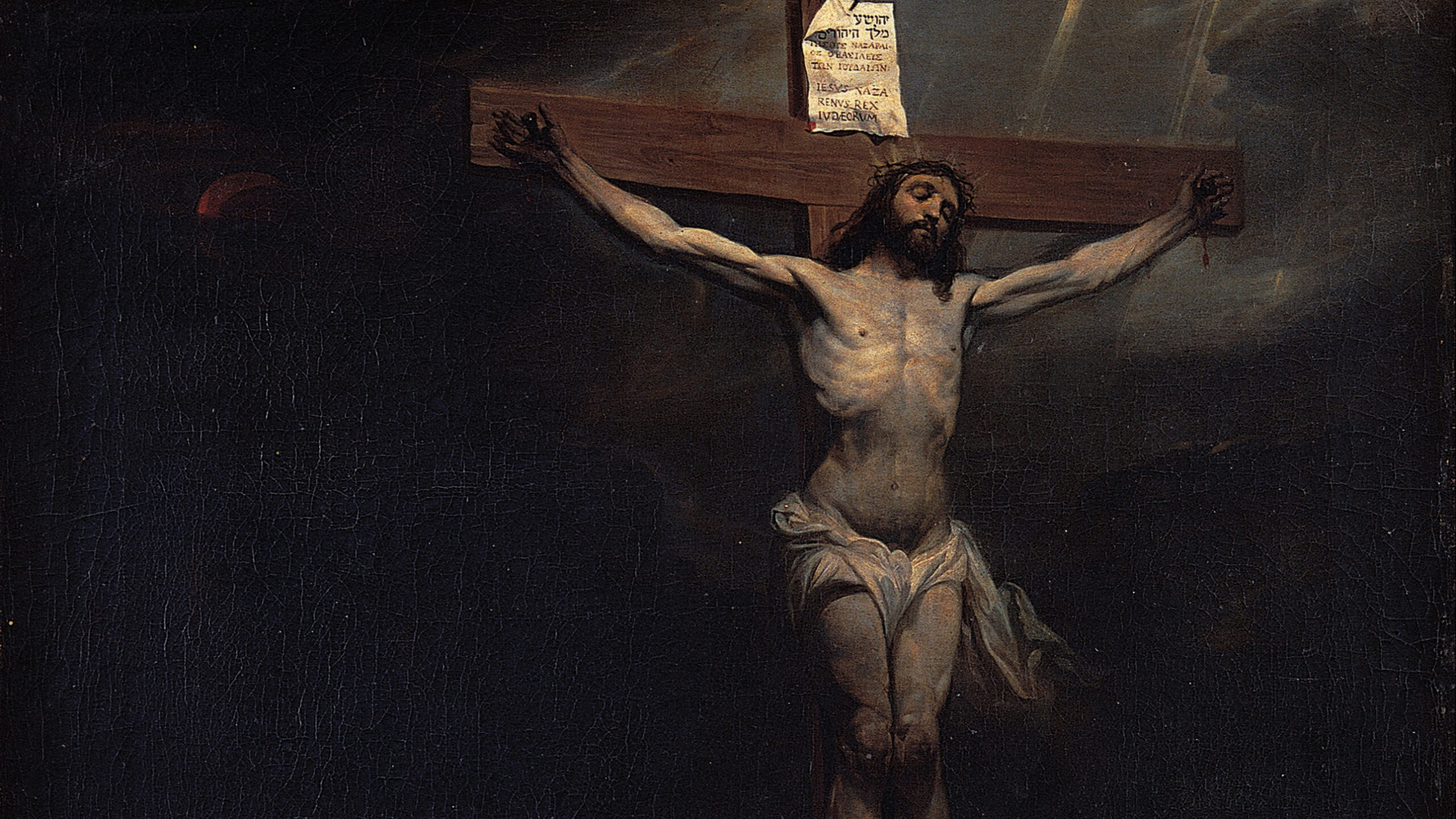
The Feast of the Exaltation of the Holy Cross is one of those rare dates in our Church calendar when we honor not a person but an object, and in this case, an object that orients us in the story of our salvation. Through his death, Jesus transformed the cross from a brutal instrument of torture into a sign of hope and deliverance, opening heaven to us. As the priest prays over the gifts at Mass on this feast, “May this oblation, O Lord, which on the altar of the Cross canceled the offense of the whole world, cleanse us, we pray, of all our sins.”
One way of entering more deeply into the liturgical richness of this feast is by reading the Old English poem “The Dream of the Rood.” (Rood is an older term for the cross.) This poem appears in the Vercelli Book—a personal book of prayer—and also has connections to the Ruthwell Cross, which appears to have portions of the poem inscribed in runes upon its stone surface.
The poem opens with a dreamer’s vision of the cross in its glory:
It seemed that I saw a most wondrous tree
raised on high, wound round with light,
the brightest of beams. All that beacon was
covered in gold; gems stood
fair at the earth’s corners, and there were five
up on the cross-beam. (lines 4–9, Roy Liuzza’s translation)
The vision, like so much of the vocabulary of this poem, has a sparkling quality, a doubleness. The tree is at once an honored and exalted treasure and a memory of suffering:
Wondrous was the victory-tree, and I was stained by sins,
wounded with guilt; I saw the tree of glory
honored in garments, shining with joys,
bedecked with gold; gems had
covered worthily the Creator’s tree.
And yet beneath that gold I began to see
an ancient wretched struggle, when it first began
to bleed on the right side. I was all beset with sorrows,
fearful for that fair vision; I saw that eager beacon
change garments and colors—now it was drenched,
stained with blood, now bedecked with treasure. (13–23)
Then, marvelously, the cross itself begins to speak to the dreamer, to recall the struggle in which both the cross and the Lord were engaged together against the powers of darkness. Part of the beauty of this poem is its rendering of Anglo-Saxon warrior culture in the description of the cross’s fealty toward its Lord. Christ is depicted as a champion who embraces the cross eagerly:
Then I saw the Lord of mankind
hasten eagerly, when he wanted to ascend upon me.
I did not dare to break or bow down
against the Lord’s word, when I saw
the ends of the earth tremble. Easily I might
have felled all those enemies, and yet I stood fast.
Then the young hero made ready—that was God almighty—
strong and resolute; he ascended on the high gallows,
brave in the sight of many, when he wanted to ransom mankind.
I trembled when he embraced me, but I dared not bow to the ground,
or fall to the earth’s corners—I had to stand fast. (33b–43)
As thane, the cross shares in Christ’s suffering—“They mocked us both together; I was all drenched with blood / flowing from that man’s side after he had sent forth his spirit” (48–49)—and also in Christ’s victory. The cross recalls its finding: “They dug for us [the cross of Christ and the two crosses on which the thieves died] a deep pit, yet the Lord’s thanes, / friends found me there . . . / adorned me with gold and silver” (75–77), a reference to Saint Helen’s discovery of Christ’s cross in AD 326.
The cross also charges the dreamer to speak of this vision to others, noting the cross’s protection over those of us still on earth: “But no one there need be very afraid / who has borne in his breast the best of beacons; / but through the cross we shall seek the kingdom, / every soul from this earthly way, / whoever thinks to rest with the Ruler” (117–121). Christ’s command to take up our cross and follow him resounds here.
The words operate almost like a sacramental, leading the soul to prayer, examination of conscience, and evangelization.
In my own small study of this poem, I have found that perhaps the best way to truly see its beautiful layers of meaning is to read multiple translations of “The Dream of the Rood.” Some translations privilege the alliterative verse that often marks Anglo-Saxon poetry; others make choices that underscore the religious and cultural realities at play in the poem. Based on the spaces in which “The Dream” seems to have originally appeared—on a stone cross and in a personal prayer book—the words operate almost like a sacramental, leading the soul to prayer, examination of conscience, and evangelization.
Part of the sacramental nature of this poem can be seen, as Heather Maring notes, in its connection to the Good Friday liturgy. On Good Friday, Catholic churches across the world carry out a ritual called the Adoration of the Holy Cross, which begins with the Showing of the Holy Cross. The priest processes to the back of the church, and returns with a large wooden crucifix, which is covered by a cloth. Three times in his procession to the front of the church he utters the Ecce lignum crucis: “Behold the wood of the cross, on which hung the salvation of the world.” The faithful respond with “Come, let us adore.” Each time the Ecce lignum is said, a bit of the cloth is removed to reveal the cross and the figure of the crucified Lord. The faithful then process to the front of the church to adore the cross, by either kissing it or genuflecting toward it.
This ritual plays out in narrative form in “The Dream of the Rood.” The cross of Christ is revealed to us within the framework of the poem and we are called to adore. In the poem, we see together the reality of Good Friday and the Exaltation of the Holy Cross in the mystical transformation of the cross of Christ from suffering, blood-encrusted wood to a gem-covered being, and the story of the Crucifixion as told by the cross. Through the vision of the rood, the dreamer’s mind (and the mind of the reader) becomes, as Britt Mize suggests, a precious chamber, a reliquary for holding the voice and sight of the true cross, as “references to the contents of the mind in Old English poetry often reify thoughts, knowledge, understanding, and attitudes as precious possessions.”
In “The Dream of the Rood,” there are many precious possessions to be gleaned in the multiple layers of meaning found in the original Old English. The beauty of this poem is contained in words that can mean more than one thing. To give a couple brief examples, the word for tree in Old English (treow) also bears another definition, both of which are at play in “The Dream,” as pledge or troth (a word encompassing one’s loyalty, faith, and truth). The cross is both a tree and one who pledges itself to the Lord. In line 16 of the Old English translation of the poem, the verb ġeġyred is another word endowed with multiple definitions: “made ready, prepared, put in a state of readiness for use” (some translators use the word girt) and “adorned (with lit. or fig. ornaments).” As Michael D. Cherniss notes, “To decorate an object is, in heroic convention, to ‘honour’ it, to make its inherent worth apparent.” On the one hand, readers are invited to look upon the beauty of the cross, adorned in gold. But on the other hand, ġeġyred calls to mind the fact that the cross is at the service of Christ.
For those wanting to enter more deeply into this feast, consider gathering friends and family around and reading this beautiful poem aloud. It is my belief that “The Dream of the Rood” was written to enact what it speaks of—to call us to greater devotion to the Lord, to the foot of the cross at Mass, and to the shouldering of our own crosses.