
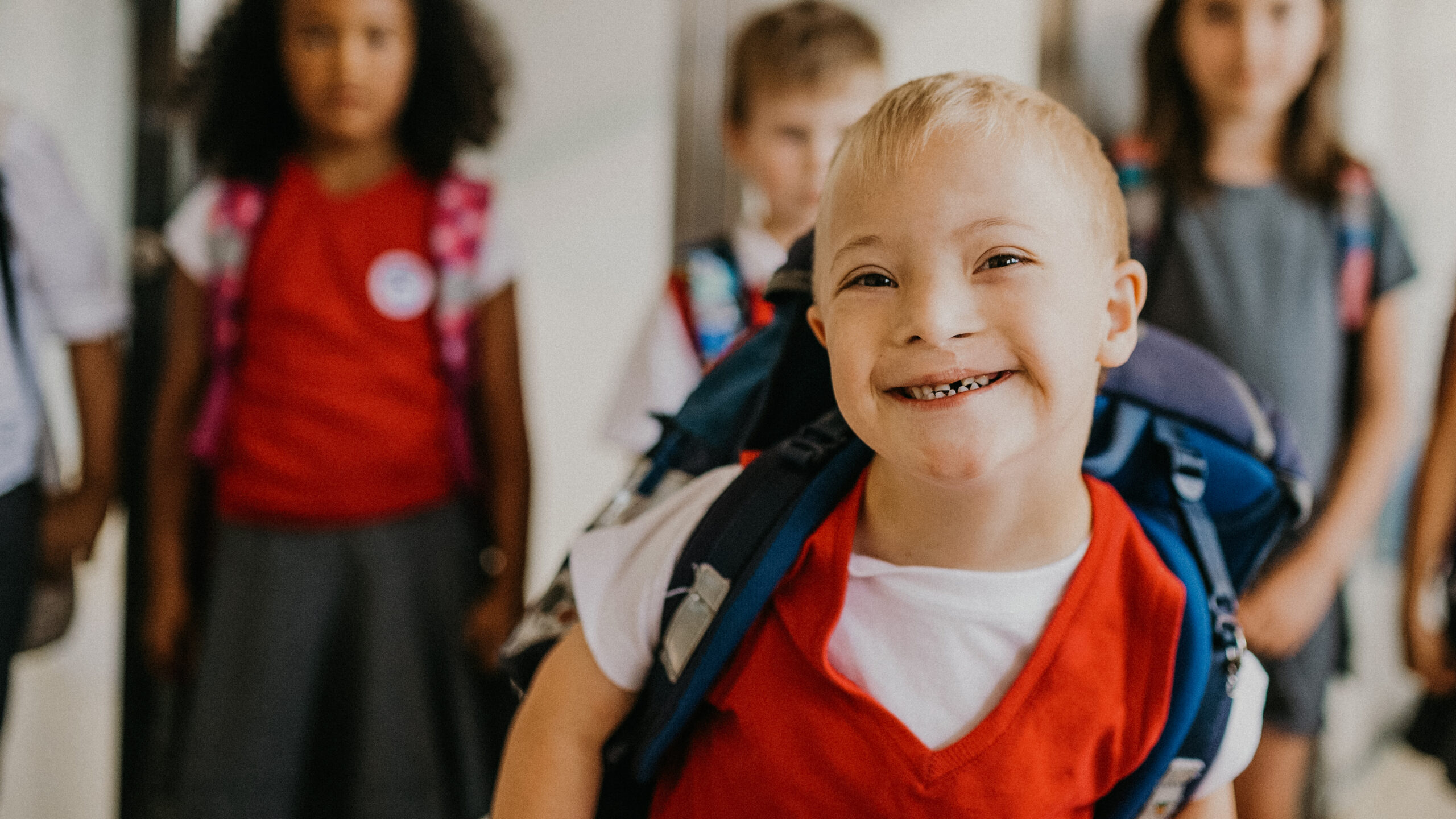
School is rarely a smooth journey for parents or their children. For Catholic parents aware of the growing challenges presented by government-funded schools, a Catholic school might be seen as the best—or maybe the only—choice for their family. But what do parents do if they already have three children in their parish school and are told their fourth child can’t enter kindergarten because of a developmental disability? This is an all-too familiar experience for many families.
According to the Individuals with Disabilities Education Act (IDEA), government schools are required by law to provide a “free, appropriate, public education” in the “least restrictive environment” to children with disabilities. Catholic schools are not government-funded schools, so they’re not obligated to do the same—at least, not obligated by law. But more about that later.
Since IDEA was passed in 1990, inclusion programs have grown in government schools so that most children with disabilities are able to be included in a general education classroom with their nondisabled peers for at least some part of the school day. These inclusion programs have come to be seen as the gold standard by advocates—myself included—who are committed to including children with disabilities in all schools.
Only about 2 percent of Catholic schools are inclusive schools.
The most recent data from the National Catholic Educational Association (NCEA) shows that 9.1 percent of students in Catholic schools have a diagnosed disability, but the data doesn’t specify if those are disabilities like dyslexia or Down syndrome. Schools may welcome children with dyslexia, but most Catholic schools exclude children who have greater learning challenges, like Down syndrome. According to the National Catholic Board on Full Inclusion, only about 2 percent of Catholic schools are inclusive schools. For parents fortunate enough to live in a diocese with a Catholic school that accepts students with an intellectual or developmental disability, congratulations!
Schools of special education aren’t inclusive schools; their goal is different from government schools with inclusion programs. They strive to provide an education for children with intellectual disability that focuses on functional academics and life skills. There aren’t many of these that are Catholic schools, but one example is St. Katherine School in the Archdiocese of Philadelphia. Schools of special education, again, are not inclusive schools: They serve students with intellectual disabilities in a segregated environment. St. Katherine’s website says they only accept students with an IQ of 70 or below.
Inclusive schools’ status as being the gold standard has recently been challenged. Research was published this year that questions how effective inclusive schools have really been in educating students with disabilities. Douglas Fuchs, Allison Gilmour, and Jeanne Wanzek’s research was published in the Journal of Learning Disabilities with the title “Reframing the Most Important Special Education Policy Debate in 50 Years: How Versus Where to Educate Students with Disabilities in America’s Schools.” There is an interesting commentary on the research here.

The essay contrasts the difference between schools that include children with disabilities in general education classrooms versus other approaches that provide multiple placement options and provide more intensive instruction beyond what can be offered to different learners in an inclusive classroom. The essay calls those who reject schools of special education “abolitionists” and those who believe in the value of special placements “conservationists.”
The authors of this study reviewed fifty years of evidence on how and where children learn best, and they claim evidence to support the superiority of inclusion programs is weak. On what do they base their claim? They state that “most of the efficacy studies failed to control for students’ academic performance prior to their placement in one setting or the other, nor for the likelihood that those in general classrooms were there because of a belief that they could succeed there” whether they really did or not.
In other words, the authors claim that research previously conducted that justified the superiority of inclusive education was incomplete and inconsistent, and the reality is that “those with more serious learning problems gain more in special classes.” However, inclusion is more successful “when individualized instruction is provided in the regular class . . . [and] a wider range of students with and without disabilities can be successfully accommodated.”
What can be known, though, is that where students learn is not as important as how they are taught.
There is much more to digest in this research than can be discussed in this brief article, but the main theme is that decades of studies on the best way to educate students with disabilities is inconclusive.
What can be known, though, is that where students learn is not as important as how they are taught. That seems like stating the obvious, but it presents a sizable problem when the choice is binary—i.e., a special education school or an inclusive school that has adopted universal design for learning and is attempting to accommodate all students without adequate support. As I wrote earlier, though, few Catholic schools provide either choice. Parents must then be consigned to their children attending a government school that will accept their child.
So, what is a parent to do? How can the question that is the title of this article be answered? What is the best education for a child with a disability?
Again, at this point, Catholic parents in most areas of the country have little choice. The growing number of Catholics who reject government schools must either compromise their values and accept what the government schools offer or consider if they have the capacity to homeschool and engage tutors and other support services as needed.
Parents in this situation are encouraged to become advocates in their parishes for their children to be included in their local Catholic school, and happily there are many Catholic consulting and funding organizations nowadays willing to assist.
For those who have the option to place their children in a Catholic school but are on the fence about if it’s the best choice, priorities and desired outcomes rise to the surface as the most important questions to discern. Is the priority a Catholic learning environment, academic achievement, or social development? Dr. Fuchs and his team indicate that academic achievement is best accomplished in an environment that can provide intensive one-on-one support. If the goal is academic achievement, how can you ensure the Catholic school is providing that or assist it to do so? If the goal is social and spiritual development, Catholic schools that recognize the true nature of the human person and value each student as a unique creation, made in God’s image, is the very best place to be.
I mentioned earlier that Catholic schools are not obligated by law to provide an education to children with disabilities, but what about a moral obligation? I would say that the Church has a profound moral obligation to provide an appropriate education for all students, including students with disabilities.
I find myself often quoting from the US Bishops’ 1978 Pastoral Statement on Persons with Disabilities:
Defense of the right to life, then, implies the defense of other rights that enable the disabled individual to achieve the fullest measure of personal development of which he or she is capable. These include the right to equal opportunity in education, in employment, in housing, as well as the right to free access to public accommodations, facilities and services.
This prophetic statement—written just a few years after Roe v. Wade was decided by the US Supreme Court—called us to expand our understanding of what it means to be pro-life. Unfortunately, after almost fifty years this admonition has largely gone unheeded. But aside from including the integral human development of persons with disabilities as a pro-life issue, the Church also teaches that education is a fundamental right that should be available to all. The Second Vatican Council’s document on education, Gravissimum Educationis, calls it an “inalienable right.”
So, what is the best education for your child? The Church says a Catholic education. Fortunately, there are many now working hard to make the possibility of a Catholic education available to all students. Parents, don’t be satisfied until one is available in your parish.
And a final comment about inclusion of children with disabilities in the general classroom: Why can’t these classrooms also offer the one-on-one support that Fuchs and his team identify as the secret to success? But I suppose the first question that must be answered is why Catholic schools can’t find a way to do what they’re called to do in the first place: welcome all students. They have a moral obligation to find a way.