
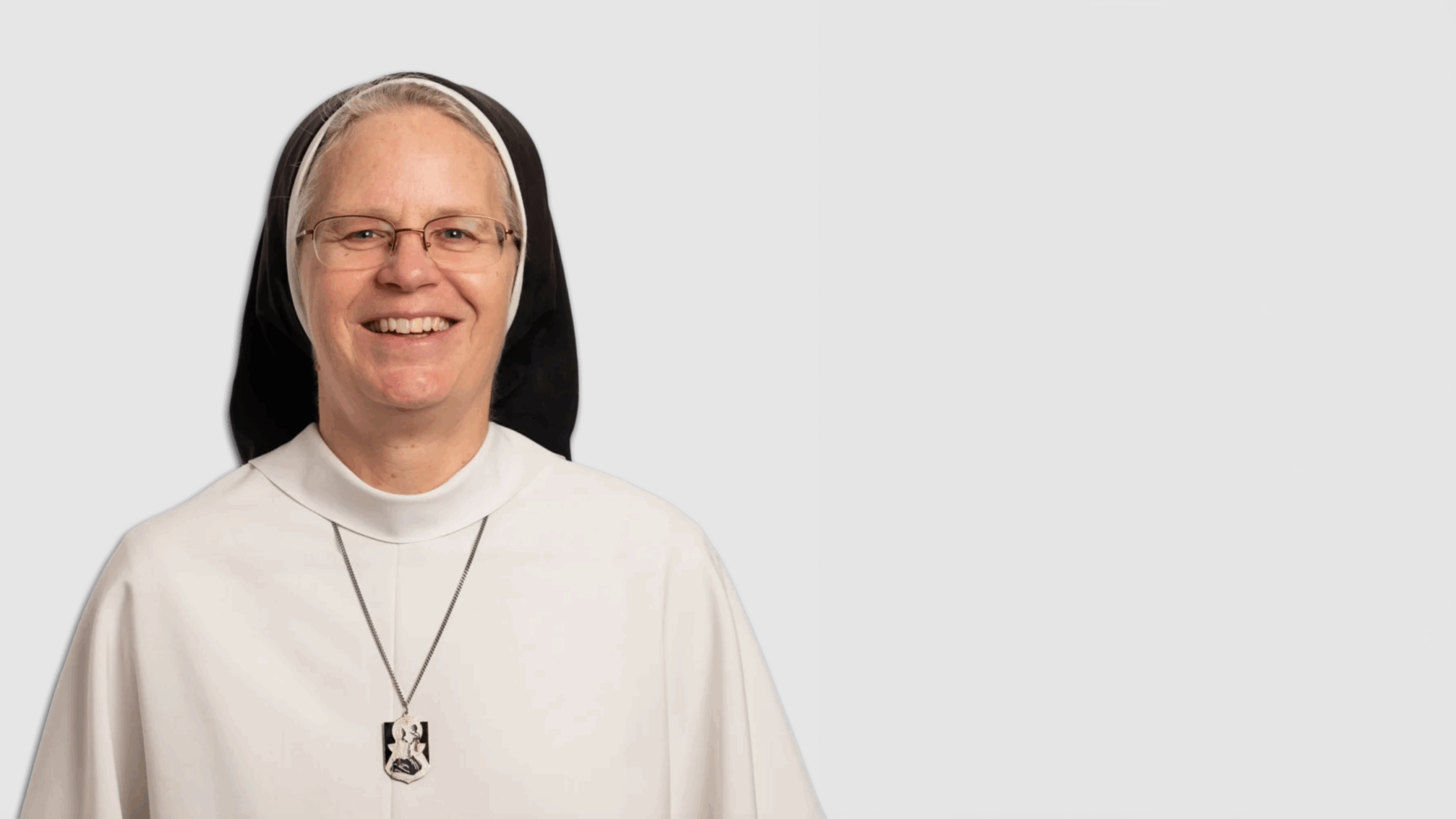
Continuing our Leaders in Catholic Education series highlighting Catholic leaders across the country playing significant roles in the Catholic renewal movement, I would like to introduce Sr. John Dominic Rasmussen, OP, co-foundress of the Dominican Sisters of Mary, Mother of the Eucharist. She is also the founder of Openlight Media’s Education in Virtue program, which aims to cultivate authentic virtue in learners of all ages, fostering joy, faith, and identity in Christ through engaging resources and community support.
Dr. Melissa Mitchell: Tell us a little about your upbringing and your family.
Sr. John Dominic: I was born in Berkeley, California, and lived there until I was five, when we moved to Nashville. Culturally, it was a dramatic shift. My family was largely secular, and faith formation and regular church attendance were not part of our daily life.
The West Coast culture came with us, and I can see now how it shaped me. I call that move my first “school of evangelization.” It taught me patience, how to remain present, how to love people where they are even when they aren’t open to where my faith eventually led me while still learning how to speak truth.
My first real exposure to Christianity came when my parents moved me from public school into a private Christian school. Ironically, my introduction came through a song about the end times and being “left behind.” It stirred a deep fear in me and tapped into a separation anxiety I carried from leaving my grandparents in California.
I became so anxious that I followed my mother everywhere, terrified of being left behind. A neighbor eventually suggested that I speak with a local pastor. He recommended that I get a Bible and whenever fear surfaced, I should pick it up and read. My mother bought me a children’s Bible and I began reading it regularly. I also started saying a simple prayer: “Dear God, show me how to love you more.”
When did you discern religious life?
Everything changed in high school. I converted to Catholicism and received the sacraments during my sophomore year while attending an all-girls school run by the Nashville Dominicans. At first, I avoided the sisters simply because I didn’t know who they were or what religious life meant. Over time, being around them became natural.
What stirred us was a deeper question: What is needed for the renewal of religious life in the United States?
Very early I had a clear and steady desire that has never wavered throughout my religious life: Why do you want to enter? To save my soul and to help save other souls. To bring people to Jesus and to assist in the work of salvation. That has truly been the driving force of my entire vocation.
It was hard on my family that I was entering religious life right after high school. Over time, they came to see that I wasn’t being forced into a mold but that I was becoming more fully myself. Living a virtuous life and following God’s will leads to true human flourishing. We become who God created us to be. That recognition helped them understand my vocation, even if the journey there was not easy.
Tell us about your education and your teaching career.
I entered the Dominican Sisters of St. Cecilia in Nashville, a community known for its strong tradition in education. I earned my teaching degree from Belmont University and had already been teaching well before graduation. By my sophomore year, I was placed in the classroom, writing lesson plans, and discovering teaching was not just a job but a lifelong vocation.
I didn’t initially see myself as a teacher, but once I began working with students, I fell in love with it: the relationships, the collaboration, and being part of the broader mission of Catholic education.
One of the most beautiful aspects of living in a teaching community is that formation never stops. Continuing education happens naturally in daily life through conversations with the sisters, sharing ideas, and learning from one another. The sisters often come from dioceses across the country, so you gain a real sense of the pulse of Catholic education nationwide. Constant and ongoing exchange became a vital part of my formation.
Later, I earned a theology degree and served as an administrator for twenty years. When we came to Ann Arbor and founded the Dominican Sisters of Mary, Mother of the Eucharist, there were just four of us. We had the extraordinary opportunity to build schools from the ground up that reflected our charism of Mary and the Eucharist.
What led you to start a new religious order?
It grew organically out of our charism. The formation and mission flowed naturally, and I was able to lay the foundation for a school that embodied that vision. I was very happy in Nashville. St. Cecilia is a flourishing community. What stirred us was a deeper question: What is needed for the renewal of religious life in the United States?
At the same time, Pope John Paul II was speaking about renewal in Vita Consecrata. With the wisdom and generosity of Mother Assumpta, who had previously assisted Cardinal O’Connor with the formation of the Sisters of Life, the four of us came together. Though we arrived at this point independently, our response was the same. How could we answer this call to renewal, and how could we bring religious life to another part of the country where it was needed?
We’ve been talking about the renewal of our Catholic faith—particularly in light of John Paul II’s call to evangelization—and about how we are no longer living in Christendom. You’re very much part of this renewal movement. How would you describe the renewal of Catholic education today?
To understand renewal in education, we must return to the source. Historically, Catholic schools flowed directly from the charisms of religious communities. They were not merely institutions; they were extensions of religious life. That connects directly to your earlier question about my own formation. These conversations about Catholic education—philosophical, theological, and practical—were happening constantly within religious communities.
Fifty years ago, religious sisters and brothers were the majority in schools, and the laity were the minority. That reality isn’t coming back in the same way. When we started our schools in Ann Arbor, we had to ask ourselves: Should the sisters do all the teaching? And the sisters themselves said no. Today, renewal requires a true collaboration between religious sisters and lay women and men, married and single educators. That mix gives students a living witness of the Church in her fullness. We don’t return to the past, but we do return to the template.
That template: Catholic education requires Catholic teachers and leaders who have a relationship with Jesus. At the heart of every authentic Catholic school is the balance of contemplation and action, remaining in Christ through prayer and walking with him in daily life. Fidelity matters more than form.
Renewal begins with educators who remain in Christ and walk as he walked. Everything else flows from there.
For educators, this interior template looks different depending on one’s state in life. One person may find that contemplative core in ten quiet minutes with a cup of coffee and a window. I need a Holy Hour every day. The amount of time isn’t the point; fidelity is. My goal in speaking to educators is to help them discover that “still point of grace” where they remain in Christ.
Then comes the second part: Walking where Jesus walked. We often jump straight to “take up your cross,” but Christ’s life includes so much more: weddings, friendships, rest, storms, joy, sorrow. Discipleship means learning how to live all of it. That’s why the virtuous life is so essential. Jesus is the perfectly virtuous man, and virtue gives us concrete ways to imitate him.
What we’re seeing now is a delayed fruit of Vatican II, which emphasized a genuine collaboration between religious and laity. It’s been a long road, but fifty years later Catholic schools are becoming a microcosm of that renewal. And you’re right that we’re no longer in Christendom. Even my own upbringing, though culturally Christian, prepared me for this moment in ways I didn’t realize at the time.
When we talk about renewal, curriculum and pedagogy matters, but no program alone will save Catholic education. Renewal begins with educators who remain in Christ and walk as he walked. Everything else flows from there.
What inspired you to begin Education in Virtue and Openlight Media?
Beginning with Education in Virtue, we had the tremendous blessing of starting new schools by building the curriculum, shaping the culture, and forming a truly Catholic educational environment. As Dominicans, our approach is deeply rooted in a Thomistic understanding of the human person, where virtue is essential to the life of faith. I kept telling teachers that they need to teach virtue and make sure virtue is embedded in what they’re doing.
During a faculty meeting, one of the teachers raised her hand and said, “Sister, what is virtue and how do we teach it? We want to do what you’re asking but we don’t know how to teach prudence or justice. We don’t know what that looks like in practice.”
We began developing practical resources that made virtue visible and livable for children. For example, another factor was the growing concern around bullying. Parents wanted an anti-bullying program, but I kept saying, “We don’t need an anti-bullying program, we need virtue.” That pushed us to deepen Education in Virtue even further.
As cell phones, social media, and constant connectivity became more prevalent, we started seeing increased anxiety, depression, and fragmentation among students. We partnered with a clinical neuropsychologist that was seeing the same patterns in her clinical work. Those conversations became the foundation for what eventually developed into Raised in Grace, a truly Catholic approach to social-emotional learning. It’s still virtue, but now integrated with neuroscience giving Catholic schools a faithful alternative to secular SEL programs.
As demand grew beyond what we could meet in person, we created Openlight Media. Videos allowed us to support schools and dioceses consistently, even amid teacher turnover. The internet is a new public square, and as Dominicans, entering that space is a natural extension of our mission.
What do you see as the most pressing challenge in Catholic education today?
The foundation must be a true Christian anthropology of the human person. Everything we do has to rest on the truth that we are created in the image and likeness of God and that we are made for wholeness. We are body and soul. That understanding is actually countercultural today, and it’s essential that it remain at the core of Catholic education. We can’t be tempted by quick fixes. We have to be patient and faithful to what has worked for centuries.
When you are forming a worldview and shaping a school’s culture, identity is everything. If leadership is clear about that identity, teachers can use any textbook because they are teaching from a coherent Catholic vision of the human person. The danger is thinking that some new program is going to “fix” things on its own. No program can replace a strong foundation.
I visit a lot of schools and the places where I see real vitality and thriving culture are those where leadership has been intentional about returning to their roots. Often that means reclaiming the charism of the religious sisters who founded the school. I’ll say to them that they may not have known the sisters who taught here forty years ago, but if these walls could speak, they would tell you how many prayers have been offered in these hallways. Those prayers still matter. The sisters are still interceding, and that spiritual inheritance is where renewal begins.
That is the heart of the challenge and the hope for Catholic education today: remembering who we are, where we come from, and building everything else from that foundation.