
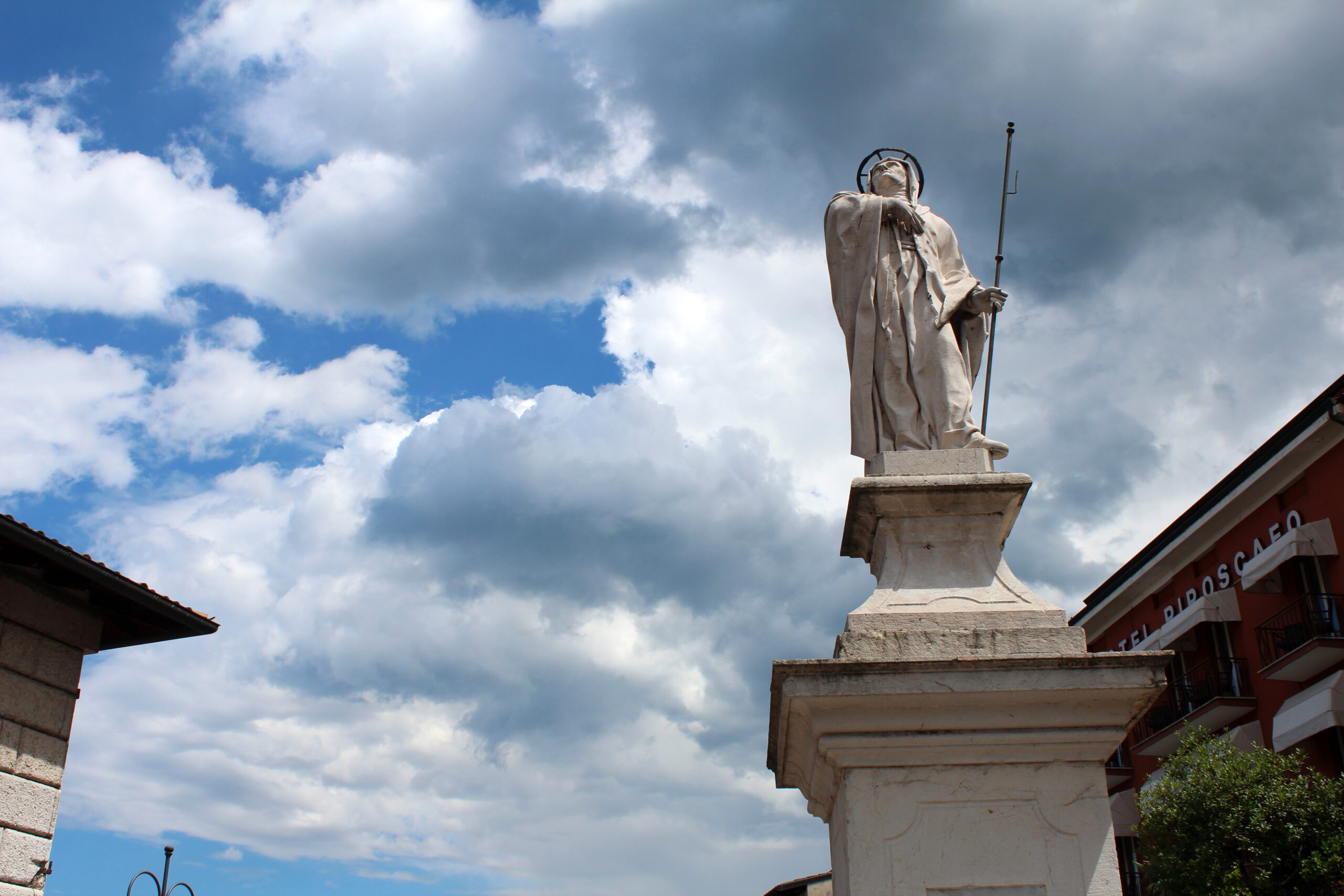
“Without doubt you will see marvelous things if you direct everything to the praise and glory of His Infinite Majesty and the good of souls.” These words of St. Angela Merici (1474–1540), whose feast we celebrate today, are powerfully modeled in this saintly woman’s life.
Born in Desenzano, Italy, Angela was raised in a faithful home and was known to be pious from her youth. As recorded in St. Angela Merici and the Ursulines, her father would often read to her of the lives of the saints, and among her favorite stories was that of St. Ursula, to whom she would cultivate a lifelong devotion. Yet some early tragedies introduced great suffering into her otherwise tranquil childhood; as a young teen, she lost both of her parents as well as her beloved sister, moving into her uncle’s home as an orphan.
This was a period of intense spiritual tumult for Angela, who was especially distressed that her sister had died without receiving the last sacraments. Angela dedicated herself to earnest prayer on her sister’s behalf and was eventually granted consolation through a vision from God. In it, the Blessed Virgin Mary appeared and showed Angela her sister in heaven. This mystical experience further invigorated Angela’s religious zeal. She took a personal vow of virginity and became a Third Order Franciscan, donning the religious habit.
When she was twenty years old, the uncle with whom she was residing died, and so Angela returned to her childhood home in Desenzano. It was around this time that Angela was given another vision from God, one that would set the trajectory of the rest of her life. In the vision, she saw a company of virgin saints ascending to heaven and was told to found a company such as this dedicated to the education of young girls.
“Follow ever the broad highway of the Church’s teaching and practice, in which so many saints walk before us.”
In sixteenth-century Europe, women only received formal education if they came from wealthy families or if they entered convents. Further, it was a time of widespread corruption in the Catholic Church, coupled with the propagation of the Reformation heresies. This left most young girls both poorly catechized and particularly vulnerable to being lured away from their faith. As Angela would later explain to her sisters, “It is your duty to protect and rescue your lambs from . . . fair-speeched worldlings and hypocritical religious, on the one hand, and heretics on the other.” Further, Angela recognized that these future mothers would have the grave responsibility of shepherding the souls of the next generation. “Disorder in society is the result of disorder in the family,” she said.
Thus, Angela began her mission by opening her home to the young girls of her town and offering them religious education. All girls from whatever classes and backgrounds were welcome to visit every day for lessons on Scripture, doctrine, and prayer. Angela became well known throughout the region not only for her well-attended instruction but for her motherly heart and for the way she walked with these young women as a role model and companion.
Angela continued this home education for almost two decades, but she knew that her ultimate goal was to found an order. She made the acquaintance of a noble family from the city of Brescia, Italy, who admired her holiness and desired her company in their home after the tragic loss of their children. At the urging of her Franciscan superiors, Angela moved to Brescia, and it is here that she felt God was calling her to formalize her order. Many obstacles arose delaying this establishment, including a tense political situation in the city and her falling gravely ill for a time. She even traveled to Rome to seek advice from the pope, who was so impressed by her that he urged her to stay. But “it is in Brescia that God wants me,” Angela insisted, and finally she established the Company of Saint Ursula in 1535 with twelve other women.

Unlike many familiar religious orders, Angela’s organization was named not after herself but after St. Ursula. While little is known of the historical details of Ursula’s life, tradition holds that she and a large group of consecrated virgins were martyred at Cologne, Germany, in the fourth century. For Angela, Ursula was the perfect role model for a company of consecrated women dedicating their lives totally to God. “Follow ever the broad highway of the Church’s teaching and practice, in which so many saints walk before us,” she urged her sisters.
The Company of Saint Ursula was the first teaching order of women in the Catholic Church and was unique for initially being a secular institute. The women did not make formal religious vows and were not cloistered in convents. This allowed them to imitate Angela’s home education model, making them accessible to as many girls as possible and examples of holiness outside the cloister. “Angela Merici presented a path of holiness also to those who were living in a secular environment,” explained Pope Benedict XVI.
Angela wrote a simple constitution for the group and served as its superior for five years until her death in 1540 at the age of sixty-six. At the time of her death, there were already twenty-four Ursuline institutions established, and after her death they continued to expand and gain recognition in the wider Church.
St. Charles Borromeo, an Italian prelate tasked by the pope with investigating the Ursulines, wrote, “Among the manifold consolations and spiritual joys granted to me during this visitation, not the least was to find your devoted Company making such solid progress in the ways of God—to find among you so many persons whose lives are a true imitation of the Blessed Ursula and her companions.” It was under his advice that the secular group was transformed into an official religious order that took religious vows under the Rule of Saint Augustine.
Today, both secular and religious Ursuline groups are active around the world and remain committed to Angela’s mission. Angela was canonized in 1807 and remains for us a model of personal holiness, a pioneer in Catholic education, and an example of complete and total dedication to one’s God-given mission.
St. Angela Merici, pray for us.