
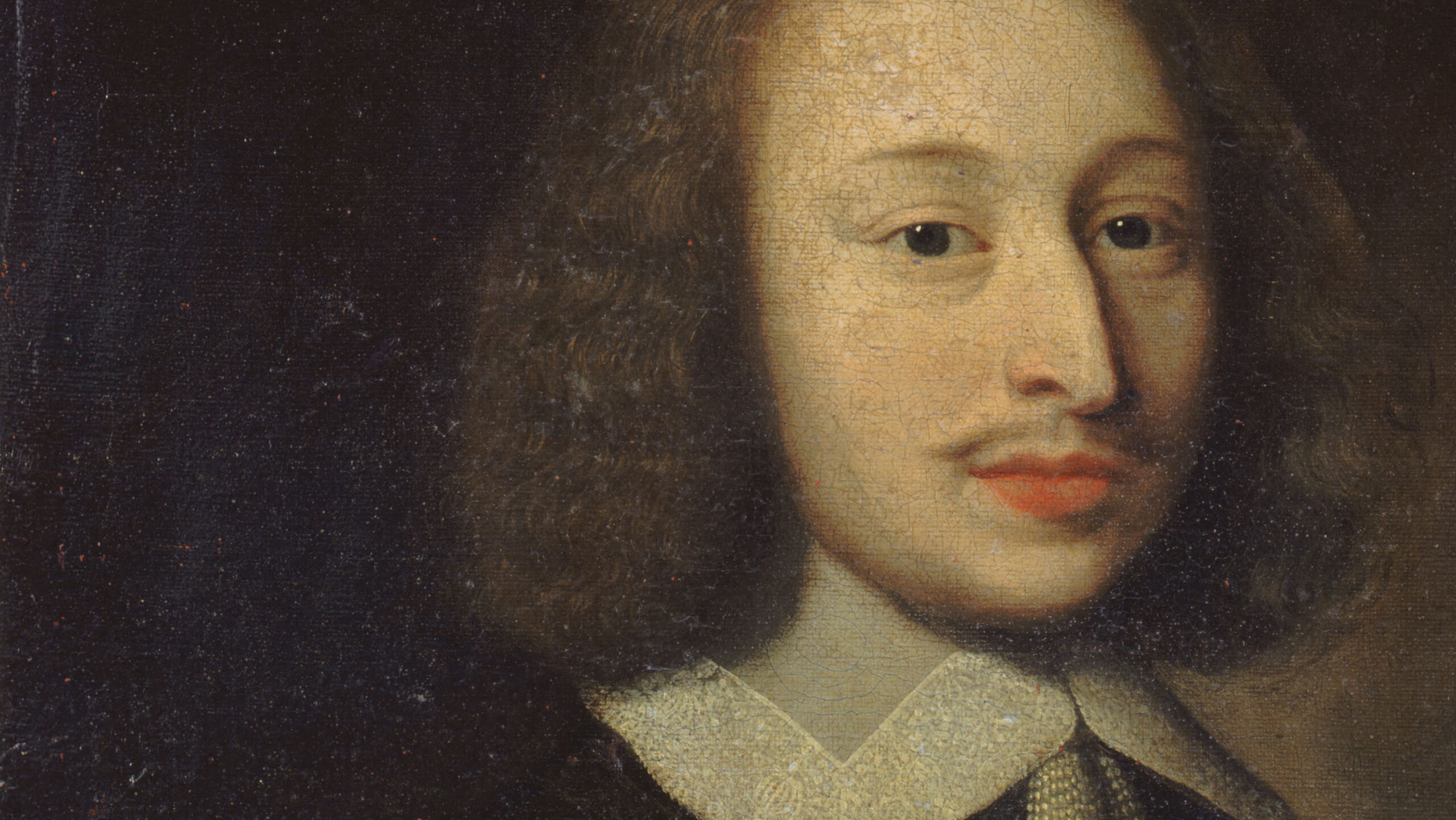
On Monday, November 23, 1654, “from about half past ten at night until about half past midnight,” French mathematical prodigy and Christian apologist Blaise Pascal experienced a dramatic conversion. It was reminiscent of the apostle Paul’s explosive encounter on the road to Damascus. So powerful was the episode that Pascal recorded this “Memorial” on parchment and sewed it into his favorite jacket. That way the experience would always be with him.
He introduced the Memorial with one word: “FIRE.”
He wrote,
GOD of Abraham, GOD of Isaac, GOD of Jacob
not of the philosophers and of the learned.
Certitude. Certitude. Feeling. Joy. Peace.
GOD of Jesus Christ.
My God and your God.
Your GOD will be my God.
He continues, describing the impact on his life:
Forgetfulness of the world and of everything, except GOD.
He is only found by the ways taught in the Gospel.
Grandeur of the human soul.
Righteous Father, the world has not known you, but I have known you.
Joy, joy, joy, tears of joy.
These thoughts in turn led Pascal to repentance and an earnest plea that he would never be separated from God again.
I have departed from him:
My God, will you leave me?
Let me not be separated from him forever.
This is eternal life, that they know you, the one true God,
and the one that you sent, Jesus Christ.Jesus Christ.
After his transformative episode, Pascal devoted himself to philosophy and theology, as well as science. He is best known for his unfinished Pensées, or “Thoughts,” a collection of approximately 800 meditations, most of which have to do with the state of man and his relationship with God. The book we have today was never intended to be published; rather, it was an early draft of a work on Christian apologetics.
Science Properly Understood
Even in the present day, Pascal is a monumental figure. Do you like to use a calculator? Thank Pascal. Wondering about hydraulics and hydrostatics? Blaise Pascal is your go-to guy. Scratching your head over probability theory or atmospheric pressure? You know who to call.
But science is a double-edged sword. We are living through yet another scientific revolution, so perhaps it should not be surprising that “science” for too many is a kind of religion. The new secular “call to worship” is “Follow the science,” even if it may be a meaningless mantra. For some, it is a substitute for Jesus’s invitation to his disciples: “Follow me.” The problem, though, is that when science takes on religious overtones, assumptions may become articles of faith. To question is to risk heresy.
Pascal warned against the abandonment of the Christian faith and overconfidence in man’s ability to solve all the problems that beset him.
Pascal lived in the period now called the Enlightenment, during which the world saw a number of scientific breakthroughs, including the phenomenon of the circulation of blood, the laws of gravity and motion, the discovery and naming of oxygen, and the discovery of life-saving vaccines. This also, unfortunately, began an evolution by which God was gradually displaced from his central role in human activity in favor of an overweening confidence in the exercise of reason.
Why do we need God if we can put electricity in a bottle?
Though numbered among Enlightenment figures, unlike some of his fellow scientists, Pascal warned against the abandonment of the Christian faith and overconfidence in man’s ability to solve all the problems that beset him. Accordingly, one of the central themes in the Pensées is the fallibility of reason. We are not as smart as we think we are.
Man is only a subject full of error, natural and ineffaceable, without grace. Nothing shows him the truth. Everything deceives him. . . . The senses mislead Reason with false appearances, and receive from Reason in their turn the same trickery which they apply to her; Reason has her revenge. The passions of the soul trouble the senses, and make false impressions upon them. They rival each other in falsehood and deception.
Misery
It is not surprising, then, that Pascal describes human life as precarious and stained by misery. When Pascal speaks of our “misery,” his observation is not so different from the warning in 1 John 1:8: “If we say we have no sin, we deceive ourselves and the truth is not in us.” He explains that human beings are afflicted with a surplus of self-love that impedes charity to others. For even the most conscientious, this involves a contradiction. He writes,
The nature of self-love and of this human Ego is to love self only and consider self only. But what will man do? He cannot prevent this object that he loves from being full of faults and wants. He wants to be great, and he sees himself small. He wants to be happy, and he sees himself miserable. He wants to be perfect, and he sees himself full of imperfections. He wants to be the object of love and esteem among men.
As St. Paul complains in Romans 7, “I do not do the good I want, but the evil I do not want is what I do. Now if I do what I do not want, it is no longer I that do it, but sin that dwells within me.” This leads Paul to cry out, “Wretched man that I am! Who will rescue me from this body of death?”
Pascal explains that it is one thing to be full of faults, but it’s worse if we don’t know our faults. The implication is clear: We need help. The possibilities include the sacrament of reconciliation and a spiritual director—or at least an honest friend. He writes, “Truly it is an evil to be full of faults; but it is a still greater evil to be full of them and to be unwilling to recognise them.” As the psalmist writes, “Clear me from hidden faults” (Psalm 19:12). But Pascal warns that it is so difficult to hear the truth that it “may appear a mortal enemy.” Accordingly, a man may devote “all his attention to hiding his faults both from others and from himself.” Nonetheless, those who help us discover our “imperfections and vices . . . do us good,” because they help us “to free ourselves from an evil.”
Humility and Conversion
An honest appraisal of our condition should not bring despair but humility and a commitment to ongoing conversion. It means brutal honesty and humility. Pascal warns that too often, we try to live a life that is not our own, a life that exists only in our imagination.
Pascal finds the sacrament of reconciliation a gentle and merciful way to deal with sin and shortcomings.
We do not content ourselves with the life we have in ourselves and in our own being; we desire to live an imaginary life in the mind of others, and for this purpose we endeavour to shine. We labour unceasingly to adorn and preserve this imaginary existence and neglect the real.
If pride doesn’t get you coming, it will get you going. Even our genuine virtues may be used against us. For example, “If we possess calmness, or generosity, or truthfulness, we are eager to make it known, so as to attach these virtues to that imaginary existence.”
Pascal finds the sacrament of reconciliation a gentle and merciful way to deal with sin and shortcomings. He writes,
The Catholic religion does not bind us to confess our sins indiscriminately to everybody; it allows them to remain hidden from all other men save one, to whom she bids us reveal the innermost recesses of our heart and show ourselves as we are. There is only this one man in the world whom she orders us to undeceive, and she binds him to an inviolable secrecy, which makes this knowledge to him as if it were not. Can we imagine anything more charitable and pleasant?
The Christian life, Pascal believes, is one of continuous conversion and commitment. Advanced in his career, St. Paul said, “This one thing I do: forgetting what lies behind and straining forward to what lies ahead” (Philippians 3:13). Pascal offers no middle ground: You either give it your all or you don’t, and that is a daily decision. He argues that there is “an absolute distinction between those who strive with all their might to learn and those who live without troubling themselves or thinking about it.” This “supernatural torpor” is a “monstrous thing.” For those who would protest that they are “doing their best,” Pascal grants no quarter: “I can only approve of those who seek with groans.”
Wonder and Contemplation
In our hurried existence, we may not take time to wonder. It’s a shame. A sense of wonder is an attitude of awe when confronted by the vastness and beauty of our astonishing world and its Creator. It is a childlike perspective that finds enchantment in the ordinary as well as the extraordinary, in the small things as well as the overwhelming. Pascal advises,
Let man then contemplate the whole of nature in her full and grand majesty, and turn his vision from the low objects which surround him. Let him gaze on that brilliant light, set like an eternal lamp to illumine the universe; let the earth appear to him a point in comparison with the vast circle described by the sun; and let him wonder at the fact that this vast circle is itself but a very fine point in comparison with that described by the stars in their revolution round the firmament.
This is reminiscent of the psalmist for whom wonder leads to a contemplation of God himself.
The heavens are telling the glory of God;
and the firmament proclaims his handiwork.
Day to day pours forth speech,
and night to night declares knowledge.
There is no speech, nor are there words;
their voice is not heard;
yet their voice goes out through all the earth,
and their words to the end of the world. (Psalm 19:1–4)
But what is required for a habit of contemplation? It is the ability to enter stillness and solitude. Pascal famously wrote, “When I have occasionally set myself to consider the different distractions of men, the pains and perils to which they expose themselves at court or in war, whence arise so many quarrels, passions, bold and often bad ventures, etc., I have discovered that all the unhappiness of men arises from one single fact, that they cannot stay quietly in their own chamber” (emphasis added).
The Catholic Church and Pascal’s Final Plea
For some years, the Catholic Church was unsure how to regard Pascal’s theological contributions. Indeed, Pascal’s Pensées was once on the Index Librorum Prohibitorum, the list of prohibitive books discontinued in 1966. Yet, Pascal now enjoys the Church’s admiration: Pope Paul VI, in his 1967 encyclical Populorum Progressio quotes Pascal’s Pensées when he says, “Man is not the ultimate measure of man. Man becomes truly man only by passing beyond himself. In the words of Pascal: ‘Man infinitely surpasses man.’”
In June 2023, Pope Francis issued a beautiful apostolic letter, Sublimitas et Miseria Hominis (The Grandeur and Misery Of Man), commemorating the fourth centenary of Pascal’s birth. Francis described the Pensées as “monumental” and praised its “philosophical depth and literary charm.” The apostolic letter begins,
In a century of great advances in many fields of science, accompanied by a growing spirit of philosophical and religious scepticism, Blaise Pascal proved to be a tireless seeker of truth, a “restless” spirit, open to ever new and greater horizons.
Eight years after his transformative experience, Pascal died of what was presumably stomach cancer. On August 18, 1662, he went into convulsions and received extreme unction. He died the next morning, and his last words were “May God never abandon me.” It must have been an agonizing passing, but perhaps the suffering was the conclusion to the transcendent transformation that began on that magical night in 1654.
Pascal’s most important contribution may be his admonition to maintain forward momentum in Christian commitment and conversion.