
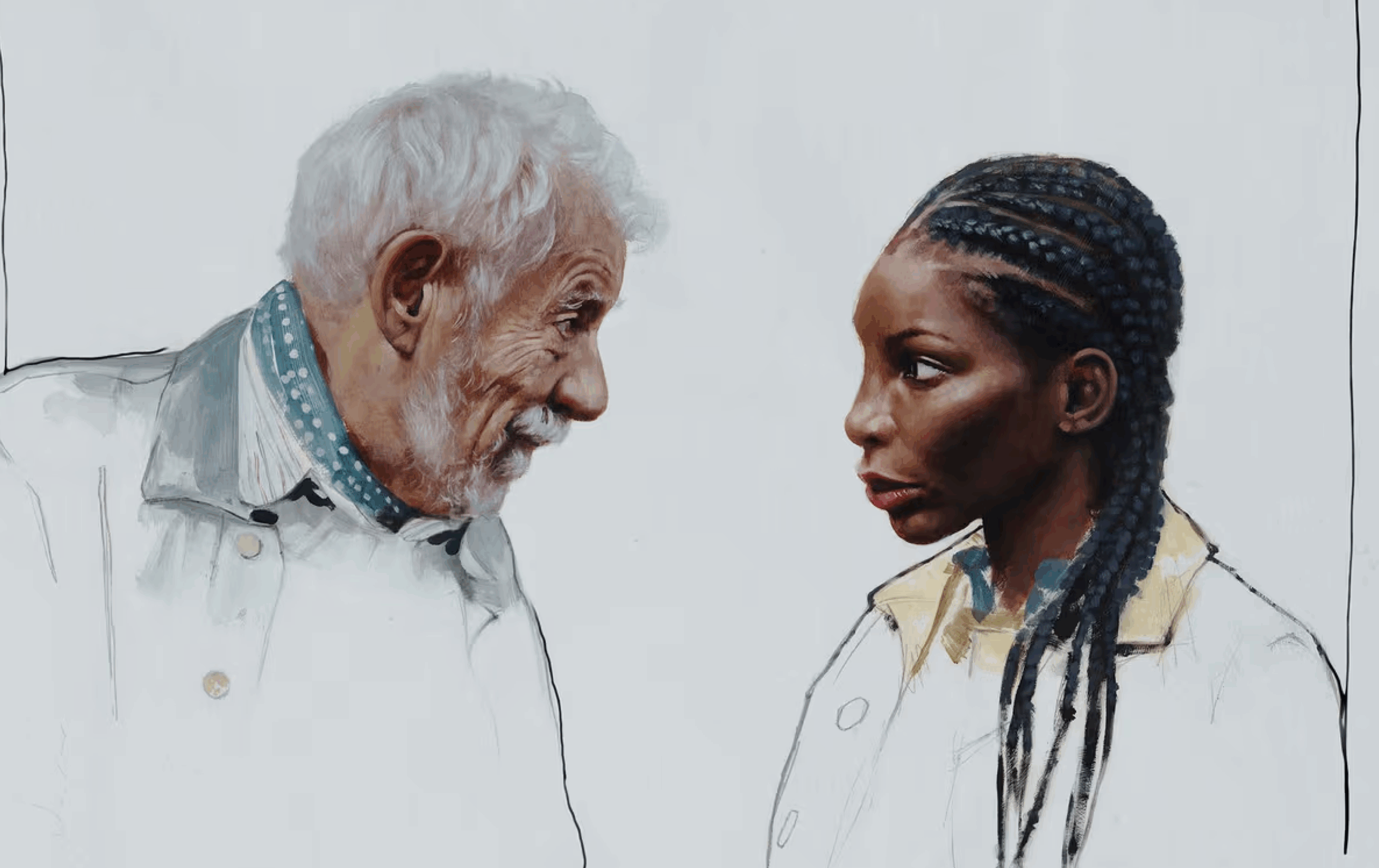

Steven Soderbergh (of the Ocean’s 11 series) has a gift for heist movies. In The Christophers, he uses his storytelling gifts to show us a reverse heist. Here, once again, talented professionals pull off an impossible job, but this time, something is improbably restored, rather than stolen.
The story starts, as it always does, with recruiting a team. But Sallie (Jessica Gunning) and Barnaby Sklar (James Corden) aren’t assembling a group of specialists—there’s only one expert who can pull the con they need. Lori Butler (Michaela Coel) is an aspiring artist paying her bills by doing restoration work. The Sklar siblings want her to stretch what “restoration” could mean by hiring her to complete (i.e., forge) paintings by their estranged father, Julian Sklar (Ian McKellen).
Their father’s highest priced paintings come from his first and second series of portraits of his lover. Everyone knows there is a third series of “Christophers” that he started but never showed. Lori’s task is to take a job as Julian’s assistant, find the unfinished canvases, and complete them in Sklar’s style, so that his children can “discover” them after his death and sell them for millions.
The action of The Christophers doesn’t take place in a glitzy, overstuffed Vegas hotel, where thieves have endless opportunities for misdirection. When Lori begins working with Julian, she visits him at his sprawling but shabby townhouse. They are alone, and the movie has the electric energy of a two-hander play in a tiny black box theater. If there are going to be tricks, they have to take the form of close-up magic, where the audience can see everything and is fooled anyway.
When Julian catches on to his children’s scheme, he confronts Lori, as furious about her arrogance as her betrayal. Does she really imagine, he asks, that she could inhabit him, understand him well enough to complete his paintings? How could she possibly guess how his sketches should look when complete if he doesn’t know himself? Taking this job is an act of contempt for him, Sklar feels. She has to be assuming there is nothing the paintings are saying, they just have to be works in his style, with the same subject.
Even a brilliant artist relies on others to lend him her sight sometimes.
But Lori has spent a great deal of time thinking about this question. In her reading of his first two series of “Christophers,” they trace the beginning and unhappy end of a love affair. (Her reading is not shared by most Sklar critics.) She has an analytical eye for his technique, observing how in the period of his rising feelings, he changed the colors he used, even employing ocher pigments, a color he’d dismissed in interviews as “too sentimental” for him to ever use. But in the second series, Christopher’s gaze slides away from the viewer and, in Lori’s opinion, Sklar began to pastiche his own style. “The lightness was forced,” she tells him, “and the joy was a lie.”
Sklar was his own first forger, trying to inhabit his earlier feelings when they (and Christopher) were gone. For Lori to attempt, in her turn, to paint in his place, she has to make a choice about what a third set of “Christophers” could say. What comes after the end of a love affair? Forging the paintings would require her to make a choice about when the Sklar she imagines would have painted them. His children would prefer a provenance close to the first two sets—so they are all of a piece (with comparably high prices). If she paints them as a coda, completed long after the first two series but kept private, what new perspective would the Sklar she pretends to be have found?
When Sklar first hires Lori, he brusquely tells her to save any praise for him and his art. He loves compliments, he tells her, “but I have to be able to believe them.” He’s tired of his fans. He’s set aside his canvas stand for a ring light, and films cameo-style videos where he wishes fans a happy birthday or describes what he might paint for them. He pops on a beret for these sessions, inhabiting the caricature of an artist. Just as with his own later Christophers, the forgery is good enough for the undiscerning viewers, but hateful to himself.
The job he initially believes Lori will do as his assistant is to make a portrait of him in a very particular medium. She is supposed to assist him in completing a catalog of his work so that his art can be distilled into a spreadsheet and made legible to his accountants. When she sees through his own defensive pastiches and self-plagiarism, she holds up a mirror—one that Sklar isn’t sure he wants to look into.
A good heist movie makes promises to the viewer, and then keeps them but in a way that still surprises us by excelling our expectations. The Oceans films walk us through the planned shape of the heist but hold back a complication, a double cross, a feint so that we can be an insider and a mark at the same time. The Christophers layers and then strips away lies to leave us (and Sklar) able to recover our awe at simple truths.

Without divulging the exact details of the denouement, I’ll simply say it reminded me of the story of the woman at the well. Jesus speaks frankly to her about her past relationships and the man she is entangled with now outside of marriage, and he tells her to ask him for living water. When she runs to tell others that she thinks she has met the Messiah, she says, “Come, see a man who told me all things that I ever did. Could this be the Christ?”
Somehow, the way that Jesus sees her allows her to recognize him. There is something startling about the way he can speak frankly about sin without it compromising his love. The woman at the well can only be healed by someone who can see her wound; she can only be forgiven by someone whom she has wronged.
Sklar can’t believe the compliments of his fans, because they aren’t directed at him as he really is. But he also no longer has anyone he trusts to know him, faults and all. Lori is ultimately a gift, even though she arrives as a thief. To lie with her paintbrush, she needs to see the full truth of Sklar as man.
As Josef Pieper puts it in “Three Talks in a Sculptor’s Studio,” “Art flowing from contemplation . . . does not want to depict what everybody already sees but to make visible what not everybody sees.” To contemplate, for Pieper, is not simply to look intensely, memorizing details. It is ultimately to borrow God’s eyes and to look with “an affectionate devotion to mankind and all things created.” Lori can forgive Sklar for the wrongs he does to her. She cannot offer him full absolution. But her considered, contemplative way of reflecting him back to himself allows him to consider he might be both guilty and lovable.
A great artist refreshes our sight and allows us to see the world with greater clarity and attentiveness. Even a brilliant artist relies on others to lend him her sight sometimes. And Soderbergh has pulled one last con: using a cynical setup to tell us a story about sincerity.