
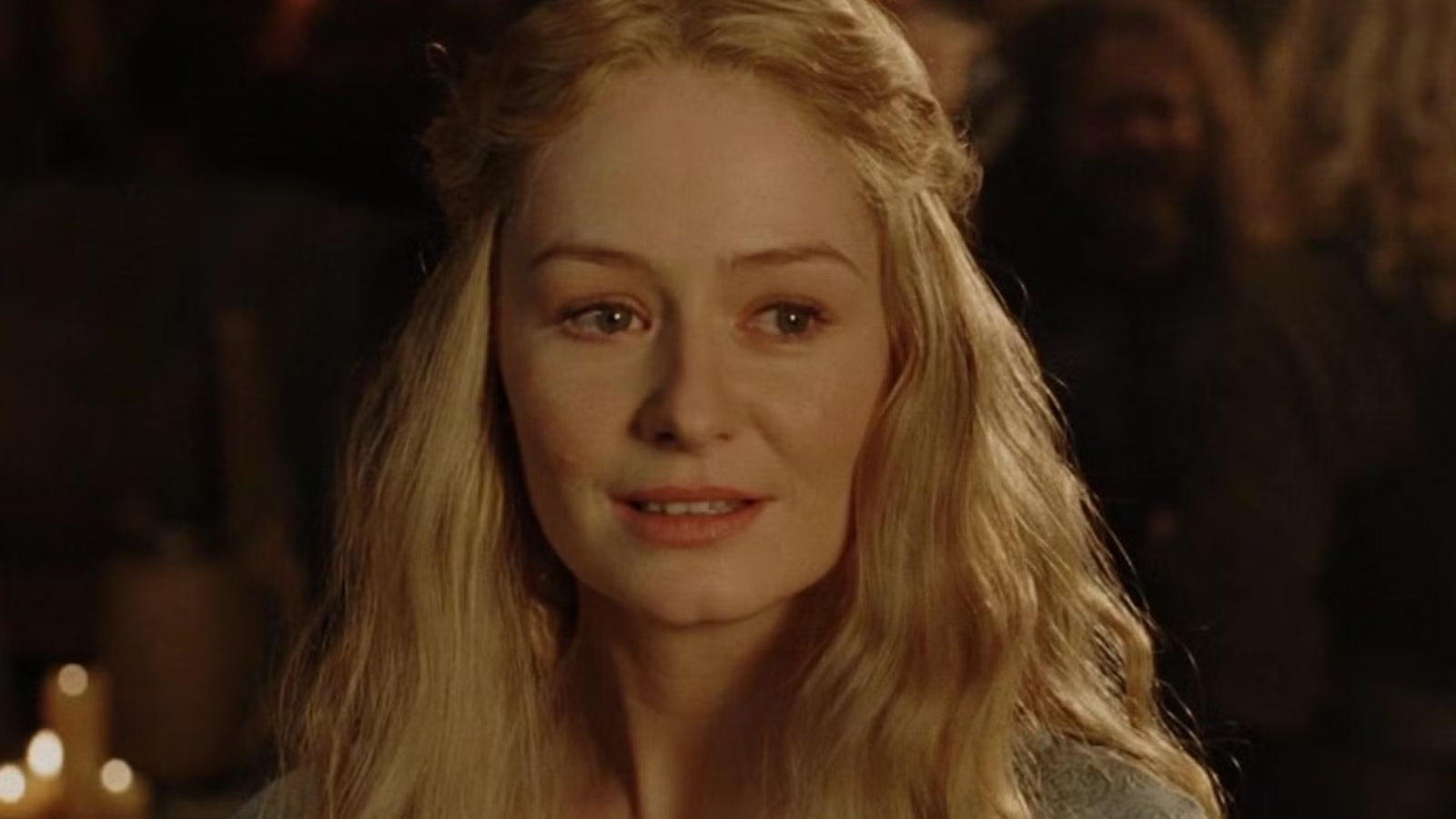
In one of the most poignant and climactic scenes in J. R. R. Tolkien’s The Lord of the Rings, the shieldmaiden Éowyn places herself between her fallen uncle, King Theoden, and the horrifying onslaught of the Nazgûl lord:
“Begone, foul dwimmerlaik, lord of carrion! Leave the dead in peace!”
A cold voice answered: “Come not between the Nazgûl and his prey! Or he will not slay thee in thy turn. He will bear thee away to the houses of lamentation, beyond all darkness, where thy flesh shall be devoured, and thy shrivelled mind be left naked to the Lidless Eye.”
A sword rang as it was drawn. “Do what you will; but I will hinder it, if I may.”
“Hinder me? Thou fool. No living man may hinder me!”
Then Merry heard of all sounds in that hour the strangest. It seemed that Dernhelm laughed, and the clear voice was like the ring of steel. “But no living man am I! You look upon a woman. Éowyn I am, Éomund’s daughter. You stand between me and my lord and kin. Begone, if you be not deathless! For living or dark undead, I will smite you, if you touch him.”
In this encounter, Tolkien shows us a supreme act of human freedom. “To be free,” notes the Jesuit scholar Walter Ong, “we must know our options and know our motives so far as possible: I want to do this, and for these reasons. Freedom is based on true and full knowledge.”
Éowyn has such knowledge. She knows also that, in facing such an enemy, she will likely perish. Nevertheless, her laughter as she faces the terrible threats and overwhelming horror of the Nazgûl reveals her untroubled spirit, hence its strangeness to Merry’s ears. Éowyn is composed and entirely self-possessed. She is free, and she is supremely brave.
Éowyn’s composure is a manifestation of the virtue of courage. Aragorn will later lament that Éowyn “was pitted against a foe beyond the strength of her mind or body.” Yet she alone remained standing before the Nazgûl’s onslaught, even when all the men had fled in terror. Her freedom to stand, in serenity of mind, before such a storm, is made possible by her great courage.
Her eyes grey as the sea were hard and fell, and yet tears were on her cheek. A sword was in her hand, and she raised her shield against the horror of her enemy’s eyes.
Éowyn, however, does not merely endure the Nazgûl. Aided by Merry, whose courage she inspires and awakens, Éowyn attacks and defeats the Witch-king, thus unexpectedly fulfilling the ancient prophecy that he would not fall by the hand of man:
Then, tottering, struggling up, with her last strength she drove her sword between crown and mantle, as the great shoulders bowed before her. The sword broke sparkling into many shards. The crown rolled away with a clang. Éowyn fell forward upon her fallen foe. But lo! the mantle and hauberk were empty. Shapeless they lay now on the ground, torn and tumbled; and a cry went up into the shuddering air, and faded to a shrill wailing, passing with the wind, a voice bodiless and thin that died, and was swallowed up, and was never heard again in that age of this world.
If courage enabled Éowyn to stand untroubled before the Nazgûl and endure his fearsome assault, another virtue enabled her to attack and overcome her foe. That virtue is the virtue of meekness.
In current usage, meekness has come to mean a kind of softness and mildness, a timidity in the face of what is arduous or uncomfortable. In classical Christian theology, however, the virtue of mansuetudo, meekness, means something quite different. Far from being mild or timid, meekness is the virtue of righteous combat against evil. It is an unyielding refusal to give evil its sway. Meekness is the virtue of the stouthearted, the virtue that Éowyn displays when she attacks and overcomes the Nazgûl.
What Is the Virtue of Meekness?
Meekness is the virtue that moderates and directs wrath, or anger. While anger is often understood in a wholly negative sense as something to be quenched or abolished altogether, Catholic moral theology sees wrath as a basic motivating force of the human person that can be used for good. That is to say, it is the energy of wrath that pushes us to overcome evil and realize the good. Wrath, of course, can all too easily explode into the uncontrollable fury of capital sin. In itself, however, wrath is a basic energy of the human person and is appropriately bridled and channeled by meekness.
Far from being mild or timid, meekness is the virtue of righteous combat against evil. It is an unyielding refusal to give evil its sway.
The Catholic philosopher Josef Pieper can help us think clearly about wrath and its moderating virtue. He writes that wrath “belongs to the primal forces of human nature.” Pieper notes further:
In this power of wrath, the energy of human nature is most clearly expressed. It is a force directed toward the difficulty of achievement, toward the thing beyond the easy grasp, ever ready to expose itself wherever an “arduous good” waits to be conquered.
Pieper turns to the teaching of St. Thomas Aquinas, for whom he notes that “wrath is the strength to attack the repugnant; the power of anger is actually the power of resistance in the soul.” A soul in which wrath has been completely extinguished or suppressed, in other words, is a soul in which the repugnant and malicious will find no resistance.
Wrath, then, is a tremendous energy of the human spirit. It is like electricity. When a power plant is working correctly, the force and energy of electricity is properly channeled, and the power works as it should. Whenever something goes wrong, however, that same energy can become explosive and destructive. So also with wrath, which easily becomes explosive and destructive whenever it is not directed. Pieper notes that the unbridled and destructive energy of wrath—that is, sinful fury—can be intoxicating. “In the upsurge of his self-will, the intemperately angry man feels as if he were drawing his whole being together like a club ready to strike. But this is the very thing he fails to achieve.”
In The Lord of The Rings, Tolkien gives us an image of this uncontrollable fury in the tragic scene where Éomer sees Éowyn, his sister, lying upon the battlefield, and thinks that she has died:
Then suddenly he beheld his sister Éowyn as she lay, and he knew her. He stood a moment as a man who is pierced in the midst of a cry by an arrow through the heart; and then his face went deathly white, and a cold fury rose in him, so that all speech failed him for a while. A fey mood took him.
“Éowyn, Éowyn!” he cried at last. “Éowyn, how come you here? What madness or devilry is this? Death, death, death! Death take us all!”
If unbridled fury clouds the mind, it is the virtue of meekness that safeguards the inner clarity and composure required to face and attack the repugnant. In his great Summa, St. Thomas Aquinas teaches that meekness especially protects self-possession in regard to the force of anger. Aquinas writes, “Meekness above all makes a person self-possessed.”
Wrath is a basic energy of the human person and is appropriately bridled and channeled by meekness.
Pieper echoes St. Thomas here. He notes that the virtue of meekness does not mean a shutting down of the power of wrath but rather its ordering:
[Meekness], however, does not signify that the original power of wrath is weakened or, worse still, “mortified,” just as chastity does not imply a weakening of sexual power. On the contrary: [meekness] as a virtue presupposes the power of wrath; [meekness] implies mastery of this power, not its weakening.
In striking down the Witch-king, Éowyn attacks the repugnant and does so from the energy, the strength, of wrath. Her wrath, however, is properly ordered. She does not, even for an instant, lose her composure or self-possession. “A sword rang as it was drawn. ‘Do what you will; but I will hinder it, if I may.’” Éowyn is supremely courageous, and she is supremely meek.
In an important essay analyzing Tolkien’s inspiration for the character of Éowyn, scholar Dorota Filipczac notes that, in addition to the concept of “Northern courage,” which so inspired Tolkien, he also drew upon some of the great women of the Bible, such as Jael and especially Judith. She notes several thematic and linguistic connections that link Éowyn to these warrior women of Scripture, and that they all do what men cannot do, and in so, deliver their people from evil.
The biblical women succeed in conquering and vanquishing great evil, but unlike their foes, whose passions are utterly unbridled, these women are supremely virtuous and thus supremely free. Surprising as it may seem, Judith, the great female warrior of the Bible, is meek even as she beheads the evil Holofernes! So also Éowyn is meek, even as she strikes down the Nazgûl lord.
Blessed Are the Meek, for They Will Inherit the Land
In Catholic moral thought, meekness is not simply a virtue that bridles and directs wrath. It is also a beatitude; that is, it is a grace that orients us to the joy of the life of heaven. The beatitudes give us a share, even in this life, in the overflowing beatitude that characterizes the life of God in which we hope to share fully by his grace. The beatitudes link the various struggles of Christian life to joy. Each beatitude, as it were, makes the exercise of virtue an easy and delightful task. The beatitude of meekness, says St. Thomas, is given so that we might be “altogether undisturbed” by the troublesome power of unbridled wrath.
The joy that the grace of meekness brings is a final key to understanding Éowyn’s character. Tolkien was, as already mentioned, greatly inspired by the reckless bravery of Norse mythology, in which the heroes, although assured of their own deaths, nonetheless rode to battle. This same bravery informs much of Éowyn’s character.
Tolkien recognized that this bravery, on its own, was inclined to despair, simply because it required the certainty of death. Éowyn falls in love with Aragorn, for example, because she sees in him a mighty captain who will lead his followers to a glorious, although assuredly fatal, end. She begs him to allow her to join his company on the Paths of the Dead, and when he refuses, she despairs and goes in search of her own death on the battlefield of Pelennor.

There, of course, she faces and overcomes the Nazgûl, and the encounter nearly kills her. She does not die, however, and Aragorn, miraculously returned from the Paths of the Dead, heals her in body. He tells Éomer, however, that he does not know if she will awaken to hope or to despair.
It is not until Éowyn meets Faramir that her meekness and bravery become linked with joy. When she meets Faramir, both are recovering in the Houses of Healing, but she is still in the grip of despair and desires to ride to battle seeking death. Faramir perceives her grief, and she in turn perceives in Faramir a hidden strength and yet a profound meekness. It was Faramir, after all, who told Frodo:
War must be, while we defend our lives against a destroyer who would devour all; but I do not love the bright sword for its sharpness, nor the arrow for its swiftness, nor the warrior for his glory. I love only that which they defend.
These are the words of a supremely meek warrior. And when, against all hope, the Ring is destroyed, Éowyn and Faramir suddenly feel the unexpected grace and light of that victory. The destruction of the Ring is a supreme victory of meekness, and it is the victory that finally heals Éowyn’s heart and enables her to respond to the love of Faramir.
Then the heart of Éowyn changed, or else at last she understood it. And suddenly her winter passed, and the sun shone on her.
“I stand in Minas Anor, the Tower of the Sun,” she said; “and behold! the Shadow has departed! I will be a shieldmaiden no longer, nor vie with the great Riders, nor take joy only in the songs of slaying. I will be a healer, and love all things that grow and are not barren.”
Some readers of Tolkien are dismayed by Éowyn renouncing the ways of war after the destruction of the Ring. Gerry Canavan, for example, criticizes Tolkien for not allowing Éowyn to ride off into the sunset swinging her sword as a kind of eternal Wonder Woman. Such a criticism, however, fails to account for the virtue of meekness, which finds its completion in joy. Éowyn is healed in spirit only when this joy, which comes from the unexpected destruction of the Ring, changes her heart.
We see this joy most clearly when, together with Faramir her husband, she meets again the newly crowned Aragorn:
Then Éowyn looked in the eyes of Aragorn, and she said: “Wish me joy, my liege-lord and healer!”
And he answered: “I have wished thee joy ever since first I saw thee. It heals my heart to see thee now in bliss.”
Aragorn speaks for us the readers, who in beholding the womanly freedom and beatitude of Éowyn, find our courage also to stand, unyielding but rejoicing, against the evil of our own times.