
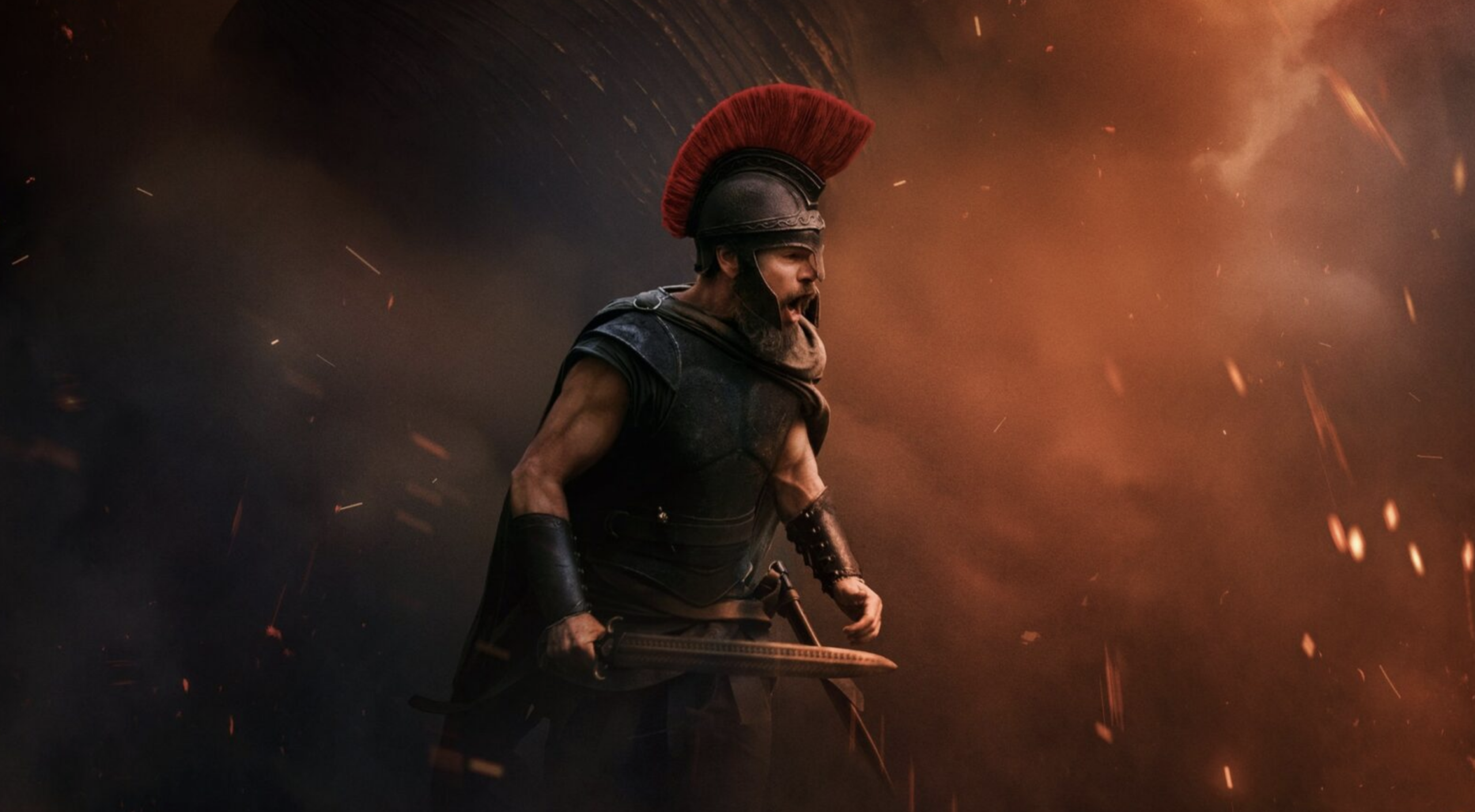
“At the core of the Homeric poems,” writes George Steiner, “lies the remembrance of one of the greatest disasters that can befall man: the destruction of a city.” He continues:
A city is the outward sum of man’s nobility; in it, his condition is most thoroughly humanized. When a city is destroyed, man is compelled to wander the earth or dwell in the open fields in partial return to the manner of a beast.
The Odyssey of Homer is the epic myth of homecoming—what Homer called nostos—after the fire and destruction of the city of Troy. Homer tells us that even after many years and many wanderings, we can still return home.
The Odyssey of Christopher Nolan, his stylistically masterful and beautiful adaptation of Homer’s epic, is also backlit by the destruction of a city, or rather two: Hiroshima and Nagasaki. In contrast to Homer, Nolan tells us that a homecoming is no longer possible for modern humanity. Modern man is perpetually adrift. Like Walter White in the series Breaking Bad, he has made himself a stranger in his own house and is surprised by the discovery.
Nolan has long prepared the cinematic ground for this disconcerting proposition. Recall the words of the Joker to Batman in Nolan’s 2008 film The Dark Knight:
Their morals, their code; it’s a bad joke. Dropped at the first sign of trouble. They’re only as good as the world allows them to be. You’ll see—I’ll show you. When the chips are down, these civilized people—they’ll eat each other. See, I’m not a monster. I’m just ahead of the curve.
The Joker tells Batman that civilization and morality are merely a facade. The veneer of modern civilization is only too thin; barbarism and anarchy lie a step away. The Joker believes he has discovered the truth of modern civilization, and he will show it to Batman. And the Joker is correct. The barbarians who threaten to topple our civilization are not foreigners or marauding bands of nomads, but we ourselves. Modern man has invented the sure means of his own annihilation.
The veneer of modern civilization is only too thin; barbarism and anarchy lie a step away.
This is the central premise of Nolan’s 2023 Oppenheimer, the film that immediately precedes The Odyssey. The hopeful belief in the transtemporal and intergalactic power of love that animated Nolan’s Interstellar (2014) has been set aside. Oppenheimer closes with the following dialogue:
Oppenheimer: “When I came to you with those calculations, we thought we might start a chain reaction that would destroy the world.”
Einstein: “What of it?”
Oppenheimer: “I believe we did.”
Nolan tells us in Oppenheimer that the price of passage from the pre-atomic to the atomic age is the destruction of the world. Our civilization has turned a corner and now stands upon the brink of a new, uncertain age.
Nor do we need Nolan’s unparalleled cinematography to tell us this. As early as 1882, Friedrich Nietzsche wrote of the death of God. By this, of course, Nietzsche was not offering a simple-minded declaration of atheism. He was diagnosing modernity and its unshakable, fanatical faith in scientific and technological progress. There is simply no room left in the modern technoworld for God. But—and hence the force of Nietzsche’s declaration—if we have killed God with modern technology, what do we really have left? Do we understand what we have lost?
In addition to Nietzsche’s grim diagnosis, there are the warnings offered by modernity’s great thinkers—all largely ignored. Think of the terrible working conditions and mind-numbing labor of immigrant factory workers in the industrial cities chronicled by Dickens and those which so angered Marx. There is also Oswald Spengler, who wrote The Decline of the West (the first volume of which appeared in the last year of the First World War). At the close of the Second World War, Horkheimer and Adorno asked, in their Dialectic of the Enlightenment, how such unspeakable carnage could have been wrought by the high ideals of rationality, progress, and modern technology. And it is Heidegger who helps us see that mankind’s insatiable ambition to obtain mastery over all things through modern technology results in the subjugation and exploitation of man himself. The atom bomb may be an engineering marvel, but it is also the supreme expression of modern man’s nihilism.

Christ cautioned his disciples against building houses upon sand, calling us instead to build upon the unshakable rock of his word. Modern man has rejected both options and instead chosen to build his house on dynamite—or, more accurately, upon plutonium. In so doing, modern man has forever put his home out of reach. Who could rest securely in a house built upon a bomb?
Thus, unlike Homer, Nolan’s Odysseus has no true homecoming. Physically, he makes it back to Ithaca and destroys the suitors, but he recognizes that he cannot return to his old life and reclaim his kingship. He is psychologically broken from the guilt of the war and from failing to bury his dead men. At the end of the movie, Odysseus and Penelope sail away into the West. His actions in Troy, especially the deceit of the wooden horse, have broken the one law that held civilization together. In disregarding “Zeus’s Law,” which calls people to treat strangers as if they were gods in disguise, Odysseus has disregarded the gods themselves. This helps explain the absence of the gods in Nolan’s film.
Only Athena is portrayed on screen, and she turns out to be merely a psychological expression of Odysseus’s remorse over the sack of Troy. Athena’s presence in the film is, in a way, like the hologram of Elvis Presley singing in Blade Runner 2049. It is familiar and nostalgic and serves to remind us of what we have irrecoverably lost. The gods are absent from the film because God has been exiled from the modern world. As Nolan’s Odysseus dismissively reminds his men, “The gods help those who help themselves.”
Pope St. John Paul II had a phrase he liked to repeat, especially to young people: “Man is able to build a world without God, but this world will in the end turn against man.” Nolan’s film affirms as much. We are on our own at sea. But, in classic Nolan style, it is a beautiful and haunting journey.