
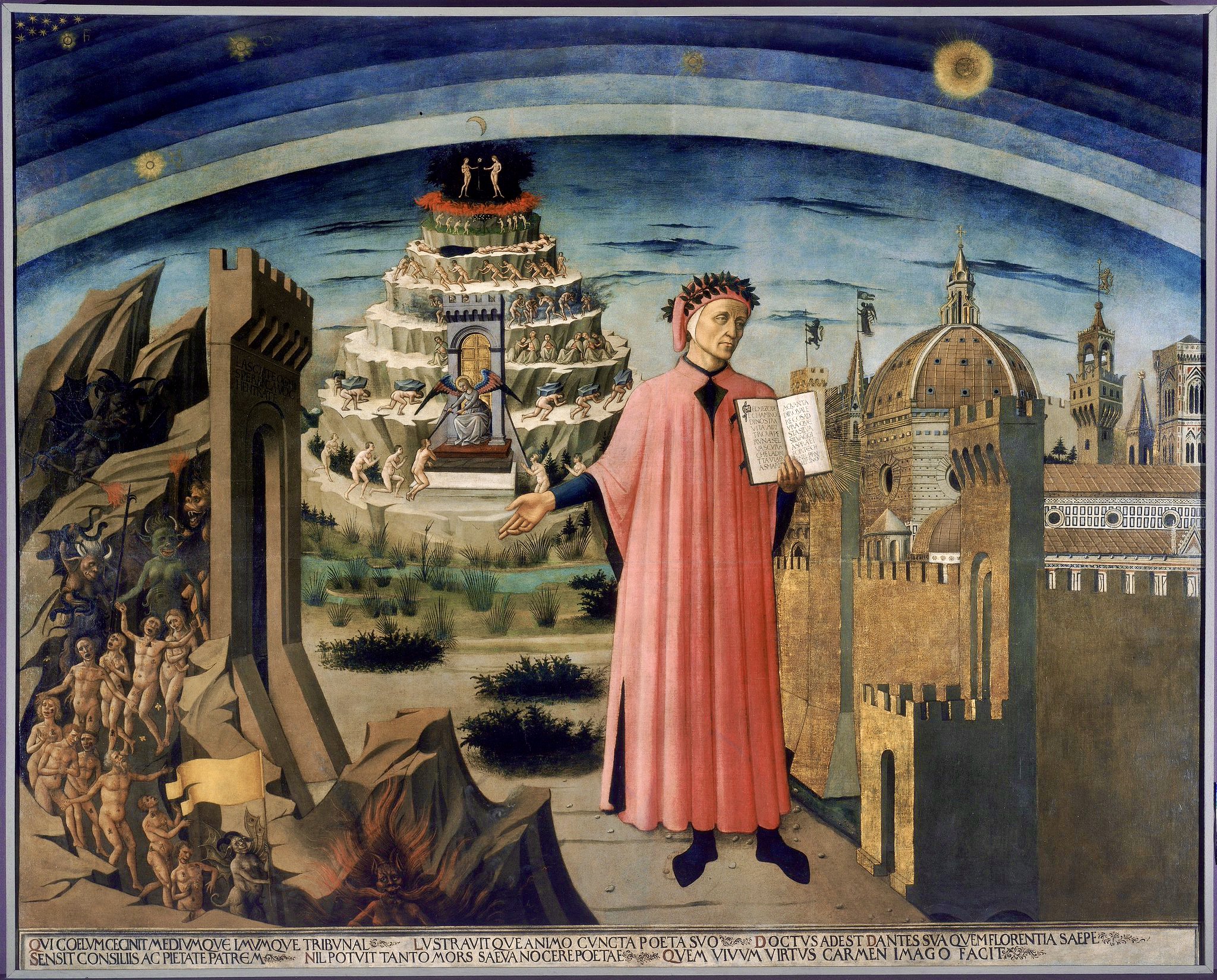
In the midst of a distracted age, when any five-minute lull in activity leads people to pull out a screen and begin scrolling, clicking, liking, and swiping, what good might it do to instead spend some time steeped in a meditative trek through the masterwork of a long-dead Italian poet? Physically, it is more difficult to tote around a 700-page tome, as it doesn’t quite fit as neatly in one’s back pocket as a smartphone. Perhaps the greater challenge, though, is intellectual. Our minds are constantly overstimulated by snippets of information, and our attention spans are increasingly unused to a sustained dive into the depths of anything. Our imaginations have grown flaccid, as binge-watching replaces even the most banal leisure reading. In such a context, attempting to read through Dante Alighieri’s Divine Comedy is a big ask.
Perhaps, to begin, the issue at hand ought to be not whether we should read Dante but whether it is helpful, in our current cultural milieu, to turn to literature at all—not literary fluff but worthy literature, challenging texts that stretch our abilities to concentrate, to understand, to appreciate the world, to see its beauty and its terrors anew. What good do such books do for us? There are many advantages to reading; one primary good is the sustenance and exercise of our imagination.
The concept of the imagination has a long and varied history. The colloquial usage of the term “imagination” often refers to flights of the mind into that which is not demonstrable, concrete, or in accord with the real. If this is all the imagination is, then leaving our imaginations unexercised would not be problematic—perhaps we’d just be more aware of “that which is” as opposed to “that which is not.” Yet D. C. Schindler, following in the footsteps of St. Thomas Aquinas in the Summa theologiae, proposes a distinct conception of the imagination, one that highlights the imagination as a primarily perceptive power rather than as an inventive power.
Schindler explains that the imagination is the power by which the sensory information taken in by the body is integrated into the mind. The imagination allows for deeper penetration into reality, by way of the sensory experiences of the person. In the imagination, the complex weave of body and soul is reinforced. In an essay titled “Why We Need Paul Claudel,” Schindler characterizes the imagination as the place “where concepts take flesh and thus where senses and spiritual meaning are joined; it is where one receives the world and also where one gives that world form; it is where one dwells upon what one receives in a patient mood of contemplation, and at the same time where one’s emotions stir and where one first feels the impulse to act.”
In the imagination, the complex weave of body and soul is reinforced.
In our inattentive age, our sensory perceptiveness is lacking and contemplative moods are few and far between. We are often so absorbed by our screens and our earbuds that even the grossest skills of perception are crippled, unable to perceive the world’s most basic inputs. We are more and more detached from “that which is” and more easily deluded by “that which is not.” What is at stake here in this detachment from “that which is”? Not only missing the world’s interesting details but also, suggests Paul Claudel, all of eternity. Claudel was a poet, and a great admirer of Dante, and nearly a full century before the introduction of the smartphone, he was decrying the foundering imagination of his contemporaries. In “Religion and the Artist: An Introduction to a Poem on Dante,” Claudel explained: “On the one hand, our superficial knowledge of the world has prodigiously increased due to the new materials that science has put at the disposal of each of us; fields of interest have multiplied, calling on all the resources of our intellectual appetite. On the other hand, God belongs to an unknown world, which is also, they say, unknowable, and so it is too easy for minds elsewhere occupied and accustomed to only tactile matters, to confuse this unknown world with Nothing.”
Even back in 1921, Claudel noted that popular imagination had been hoodwinked by that which is readily accessible, easily digested, and quickly understood. Heaven had been, and continues to be today, relegated to abstractions that lacked the power to compel hope or desire. The same continues today, notes Caitlin Smith Gilson, in her book As It Is In Heaven: Some Christian Questions on the Nature of Paradise, in which she details the many-branched consequences of an evacuated imaginative sense of the world to come. When the “mystery is left unnurtured,” she writes, it “degrade[s] . . . into a vague wish for immortality,” which has less and less power to move our hearts or our wills. When we lose our “ardent and directed desire for heaven,” our “paradisal longing for the resurrected life,” we also lose our connection with the words of St. Paul, who reminds us in Hebrews 13:14 that “here we have no lasting city, but we seek the city which is to come.” When we lose the ability to imagine heaven, we lose the impetus to desire it, and to move ourselves onward on the journey toward it in all of our daily decisions and discernments.
So it is, then, that we ought to read Dante Alighieri’s Divine Comedy. Yes, it is a great work of literature by a master poet, a poet who, T. S. Eliot claims in his “Talk on Dante,” exceeds even Virgil in his attention to the craft of poetry and in his ability to “find words for the inarticulate, to capture those feelings which people can hardly even feel, because they have no words for them.” But, most crucial for us today, is the fact that Dante’s subject matter in the Divine Comedy is a particularly apt remedy for our lack of imaginative engagement with the world to come.
When we lose the ability to imagine heaven, we lose the impetus to desire it, and to move ourselves onward on the journey toward it in all of our daily decisions and discernments.
What this means, however, is not that we ought to read Dante to make up for any number of doctrinal lacunae in our religious education. Claudel is quick to note that although the broad strokes of Dante’s eternal realm are mostly in accord with Catholic theological orthodoxy, we ought not read the Comedy as a theologically accurate catechesis manual. This is not the point of Dante’s work; it is not a catechism but a poem. Dante, says Claudel in “Religion and the Artist,” is not a missionary but a poet. The author of the Divine Comedy uses deft and specific language, an engaging narrative, and sensuous details to invite his reader on a journey; what the reader gains along the way is an entryway into what is real, a desire and anticipation for eternity, via “the joy, hope, and terror that the beautiful images chosen by the poet pour into the depths of our hearts.”
In a letter to one of his patrons, Dante offers a few suggestions regarding why we ought to read his work. He not only hoped that his readers—in his time, anyone able to read the Italian vernacular, not just the Latin scholars of the day—would meditate on how their choices have just consequences in the world to come; he also hoped that his Divine Comedy would “remove those living in this life from misery and lead them to happiness.” Dante saw his art not as a work for its own sake but as an efficacious gift to his readers—people, perhaps, wandering and lost in the midst of their own dark woods. His words, he hoped, would be a beacon that would literally lead them on a path of renewal, similar to that experienced by the fictional pilgrim as he traversed the shadows of hell and made his journey of purification through purgatory on the way to the heavenly realms of paradise.
Dante employs many “hooks” to catch the darting, silvered fish of our imagination as he embarks on his poetic venture through the geography of eternity. He writes with an ever-growing abundance of concrete similes and metaphors, as Jason Baxter notes, as well as with engaging sensual details, including descriptions of how all five senses might interpret the various realms of the afterlife. The author’s courtly devotion to his beloved Beatrice inspires higher, purer attention to the pure ways of God, as Beatrice plays a crucial role in chastising the pilgrim Dante for the errors of his past ways. All of these elements, and many more, are hooks that serve to reel us in—as readers and fellow travelers on the imaginative journey to the world to come. These hooks pull us out of our stagnant pools of earth-bound ambivalence and into clearer streams of renewed hope, and, perhaps, inspire our desire for heaven.
There is much to notice in the Divine Comedy, and most popular attention is normally focused on the doomed souls in the hellish realms of Inferno. But understanding Dante’s work is impossible without considering the work as a whole, particularly the purifications witnessed, and experienced, by the pilgrim Dante in Purgatorio. Here, in particular, are a few indications that Dante the author has confidence that art can be efficaciously transformative. In Canto XXI and XXII of Purgatorio, Dante and his guide Virgil encounter the soul of Statius, a Roman poet who wrote in the classical tradition of Virgil’s own Aeneid. Statius reveals that Virgil’s work changed his life: It inspired him not only to become a writer but also to become a Christian. Particularly transformative were the words of Virgil’s fourth eclogue, a pastoral poem with linguistic overtones similar to those found in the book of Isaiah. Though Virgil himself had no awareness of the nature of his art, it was enlightening for Statius, who tells the ancient poet that his poetry lit the lamp of truth for him.
In Purgatorio, as the journey continues, Dante suggests that it is not only literary art that can inspire the imagination and move the heart to transformation but also visual art. In Purgatorio’s Canto X and Canto XII, sculptures on the wall of the mountain’s first terrace depict carvings of humility incarnate—the Virgin Mary’s fiat, David’s humble dance before the ark of the covenant, and the Roman emperor Trajan dispensing justice to a widow. The sculptures are vivid illustrations of the virtue that the prideful inhabitants of purgatory’s first terrace lacked in their earthly lives; they are intended to inspire the penitent sinners to reform their ways and guide them toward the good. A second series of sculptures—of pride punished—are etched into the pavement that the prideful souls gaze upon as they walk, bent under the stony loads that they must bear on their way up the mountain. Their imaginations sparked, the souls shed repentant tears as they gaze upon the sculpted cautionary tales.
It is all too easy, when confronted with a challenging, historic work of literature, to hold it at arm’s length, as though it were a specimen from a bygone era, interesting from a didactic or educational standpoint but not particularly compelling or important for our own personal journey through life. The Divine Comedy is an antidote to this sort of detached reading due to the nature of the story, as well as the intentions of the author himself. Dante’s goal, remarks Claudel, “was not to teach us but to lead us, to take us with him, to have us see and touch, and, all the while reassuring our intelligence, [and training] our imagination.” As readers, we should be not only witnesses but also imaginative companions of Dante’s pilgrim, who realizes his own imperfections in the midst of a midlife muddle and who grows in humility and reliance upon God’s grace on his journey to the inexpressible wonders of the beatific realm.