
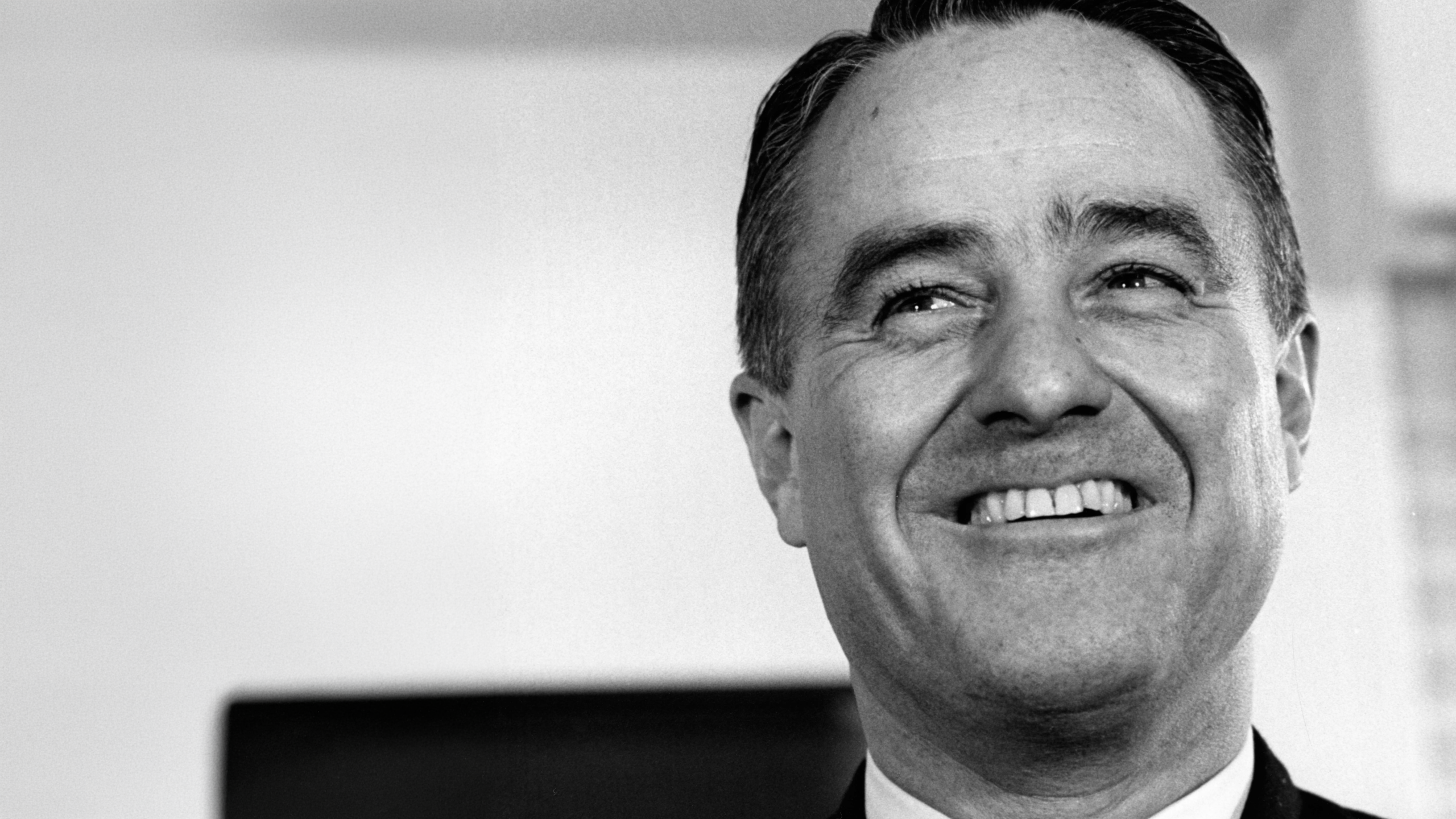
Sargent Shriver was a prominent politician in the twentieth century with ties to some of the most influential Americans of the era. Yet despite the prestige and power he enjoyed in his life, Shriver took seriously his calling as a public servant. A devout Catholic, Shriver viewed his political career not as a means to status and power but as a calling by which he could practice his faith and create a world more closely aligned with his values. Shriver established the Peace Corps in the Kennedy administration and later created and ran the Special Olympics with his wife, Eunice. For Sargent Shriver, Catholic social teaching was not just for theologians but a guide for everyone. He demonstrated this in both his work and in speeches he delivered throughout his life, outlining the intersection of faith and civic involvement. Through his example and words, Sargent Shriver provides inspiration to lay Catholics on how to bring others closer to God.
Born into a prestigious political family with roots dating back to colonial America, Sargent Shriver was not an average guy. As the US Ambassador to France, he was chummy with Charles de Gaulle. He married Eunice Kennedy and became a member of the Kennedy family’s inner circle and was influential in President John F. Kennedy’s White House. Shriver was involved in the creation of several major government programs while serving the Kennedy and Johnson administrations. Despite his place at the epicenter of political influence, Shriver remained firm in his faith, praying the Rosary and attending Mass daily.
His political views seemed to come from his faith rather than the trends of the day. Shriver was early to racial justice and remained pro-life long after it was fashionable in his political party. Shriver, the last mainstream pro-life Democratic presidential candidate (1976), demonstrated this in 1992 when he and his wife were among the signatories of an open letter in The New York Times featured as a full-page advertisement promoting pro-life policies. This was indeed an unpopular opinion in the Democratic Party of the time. That same year the pro-life Democrat Bob Casey was not permitted to speak on the issue of abortion at the Democratic National Convention, causing some controversy.
“In our society that is so self-absorbed, begin to look less at yourself and more at each other.”
In 1994, Shriver spoke at Yale College Class Day, urging his audience to lead lives dedicated to the service of others. He told the students that they were all called to be peacemakers. Shriver urged his audience to think more about others than about themselves. Perhaps unoriginal advice, but Shriver’s belief that such a life was possible for a layperson was underscored by his own career of service. The average person, he believed, really could and should take an active role in their community. Shriver spent his life trying to make that possible. “Break your mirrors! Yes indeed—shatter the glass,” Shriver told the Yale students and other attendees. “In our society that is so self-absorbed, begin to look less at yourself and more at each other. Learn more about the face of your neighbor and less about your own.”
Years earlier, Shriver delivered a similar message grounded in Catholic social teaching to the graduating class of 1963 at Fordham University. Drawing from the writings of Pope John XXIII, he focused on the relationship between church and state and, from there, the importance of civic involvement. Shriver argued that the separation between church and state allowed cooperation between the two, that “separation of Church and State does not mean the divorce of spiritual values from secular affairs.” Citing Washington, Lincoln, and others, Shriver noted that the history of politics affirms the notion that spiritual morality is essential to good governance.
Yet Shriver was not espousing political philosophy to an audience of statesmen but young people about to enter their postgraduate lives. His message was that the entire citizenry should use their moral training to partake in charitable acts. He was a model lay Catholic who viewed his career as an opportunity to serve God and urged others to do the same. As the founder of the Peace Corps, he believed that civic involvement was the role of the many rather than the few and that Catholic social teaching could be merged with individual discernment and the careers of the laity. He urged his audience of college graduates to use their blessings to make the world a better place, quoting Mater et Magistra’s reference of an earlier Vatican document: “It is necessary to arouse a sense of responsibility in individuals and especially among those more blessed with the world’s goods.” Shriver added, “Every one of you who are graduating today are among those blessed with the world’s goods. It is you that Pope John meant.”
“Separation of Church and State does not mean the divorce of spiritual values from secular affairs.”
Shriver gave practical advice on how to apply this philosophy. As a founder of the Special Olympics, he believed in the power of organizational charity. With the creation of the Peace Corps, he built an institution by which young people could serve the poor throughout the world. When discussing crises in Latin America, he urged the Knights of Columbus to take a leading role. “This is not a responsibility which can be left in the hands of the government while we pursue our daily lives and comforts,” he told his audience. “It is not a responsibility which can be avoided by criticizing foreign aid or applauding the Peace Corps.” He suggested chapters in the United States “adopt a diocese in Latin America” to make them an “object of your own personal concern and charity.” The Knights of Columbus, Shriver suggested, should donate their material goods, time, and expertise to help educate and support their adopted diocese. Pointing out the spiritual benefits of such a program, Shriver concluded, “This effort, by bringing us closer to other men, will bring us closer to God.”
Thus, for Sargent Shriver, Catholic social teaching was not merely a guideline for policymakers but a call to each of us to devote our lives to service. Shriver’s message was one of practical and organizational charity. People should find a way to serve those in need every day. Shriver taught that questions of Catholic social teaching are not merely the realm of theologians or politicians but a challenge to us all to engage in charitable acts every day and to bring about serious good through our own daily lives.