
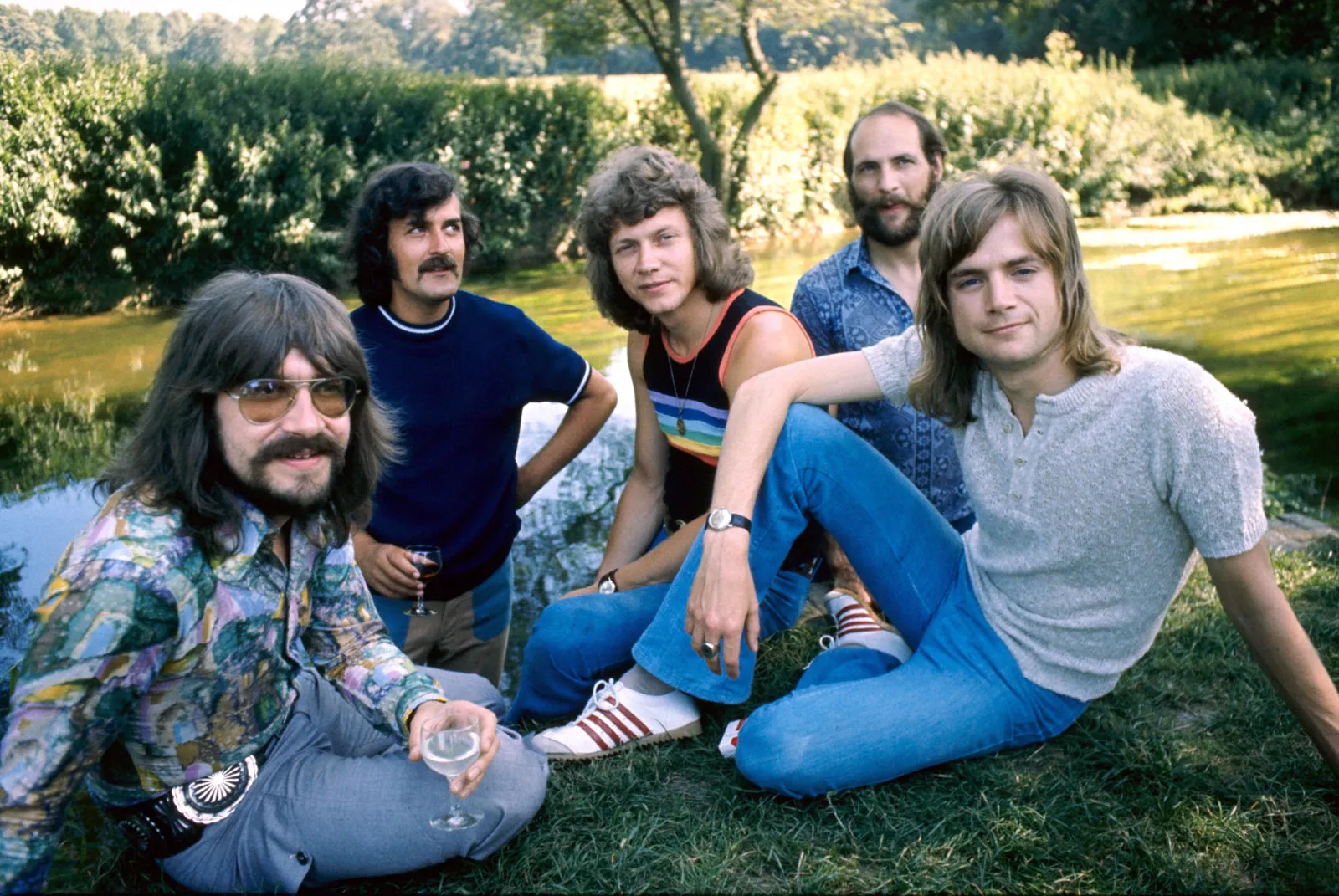
Some years ago, one of my students called me from the Chastain Park Amphitheater in Atlanta. She and her mom were attending a Moody Blues concert, and she knew they were one of my favorite groups; she also knew that I used their music in my freshman ethics class. My only question for her was, “Why didn’t you invite me?” Her grandmother might have been there as well, given The Moody Blues have a multigenerational following.
Years later, only a month ago, who but the remnant of the band came to town, performing only fifteen minutes from our house. The original band no longer exists, but former front man Justin Hayward is carrying the flag now with a small acoustic group. Though Hayward was not an original member of the band, he is now one of only two surviving members; importantly, he wrote and performed many of the band’s most popular hits. His ensemble is now largely acoustic, and celebrated acoustic guitarist Mike Dawes sometimes plays with him.
The band released a total of sixteen albums, though the early years were the best; six of their albums hit the top 20 on the Billboard 200 in the US. Though their image evolved and shifted, the band is noted for their elegant, vintage, ’70s tailored jackets and Victorian poet blouses onstage. The apparel seemed to fit the refined grace of their best music.
Sometimes band names become such household phrases that we no longer wonder what they mean. According to one report, “Moody” was inspired by the jazz standard “Mood Indigo” by Duke Ellington, and also a reflection of founder and keyboardist Mike Pinder’s opinion that the music affects people’s moods. “Blues” refers to their origins as a rhythm and blues band, illustrated by the early album The Magnificent Moodies, which includes “I’ll Go Crazy” and the hit single “Go Now.”
The band falls into the “progressive rock” category, along with others like the brilliant Pink Floyd and the edgier King Crimson. They were, moreover, a “symphonic rock” band, although their music is far less complex, yet far more lyrical than, say, that of the 1970s Emerson, Lake, and Palmer. There are many examples of the band’s symphonic rock style. One of the best is the exquisite “For My Lady,” written by flautist Ray Thomas, a song variously called “Elizabethan” and a stylish “sea shanty.” Thomas had just gone through a divorce, and the song expresses the hope that an ideal of love remains. The lyrics are supported by the woodwinds, undergirded with the rhythmic harp chords.
My boat sails stormy seas
Battles oceans filled with tears
At last my port’s in view
Now that I’ve discovered you
For those who like to hum a tune, the chorus is hard to shake.
Oh I’d give my life so lightly
For my gentle lady
Give it freely and completely
To my lady
Of course, orchestration can turn into overorchestration, as is the case with bassist John Lodge’s otherwise lovely tribute to his newborn daughter, “Emily’s Song,” which is occasionally encumbered by the brass arrangement. Lodge was a committed evangelical Christian throughout his career, and he said it protected him from many of the excesses of the rock world. His song “I’m Just a Singer (In a Rock and Roll Band)” is a response to all of the fans that idolize rock musicians, who may have no more wisdom than anyone else. Lodge puts the onus of responsibility on the fan and asks him to pass on what he has learned.
So if you want this world of yours to turn about you
And you can see exactly what to do, please tell me
I’m just a singer in a rock and roll band.
“I’m Just Beginning to See That I’m On My Way”
When nineteen-year-old Justin Hayward joined The Moody Blues, his impact was seismic. His creative gifts brought an elegance and a spiritual tone to the music of the group. In an interview, Hayward was asked how it all started. He began, “Well, I come from a family of deep faith.” He explained that in elementary school, he fell in love with the traditional hymns that were sung daily. He explored Eastern religions and meditation during the 1960s, and the band carried on a friendship with Timothy Leary, to whom they paid homage in “The Legend of A Mind,” written by Ray Thomas. Eventually, however, Hayward—by then the lead singer, chief songwriter, and lead guitarist of The Moody Blues—returned to his natal Anglican faith. He has cited the writings of C. S. Lewis as a profound influence on his reversion.
Hayward arrived in time for the band’s second album, Days of Future Passed. The band was originally asked by Deram Records to record a rock-oriented adaptation of Dvořák’s “New World Symphony,” but the band, supported by the London Festival Symphony, created a symphonic song cycle tracking the stages of a 24-hour day, from dawn to the late-night hours. Of the seven tracks on the album, two were massive hits, “Tuesday Afternoon” and the angst-ridden “Nights in White Satin.” Both were penned by the young Hayward.
“Nights in White Satin” has been called the song “that changed rock forever.” The song’s anguish is enhanced by soaring strings and multitracked, overlaid vocals. The opening lyrics are so familiar as to be iconic. Hayward once acknowledged that the song was prompted by an episode in which the sun was setting on one relationship but rising on another.
Nights in white satin, never reaching the end
Letters I’ve written, never meaning to send
Hayward explained that though romance was in the background of several of his songs, he also understood that the compositions often evolve into something more than a discrete experience; they express universal struggles, not just romantic but philosophical. The singer admits,
Beauty I’ve always missed, with these eyes before
Just what the truth is, I can’t say any more.
The passion is intense:
‘Cause I love you
Yes I love you
Oh how I love you
At the same time, the pain is palpable, yet aching passion and angst actuate self-reflection:
Gazing at people some hand in hand
Just what I’m going through they can’t understand
Some try to tell me thoughts they cannot defend
Just what you want to be you will be in the end
The pulsating bass guitar with the interwoven organ of “Tuesday Afternoon” enhance the song’s mystical tenor. It’s a song of revelation and self-discovery:
I’m just beginning to see / That I’m on my way.
. . .
I’m looking at myself reflections of my mind / It’s just the kind of day to leave myself behind.
In the present age, the average man and woman have become incurious. We possess souls, but they are “souls without longing.” But not so here:
Something calls to me
The trees are drawing me near
I’ve got to find out why.
“Make a Promise, Take a Vow”
“The Voice” is a sturdy call to self-honesty and responsibility. It begins with the singer admitting that he doesn’t understand life as well as he thought he did. The song has an existentialist tone, meaning the world doesn’t always make sense, nor is it fair; this can be true for Christians as well as non-Christians. Such is the theme of the writings of Søren Kierkegaard, the celebrated Christian existentialist philosopher. His most accessible book is Fear and Trembling (1843), in which he argues that God’s command to sacrifice Isaac was, for Abraham, far more confusing, contradictory, even maddening, than we usually imagine.
Won’t you take me back to school?
I need to learn the golden rule
Won’t you lay it on the line?
I need to hear it just one more time.
The second verse addresses the contradiction between hope and experience:
Each and every heart it seems
Is bounded by a world of dreams
Each and every rising sun
Is greeted by a lonely one.
The bridge invokes the metaphor of the sea. Hayward sings, supported by John Lodge’s seamless harmony,
Cause out on the ocean of life, my love
There’s so many storms
We must rise above
Can you hear the spirit calling
As it’s carried across the waves?
You’re already falling
It’s calling you back to face the music
“From the Ashes We Can Build Another Day”
Hayward later revealed that the song “The Story in Your Eyes” subtly referenced the band itself. As the group grew tired of the stress from relentless touring—which eventually led to a temporary breakup in 1974—the lyrics, “We’re part of the fire that is burning, and from the ashes we can build another day,” served as a quiet confession about the struggles they were facing behind the scenes due to the stress generated by the growing demand on the band, given its soaring popularity.
“The Story in Your Eyes” is on the album Every Good Boy Deserves Favour. The phrase is a mnemonic used to remember the notes on the five lines of the treble clef staff: E, G, B, D, F (from bottom to top). The album title, then, is a clever nod to the band’s trademark symphonic sound. Even more, those same notes are played in sequence on a piano during the opening track, “Procession,” which acts as a musical prologue to the album.
Like other Hayward songs, this one turns reflective and speaks to something beyond the immediate—the experience of suffering and the benefits that it may engender. As Flannery O’Connor once remarked of an acquaintance who had committed suicide, “His tragedy was that he didn’t know what to do with his suffering.”
Listen to the tide slowly turning
Wash all our heartaches away
We’re part of the fire that is burning
And from the ashes we can build another day
Yet the nature of suffering is such that clarity may be overtaken by confusion, and nothing is guaranteed:
But I’m frightened for your children
That the life that we are living is in vain
And the sunshine we’ve been waiting for
Will turn to rain
“We All Know That It’s True”
Although The Great Divorce may not be C. S. Lewis’s most cited book, none of his other works are more important. Hayward may well have read it, given that he read Lewis “broadly.” The narrator occupies a front-row seat and observes the many creative ways that individuals justify their behavior and sidestep self-knowledge. The book is about the individual submitting to God’s methods and an acquiescence to a spiritual path not of our own design. In chapter 9, nineteenth-century author George MacDonald tells the narrator,
There are only two kinds of people in the end: those who say to God, “Thy will be done,” and those to whom God says, in the end, “Thy will be done.”
Justin and Marie Hayward have been married over fifty-five years—a remarkable feat for anyone, but especially admirable given the rock ’n roll climate in which they have lived and raised their daughter. She and her father share a close bond. When he was twenty-two, Hayward wrote the song “Never Comes the Day,” which may hold the key to their success. It addresses the elusive quest for a “perfect” relationship, one with neither inconveniences nor constraints. In Hayward’s fashion, that easily extends to the illusion of an ideal life without sacrifice. The phrase “never comes the day” means there is never quite enough time and energy in our individual and social lives:
Work away today, work away tomorrow.
Never comes the day for my love and me.
I feel her gently sighing as the evening slips away.
Hayward further explains the challenge of accepting each other as we are.
If only you knew what’s inside of me now
You wouldn’t want to know me somehow . . .
The solution to these inevitable tensions—in romance and beyond—is spectacularly mundane:
Give just a little bit more
Take a little bit less
For emphasis, Hayward adds,
You know that it’s true / We all know that it’s true.
Though “Never Comes the Day” is in the first instance about a relationship, once again, as with so many of The Moody Blues’s songs, it transcends the specific and speaks to something more. If you find the music appealing, time with the band is well-spent, as the themes that frame many of their songs are universal. Those themes include the courage to meet self-knowledge head on, the sober anticipation that “there are so many storms we must rise above,” that sometimes “the truth is hard to swallow,” and that if we will acknowledge the “voice within,” we will “see a change already beginning.”
We all know that it’s true.