
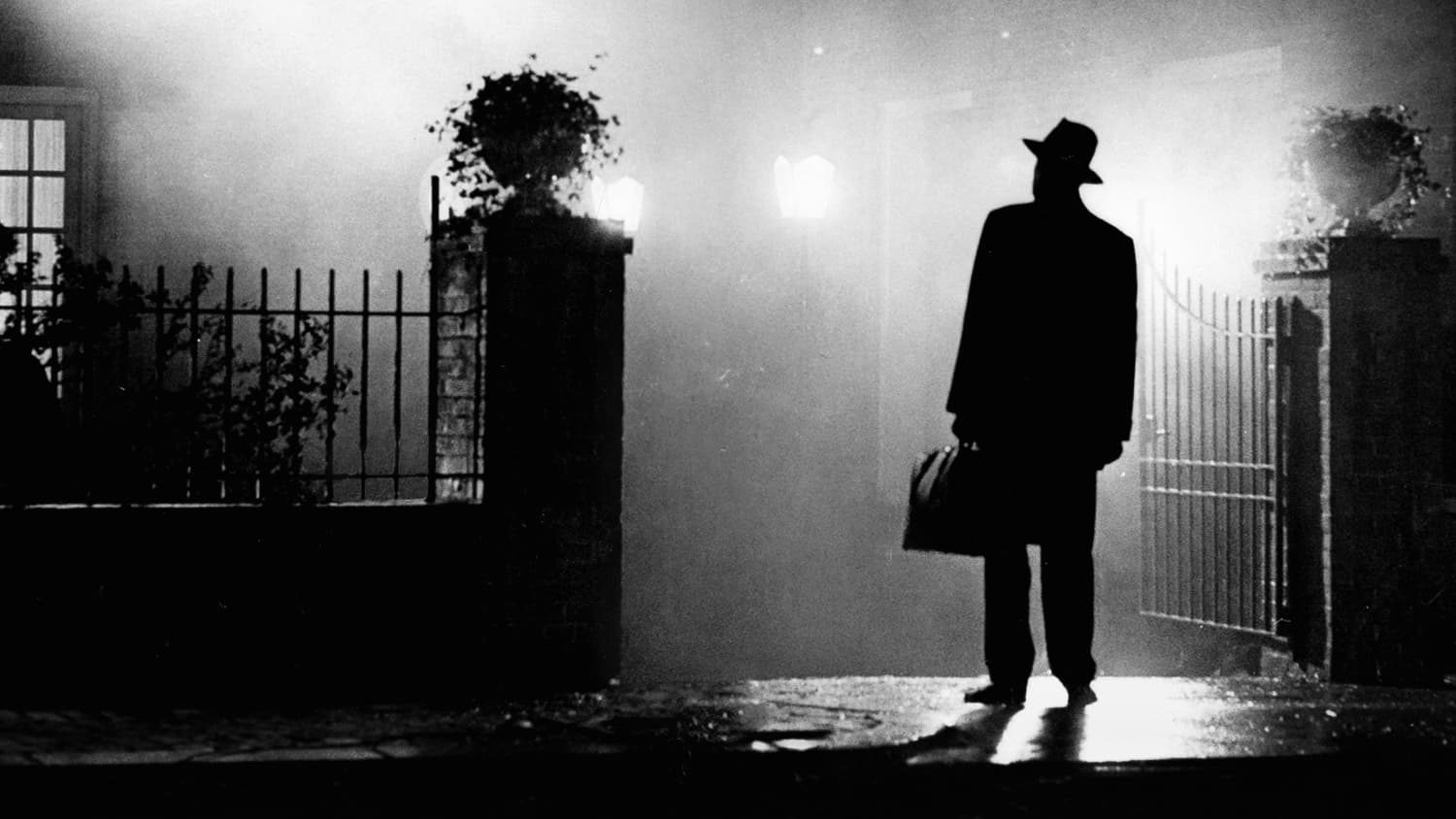
“What are the Church’s greatest needs at the present time? Don’t be surprised at our answer and don’t write it off as simplistic or even superstitious: one of the Church’s greatest needs is to be defended against the evil we call the Devil.”
— Pope Paul VI, Confronting The Devil’s Power (1972)
Pope Paul VI wrote Confronting The Devil’s Power a mere year before the release of the film that brought the Church’s battle with the devil into popular consciousness: The Exorcist. It spawned a level of hysteria, controversy, and fascination rarely seen in cinematic history, with audience members fainting, having epileptic fits, vomiting in aisles, and fleeing picture theaters in terror with one attendee reporting, “I never stood in line for anything before or since; my father and my best friend and I stood in line for 45 minutes in the cold in Chicago waiting to get in to see the movie. . . . There was all this gasping and fainting . . . everybody was shocked.”
The Exorcist has become one of the most critically acclaimed, revered, and influential films in horror history. Yet whilst The Exorcist is a horror classic, it is also a profound exploration into faith and the exclusive power of the Catholic Church to combat the forces of evil. I would like to discuss The Exorcist, the devil, demonic possession, and the Catholicism impressed upon its haunted celluloid.
While popular belief may relegate the devil or Satan to the realm of mythology or fantasy, the Church teaches that he is in fact a real being. The Catechism of the Catholic Church defines the devil in these terms:
Behind the disobedient choice of our first parents lurks a seductive voice, opposed to God, which makes them fall into death out of envy. Scripture and the Church’s tradition see in this being a fallen angel, called Satan or the devil. . . . Satan or the devil and the other demons are fallen angels who have freely refused to serve God and his plan. Their choice against God is definitive. They try to associate man in their revolt against God.
From the earliest days of Christianity, there have been accounts of demonic possession or spiritual attacks inflicted by the devil to harm a person physically or psychologically. Christ himself exorcised demons in the New Testament (see Luke 4:33–35).
The word “exorcism” comes from the ancient Greek exorkismós, meaning “bind by oath.” In the Catholic tradition, an exorcism can only be performed by an ordained priest officially commissioned by Church authorities and performed according to the Rite of Exorcism outlined in De Exorcismis et Supplicationibus Quibusdam (1614, revised in 1999). Ecclesiastical authorities are extremely diligent in distinguishing between mental illness and true demonic possession, and it is essential the victim is subjected to the rigor of extensive scientific and psychological testing before performing an exorcism.
The Exorcist author William Peter Blatty was born in New York City in 1928. He was raised by a devout Catholic mother, attended the Jesuit school Brooklyn Preparatory, and earned a bachelor’s degree at Georgetown University. He started his writing career with comedic novels and screenplays, including Which Way To Mecca, Jack? (1960), Twinkle, Twinkle, “Killer” Kane (1966), and Promise Her Anything (1965), starring Warren Beatty and Leslie Caron. After limited success, Blatty began writing The Exorcist, inspired by a 1949 case of demonic possession and exorcism of an anonymous fourteen-year-old boy called Roland Doe. The events were recorded by attending priest Raymond J. Bishop, who detailed a series of exorcisms at Georgetown University Hospital. It was whilst studying at Georgetown that Blatty heard the story:
In 1949 I was a junior at Georgetown University and in class I heard details of a so-called case of possession and exorcism that was going on somewhere nearby. . . . When I first heard about this case it struck me immediately that if one can credibly demonstrate the existence of evil spirits, there can be angels, and at the very least a spiritual dimension to intelligence.
He recruited his high school teacher Fr. Thomas Bermingham to help write the book, who remarked, “I said to Blatty, I’ll work with you on one condition: that you take it seriously, I don’t want another Rosemary’s Baby, I really want something that will confront the awesome problem of evil in God’s world. So we worked for a year before he wrote the first page of The Exorcist.”
Upon the book’s release in 1971, The Exorcist topped The New York Times Best Seller list for seventeen weeks and sold more than thirteen million copies in the US alone. From the outset, Blatty had desired to make the novel into a film but was cautious about the type of director he wanted, saying, “I thought this needs an honest director, that is not Catholic, that is agnostic on the subject and can give this incredible story a sense of documentary reality.”
“The film sits atop a subgenre of philosophical horror. The dialogue is fueled by inquiry, mimicking Plato’s Socratic dialogues, dialectically volleying back and forth toward truth. ”
After Blatty saw William Friedkin’s The French Connection (1971), he was convinced Friedkin was the man. Friedkin cast Ellen Burstyn as Chris MacNeil, Jason Miller as Fr. Karras, Max von Sydow as Fr. Merrin, and Linda Blair as the possessed Regan, and they began filming in 1972. The filming was fraught with accidents, problems, and deaths, with Friedkin reflecting, “I’m not a convert to the occult, but after all I’ve seen on this film, I definitely believe in demonic possession. . . . We were plagued by strange and sinister things from the beginning.” Real Catholic priests were employed as extras and advisors in the film, including the aforementioned Fr. Thomas Bermingham and Fr. William O’Malley, who according to Friedkin, would periodically bless the set:
I tried to keep the atmosphere very light. I tried to make it so that nobody would really get upset. Inwardly a lot of people were disturbed by the filming, without a doubt, because to watch a child—a 12-year-old girl—go through what she had to go through was very difficult for a lot of people in the cast and on the crew. But they trusted me. I cast two actual Jesuit priests in the film to play priests; and they were also technical advisors. And periodically I would have the set blessed.
The story centers around Regan MacNeil, a twelve-year-old girl living in Georgetown. Regan begins exhibiting disturbing behavior after communicating with an entity called Captain Howdy via a Ouija board. Her mother takes her to doctors and psychologists for neurological explanations for her violent, bizarre, and satanic behavior. However, her condition worsens and Chris turns to the Catholic Church for help. Fr. Damien Karras, a Jesuit and psychologist struggling with his faith, is assigned to investigate. After witnessing Regan’s condition, he concludes she is possessed by a demon. The Church approves an exorcism, assigning Fr. Merrin to perform the ritual with Karras assisting. The exorcism is a terrifying and harrowing experience leading to the deaths of Fr. Merrin and Fr. Karras, who sacrifices himself to save Regan.
Fr. Damien Karras is central to the story of faith. Karras is a man of both faith and science who is having difficulty balancing the two avenues of knowledge in an increasingly secularized world. He battles with the obligations of the priesthood, caring for his sick mother, the reality of supernatural events in the face of scientific skepticism, and despair more broadly, as he confesses to another character, Fr. Tom: “I think I’ve lost my faith, Tom. I think I’ve lost it.” His story arc from spiritual uncertainty to faith and self-sacrifice strikes at the heart of the postconciliar era–Catholic priest’s confrontation with modernity.
Fr. Merrin embodies tradition, unwavering faith, and the mystical authority of the Catholic Church. Merrin is the veteran sacramental warrior who—with stole, holy water, Bible, and ritual—channels Christ’s authority to exorcise the personification of evil itself. Through Merrin’s extensive understanding and experience with the devil, he inspires the younger Karras to an understanding of supernatural phenomena and a deeper consideration for the mystical foundation of Church teaching. In these respects, Merrin represents the preconciliar priest who retains the ancient certainty in the devil and exorcism without the skepticism of secular modernity. Collectively, Karras and Merrin remind contemporary Catholics that it is only through the unification of tradition with progress, faith with reason, religion with science, preconciliar with postconciliar teaching, that we can successfully conquer Satan and evil in this world.
Regan MacNeil represents the innocent soul under siege, a symbol of spiritual vulnerability in a fallen world. She is a child made in the image and likeness of God whose body and soul has become the battleground between divine and diabolical forces. Her mother tries to help her through psychiatry and science but ultimately must turn to the spiritual authority of the Church. Her possession reminds modern audiences there are forces beyond the power of science, medicine, or technology that the Church alone has the means to battle and conquer.
The Catholic priest is depicted as the only combatant with the intellectual and sacramental formation to be the hero in the face of satanic evil. Fr. Merrin is never surprised or truly startled by the dramatic and repulsive behavior of Regan/Pazuzu, the demon. He knows Christ within his heart, and his Church is the repository of truth, goodness, and beauty that no evil can overcome.
In the director’s cut, the film opens with a shot of the MacNeil house, panning down to the street and fading into the profile of the Virgin Mary. The credits fill the screen and we cut to Fr. Merrin at an archaeological site in northern Iraq. The priest unearths an amulet portraying the demon Pazuzu, foreshadowing his encounter with the demon later in the film. The opening scenes are filled with a haunting, paranoid, and chilling mood as we see Fr. Merrin navigate the streets of Hatra, setting the atmospheric tone for the remainder of the film.
One of the key early scenes is when Regan is seen playing with a Ouija board. She tells her mother she’s been speaking to someone called Captain Howdy. Whilst the Ouija board is deceptively marketed as a children’s toy, it is designed as a portal to open you up to communicating with dead people or demonic entities. The Catholic Church is unequivocal about its condemnation: “All forms of divination are to be rejected: recourse to Satan or demons, conjuring up the dead or other practices falsely supposed to ‘unveil’ the future” (CCC 2116). It is suggested that if Regan (and the original 1949 case) were not playing with a Ouija board, the demonic possession would never have happened.
Obviously, the sequences of Regan possessed by the devil/Pazuzu are the most well known: levitation, backward spider-walking, head spinning, and blasphemy. These scenes are repulsive but necessary in portraying the extent of the depravity and horror of the devil and demonic possession. They shock the audience out of any apathy or complacency, forcing the viewer to be repulsed by the devil rather than softened and seduced by his malevolent power. The film still holds resonance today because it retains the intensity to cut through hardened moviegoers’ conditioning to violence and sin. If the scenes of demonic possession were in any way watered down, the enduring power of the film for cross-generational impact would be greatly diminished.
William Peter Blatty went on to direct The Exorcist III and lived his life as a committed Catholic with his wife. She later remarked about her husband:
He was gobsmacked by the reaction. He said many times he never set out to scare anybody. It wasn’t his intention to write a scary book or a scary movie. He was writing what he said was a metaphysical mystery story, so for him it was more the faith aspect of the film. . . . It’s a very Catholic film, and that was really more what his emphasis was, so he was surprised that people thought it was so scary.
The Exorcist holds a singular place in popular consciousness. It has influenced countless cinematic remakes, spawned several sequels, inspired TV dramas like Evil, and found its way into pop culture references like in The Simpsons. At the time, distinguished film critic Pauline Kael described The Exorcist as “the biggest recruiting poster the Catholic Church has had since the sunnier days of Going My Way and The Bells of St Mary’s.”
We must rely on the authority and truth of the Catholic Church, since it is only through her sacramental formation that we can be delivered from evil.
The Church community’s response was mixed, with some denouncing The Exorcist and others praising it as “faith affirming.” The American bishops’ Office for Film and Broadcasting rated the film A-IV—suitable for adults, with reservations—in its Catholic Film Newsletter. It gave the film a broadly negative review, faulting it for suggesting exorcisms were common and possibly encouraging belief in the occult and satanism. However, retrospectively, Vatican exorcist Fr. Gabriele Amorth in his book An Exorcist Tells His Story called The Exorcist his “favourite film”:
The director stated that he wanted to tell the facts of an episode that had actually happened in 1949. The movie did not draw any conclusions concerning diabolic possession. According to the director, this was a question for theologians. When the Jesuit priest was asked if The Exorcist was just one of many horror movies or something altogether different, he maintained that it was the latter. He cited the great impact the movie made on audiences throughout the world as a demonstration that—save some special effects—that film had dealt with the problem of evil, reawakening an interest in exorcisms that had been all but forgotten.
Gavin F. Hurley, the author of Catholic Horror and Rhetorical Dialectics, wrote in an article for America:
The Exorcist is a compelling illustration of spiritual warfare. It depicts Catholicism as a compass for truth, directing believers into God’s armory, equipping them with spiritual weapons to combat arguments rather than inflict physical harm. The film sits atop a subgenre of philosophical horror. The dialogue is fueled by inquiry, mimicking Plato’s Socratic dialogues, dialectically volleying back and forth toward truth.
Whether you see the artistic and theological merits of The Exorcist or not, it is undoubtedly an intense and influential cinematic portrayal of the horrors of demonic possession and the diabolical power of the devil. The film rightly warns us from dabbling in the occult and reminds us of the existence of the devil and to be vigilant in our protection of the most vulnerable members of our community.
I have always had reverence for The Exorcist and the influence it has exerted over the culture. If nothing else, it is a conversation starter with atheists and agnostics. I’ve had many discussions with non-Catholics about The Exorcist over the years and about the existence of the devil and demonic possession, the mystical power of the Church, and the validity of exorcism—often concluding that occultism is spiritually dangerous and there are mysteries beyond the realm of scientific or psychological explanation. I always suggest, as The Exorcist shows us, that we must rely on the authority and truth of the Catholic Church, since it is only through her sacramental formation that we can be delivered from evil.