
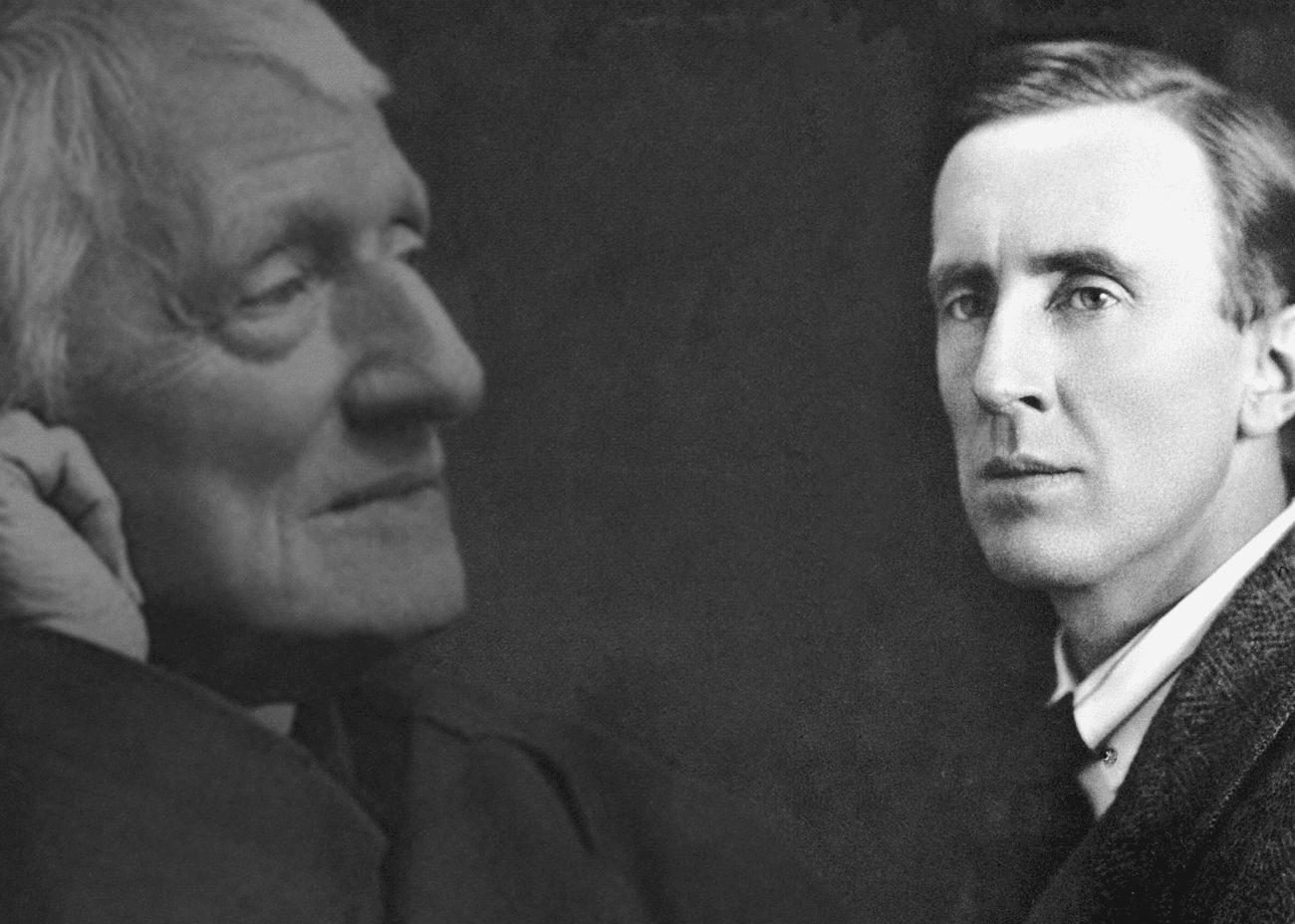
On November 1, 2025, John Henry Newman was formally recognized by the Catholic Church as the thirty-eighth Doctor of the Church, in recognition of the significance and lasting value of his theological writing and teaching. He will be only the second English Doctor, the first being St. Bede from the eighth century. Newman was a gifted theologian and preacher, but also a poet and novelist, and is a major figure in both English Catholicism and English letters. As such, he invites comparison with a fellow English Catholic and man of letters: J. R. R. Tolkien, the author of The Hobbit and The Lord of the Rings. Both men have a significant presence and growing importance in our own day, and in both cases their influence extends far beyond their coreligionists.
The lives of these two men were separated by just two years, as Newman died in 1890 and Tolkien was born in 1892, but they might at first seem to be part of very different worlds. Newman was a man of the nineteenth century and the reign of Queen Victoria; Tolkien, of the twentieth century and the era of two world wars. Newman was famous (or infamous) in his own day for being one of the most prominent figures in the Church of England’s Oxford Movement, only to shock his contemporaries by his conversion to Catholicism; Tolkien was a serious, lifelong Catholic, but his faith, though an essential part of his life and creative imagination, was expressed implicitly rather than explicitly in his fiction. However, when I was researching Tolkien’s Faith: A Spiritual Biography, I discovered that there are many Newmanian connections woven through Tolkien’s entire life.
Newman’s influence can be traced back to Tolkien’s formative years. Tolkien was born in Bloemfontein, South Africa, to devout Anglican parents and baptized in the Church of England. When he was just four years old, his father died, and his mother, Mabel, embarked on life back in Birmingham, England, with her sons, Tolkien and his little brother, Hilary. Mabel became increasingly drawn to Catholicism, and in 1900, when Tolkien was eight years old, she was received into the Catholic Church at St. Anne’s, Alcester Street—a church that John Henry Newman had founded after his ordination and his return from Rome as a Catholic, and where he had first preached as a Catholic. Looking for a parish church that would be supportive of her as a convert, widow, and mother, she settled on the Birmingham Oratory, which was again founded by none other than Newman in 1852; he served as its superior until his death.
Other Newmanian threads appear throughout Tolkien’s life.
At the Birmingham Oratory, the Tolkien family met Fr. Francis Xavier Morgan, who soon became a good friend of the family. Sadly, Mabel died in 1904, when Tolkien was just twelve years old, entrusting her boys to the care of Fr. Francis as their legal guardian, whom Tolkien would later call his “second father.” Tolkien recalled growing up as “virtually a junior inmate of the Oratory house, which contained many learned fathers.”1 Many of them had worked with and been personally taught by Newman, including Fr. Francis, who also served as Newman’s final personal secretary, handling correspondence and financial matters. Life at Newman’s Oratory had a far-reaching effect on Tolkien’s formation. Even though these were difficult years for the orphaned Tolkien, he had a wholly positive experience at the Oratory and late in his life recalled that at the Birmingham Oratory, he “had the advantage . . . of a ‘good Catholic home’—‘in excelsis’ [in the highest].”2
Other Newmanian threads appear throughout Tolkien’s life. For instance, we find an allusion to Newman’s motto Ex umbris et imaginibus in veritatem (From shadows and images into truth), in Tolkien’s work-diary as a student at Oxford. Tolkien’s third son, Christopher, born in 1924, had as his godmother Eleanor Mozley, the great-niece of John Henry Newman; her grandmother was Jemima Newman—John Henry’s sister. When Tolkien returned to Oxford as a professor, he was involved with the Newman Society and, in the 1940s, became involved with the national Newman Association, for which he served as an honorary vice president.
This brief overview of the Newmanian threads woven through Tolkien’s formation and adult life provides the background for a consideration of an aspect of Tolkien’s mature thought that I believe is significantly influenced by Newman’s Essay on the Development of Christian Doctrine.3 A positive view of the “development of doctrine” is not an idea usually associated with Tolkien, but he had a much more nuanced reaction to Vatican II and even to the changes in the liturgy than has usually been recognized to date. Indeed, I had to revise my own ideas on this topic when I did the research for Tolkien’s Faith.
The most visible change in Catholic practice that came from the Second Vatican Council, convened in 1962, was the revision of the liturgy of the Mass, which unfolded in stages over a number of years; first the existing liturgy was translated into English, and then, later, the Novus Ordo (the new order of the Mass) was introduced. Tolkien grieved the loss of Latin, which he loved, and its replacement with a clumsy English translation, and he was unenthused by the Novus Ordo, but he came to terms with the changes. In later years, he even served as a lector (in English) at Mass.
In this regard, it is worth noting that he did not sign the 1971 “Petition to Pope Paul VI by Distinguished Writers, Scholars, Artists, and Historians Living in England to Spare the Traditional Latin Mass” (commonly known as the “Agatha Christie indult”), though several of his friends from the Inklings did, and despite the fact that as one of the most prominent literary Catholics in England, his support would surely have been valued. We do not have the details in this regard, but a previously unpublished letter from 1967 that appears in the revised and expanded edition of Tolkien’s Letters gives a clear indication of his overall views: “For all of us ‘conservatives’ I think the trouble in our Church is at present more trying than all our personal and physical woes. But it has to be endured. Only loyalty and silence (in public) will provide the ballast for the rocking bark! As the disciples said to Our Lord: we have nowhere else to go.”4
As an avid reader of newspapers, Tolkien followed the Second Vatican Council closely. In a 1967 letter, he identified one element of the council as a debate between the principles of aggiornamento and primitivism and cautioned that “aggiornamento: bringing up to date . . . has its own grave dangers, as has been apparent throughout history.” Aggiornamento soon became a buzzword, adopted as a general umbrella term for numerous sweeping changes and modernizing moves. However, Tolkien was also skeptical about primitivism (efforts to return to the forms practiced by the earliest Christians or the basic elements deduced from Scripture), declaring that although it has good motives, it is both “mistaken” and unattainable. For one thing, he says, “‘primitiveness’ is no guarantee of value”—pointing out that “grave abuses” in liturgical behavior were present from the beginning of the Church, as evidenced by St. Paul’s letters to the Corinthians.5
“As the disciples said to Our Lord: we have nowhere else to go.”
Tolkien’s deliberations here issue in a profound meditation on the organic nature of the Church, which, he says,
was not intended by Our Lord to . . . remain in perpetual childhood; but to be a living organism (likened to a plant), which develops and changes in externals by the interaction of its bequeathed divine life and history. . . . There is no resemblance between the ‘mustard-seed’ and the full-grown tree. 6
Tolkien loved trees, so it is not surprising that he chose this image, and the mustard tree is an allusion to one of Jesus’s parables: “The kingdom of heaven is like a grain of mustard seed which a man took and sowed in his field; it is the smallest of all seeds, but when it has grown it is the greatest of shrubs and becomes a tree, so that the birds of the air come and make nests in its branches” (Matthew 13:31–32).
It’s also the same image that Newman used in The Development of Doctrine: “In one of our Lord’s parables ‘the Kingdom of Heaven’ is even compared to ‘a grain of mustard-seed.’. . . Here an internal element of life, whether principle or doctrine, is spoken of rather than any mere external manifestation; and it is observable that the spontaneous, as well as the gradual, character of the growth is intimated.”7
Tolkien’s view of the Church as a living organism that must be approached with care and respect for its intrinsic nature reflects the conclusion that Newman reached and is worth considering in more detail. Newman’s challenge to primitivism is vividly expressed in this passage:
It is indeed sometimes said that the stream is clearest near the spring. Whatever use may fairly be made of this image, it does not apply to the history of a philosophy or belief. . . . Its beginnings are no measure of its capabilities, nor of its scope. At first no one knows what it is, or what it is worth. It remains perhaps for a time quiescent; it tries, as it were, its limbs, and proves the ground under it, and feels its way. From time to time it makes essays which fail, and are in consequence abandoned. It seems in suspense which way to go; it wavers, and at length strikes out in one definite direction. In time it enters upon strange territory; points of controversy alter their bearing; parties rise and fall around it; dangers and hopes appear in new relations; and old principles reappear under new forms.
It changes with them in order to remain the same. In a higher world it is otherwise, but here below to live is to change, and to be perfect is to have changed often.8
Tolkien makes exactly this argument as he expands his own arboreal analogy:
There is no resemblance between the ‘mustard-seed’ and the full-grown tree. For those living in the days of its branching growth the Tree is the thing, for the history of a living thing is part of its life, and the history of a divine thing is sacred. The wise may know that it began with a seed, but it is vain to try and dig it up, for it no longer exists, and the virtue and powers that it had now reside in the Tree.9
He is not arguing for uncritical acceptance of every aspect of modern life and liturgical practice of the Church. Rather, in line with Newman, who distinguished between development and corruption, Tolkien says that “the authorities, the keepers of the Tree, must look after it, according to such wisdom as they possess, prune it, remove cankers, rid it of parasites, and so forth.”10 If those who seek the health of the Tree fixate on the idea that they can return it to its condition as a seedling, then Tolkien says that they will in fact do great harm, for a mature living creature cannot be made immature once again. As a “living organism,” the Church changes in order to remain essentially unchanged.
Tolkien found many of the changes to Church practices in the 1960s very painful indeed. But like John Henry Newman, he viewed change (however uncomfortable) as inevitable, something that must be faced and accepted. Tolkien himself declared, “I am not a reformer nor an ‘embalmer’! I am not a ‘reformer’ (by exercise of power) since it seems doomed to Sarumanism. But ‘embalming’ has its own punishments.” What these “punishments” are can be seen in his explanation of the fault of the Elves. He explained:
the Elves are not wholly good or in the right. Not so much because they had flirted with Sauron; as because with or without his assistance they were ‘embalmers’. They wanted to have their cake and eat it: to live in the mortal historical Middle-earth because they had become fond of it . . . and so tried to stop its change and history, stop its growth, keep it as a pleasaunce, even largely a desert, where they could be ‘artists’—and they were overburdened with sadness and nostalgic regret.11
As a “living organism,” the Church changes in order to remain essentially unchanged.
As Newman put it in the closing words of The Development of Doctrine: “Wrap not yourself round in the associations of years past, nor determine that to be truth which you wish to be so, nor make an idol of cherished anticipations.”12 Or as Tolkien remarked to his son: “‘Back to normal’—political and Christian predicaments—as a Catholic professor once said to me, when I bemoaned the collapse of all my world that began just after I achieved 21.”13 Political and religious turmoil was the rule, not the exception, in history. Absolute fixity was not a feature of this world for, as the Letter to the Hebrews has it, “Here we have no lasting city, but we seek the city which is to come.”
Tolkien died on September 2, 1973. That fall, Merton College held a memorial service in the college chapel. Appropriately, given Tolkien’s lifelong witness to friendship in charity with Christians outside the communion of the Catholic Church, this Anglican service was an ecumenical occasion. The closing hymn was one of John Henry Newman’s: “Praise to the Holiest in the Height”—particularly fitting for Tolkien, whose spirituality had been so deeply formed by the English Oratory that Newman founded and whose life and work can be seen as very much part of Newman’s intellectual and spiritual lineage.
***
This article is adapted from material in Tolkien’s Faith: A Spiritual Biography (Word on Fire Academic, 2023).
1. J. R. R. Tolkien, Letter 306. The Letters of J.R.R. Tolkien: Revised and Expanded Edition, ed. Humphrey Carpenter (William Morrow, 2023).
2. Tolkien, letter 306.
3. I have not yet found decisive evidence that Tolkien read The Development of Doctrine (as it is commonly known), but given his formation at the Oratory and later involvement with the Newman Society and Newman Association, I find it impossible to believe that he was unfamiliar with it.
4. Tolkien, letter 294a.
5. Tolkien, letter 306.
6. Tolkien, letter 306.
7. Newman, An Essay on the Development of Christian Doctrine (Longmans, Green, 1909), 73. Available at https://newmanreader.org/.
8. Newman, The Development of Doctrine, 40.
9. Tolkien, letter 306.
10. Tolkien, letter 306.
11. Tolkien, letter 154.
12. Newman, The Development of Doctrine, 445.
13. Tolkien, letter 306.