
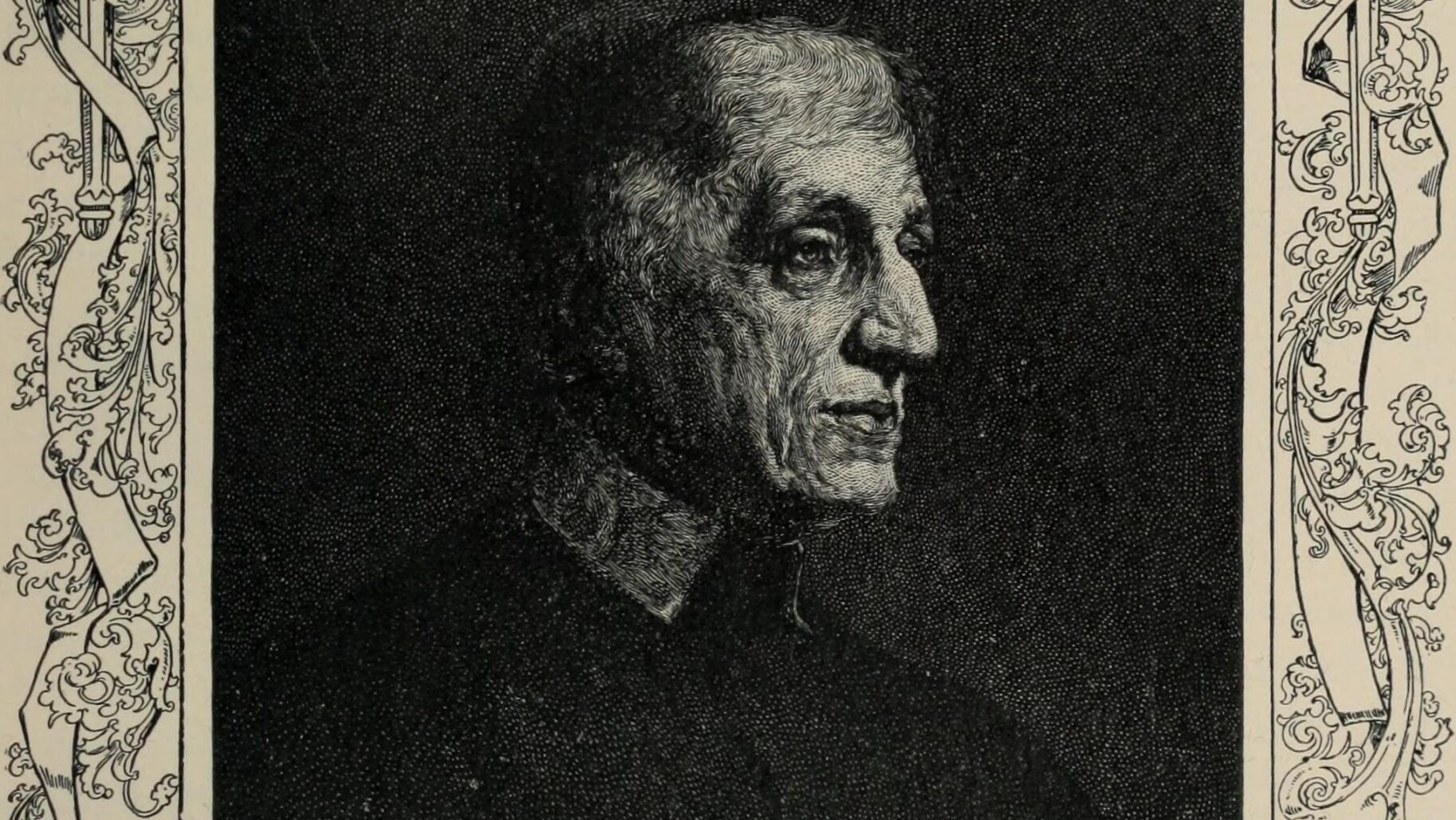
One hundred eighty years after his reception into the Catholic Church, England’s most famous convert is to be received by all Catholics around the world as the thirty-eighth Doctor of the Church. St. John Henry Newman, beatified by Benedict XVI, canonized by Francis, is now given this new honor by Pope Leo XIV; with it, Newman is offered as a universal guide for the ages. Newman is being offered to us for this moment as well. His age, like our own, was one fraught with technological and intellectual convulsions, and his wisdom has much to teach us today about how to live a vibrant Catholic life in the midst of challenging times.
Newman was born in 1801 into a largely agrarian world in which no one had ever travelled faster than a galloping horse. By the end of the century, when he died in 1890, steam and steel had shrunk the map. At the beginning of his life, a journey from London to Birmingham took more than two days by carriage; by the end of his life, that same journey took just two hours by train. Telegraphs, telephones, and electric light seemed to compress time and space.
The convulsions of the nineteenth century were not just industrial, they were also intellectual. In the decades after Newman’s conversion, Marx published The Communist Manifesto (1848), Darwin released On the Origin of Species (1859), and by the time of Newman’s death, Freud was beginning to map a purely psychological account of the inner life. Reason, revelation, and imagination were all being renegotiated.
Newman observed that Christianity was retreating from the public to the private.
What was the impact of all this on nineteenth-century Christianity? Newman observed that Christianity was retreating from the public to the private. In his “Biglietto Speech” of 1879, delivered the night before he became a cardinal, he said that the principal cause of his life, to which he had devoted “thirty, forty, fifty years,” was resisting what he called “the spirit of liberalism in religion . . . the doctrine that there is no positive truth in religion, but that one creed is as good as another.”
Newman argued that religion in his time was being reduced to “mere sentiment and taste,” a matter of “each man having a right to make it say just what strikes his fancy.” Newman warned that these trends indicated the impending de-Christianization of English society. “Hitherto,” he said, “The civil power has been Christian. . . . Now everywhere that goodly framework of society, which is the creation of Christianity, is throwing off Christianity.” His concern was not for preserving Christian dominance but on its impact on people’s souls and for the very possibility of a shared moral language and life. If religion were reduced to “a private luxury,” tolerated so long as it kept to itself and did not “obtrude upon others,” the moral grammar of the West, he warned, would collapse.
Many, of course, did not fear the loss of the central role of religion in public life but in fact welcomed it as progress. The memory of Europe’s wars of religion loomed large for post-Enlightenment thinkers who were eager to offer an alternative vision of civic life that did not depend on religion. If religion bred conflict, the cure seemed obvious: secularization. The modern state should build its foundations on reason, science, and universal ethics, not on revelation or creed. A secular pluralism for more peaceful societies, or so the thinking went (and in many places still goes).
In his article “The Metaphysics of Democracy,” Fr. Thomas Joseph White, OP, describes this peace promised by a secular pluralism as depending on what he called an “ecumenism of theoretical minimalism”: a civic arrangement that keeps the peace by asking people to mute their religious convictions. Fr. White argues this bargain, “the suppression of faith,” has left us metaphysically malnourished:
Paradoxically, this process frustrates the spiritual desires of many modern secular people, who are unsatisfied with thin consumerism and wish to participate in something greater than themselves. Their mounting rejection of the liberal project has precipitated a crisis, one felt most acutely in the political realm. It has taken the form of a resurgent nationalism, an inchoate response to the suppression of faith that is inadequate and perhaps dangerous.
In our modern culture, the spirit of liberalism in religion Newman fought has not vanished; it has mutated. One way of summarizing this mutation is that we have gone from the spirit of liberalism in religion to liberalism of religion.
Having lived under the spirit of the liberalism of religion for many decades, a few things seem clear. First, the collapse of a shared moral grammar that Newman feared seems more and more evident. The West seems less marked by pluralistic peace than a fragmented marketplace of sovereign individuals and a public discourse often reduced to postures of silence or violence. Second, it seems clear that the spirit of liberalism of religion has been successful at making Christianity impotent both to society and to the believer.
A religion that asks little, risks nothing, and transforms no one.
Privatized Christianity is a Christianity robbed of its ability to affirm and elevate the quest for meaning and truth and to offer its genius in correcting and channeling the passions and conflicts that inevitably arise in this shared quest. Likewise, privatized Christianity conditions the believer toward a domesticated, middle-class religion. A religion that asks little, risks nothing, and transforms no one.
Even amid signs of a “quiet revival” in England and across the West, dreaming of a wholesale re-Christianization of culture would be woefully premature. The task instead, under Newman’s tutelage, is to rediscover the authentic power of Catholicism in order to carry on Newman’s fight in our own day against the spirit of liberalism of religion. To do this, I believe lay Catholics need to develop what I call the “Newman Touch.”
“The Newman Touch” is a phrase inspired by listening to a recent The Rest Is History podcast series about a figure who would have loomed large in the imagination of Newman and many in England in the nineteenth century—namely, Admiral Lord Horatio Nelson. Before his victory at the Battle of Trafalgar in 1805 (just four years after Newman’s birth), Nelson explained to his officers his approach to naval battle, what he called the “Nelson Touch.”
Before Nelson, naval battles were fought at a distance, a formal, almost balletic exchange of shots that mostly missed. Nelson’s method was the opposite: Get close, break the line, lead from the front. It was extraordinarily risky but relied on sailors so well formed that when chaos came, they could act with freedom and precision. I am not offering Nelson as a moral exemplar—he was far from that—but the Nelson Touch is a useful analogy to encapsulate Newman’s approach. Newman, like Nelson, was courageous but never sought conflict for its own sake; yet when the moment demanded it, he entered the fray in close quarters. Both men believed courage, character, and formation were key.

The Newman Touch is personal and purposeful. Newman’s episcopal motto Cor ad cor loquitur (Heart speaks to heart) bears witness to the deeply relational mode of engagement Newman modeled and advocated. At the same time, Newman wanted lay men and women to be the protagonists of the battle against the spirit of liberalism in religion. Amid anti-Catholic hostility after the restoration of the hierarchy of England and Wales, he urged the laity to “make the excuse of this persecution for getting up a great organisation . . . going round the towns giving lectures or making speeches.”
In his Oxford sermon “Personal Influence: The Means of Propagating the Truth,” Newman insisted that the faith “has been upheld in the world not as a system, not by books, not by argument, nor by temporal power, but by the personal influence of those who are at once teachers and patterns of it.” Personal influence, for Newman, was not mere pleasantness. It was firm, luminous, effectual, “the moral power which a single individual has, trained to practise what he teaches.”
In addition to the role of personal influence in the battle for truth, we also need to include what Newman considered the “best weapon” in the fight against liberalism in religion after “a good life”: “a sound, accurate, complete knowledge of Catholic theology.” Hence his famous desire: “I want a laity, not arrogant, not rash in speech, not disputatious, but who know their religion, who enter into it, who know just where they stand, who know what they hold and what they do not. . . . I want an intelligent, well-instructed laity.”
Therefore, the Newman Touch is about the laity growing in personal influence and formation. It is an inoculation for believers against the spirit of liberalism of religion. Unlike an ecumenism of theoretical minimalism, the Newman Touch is not a recipe for peace but perhaps better described as the medicine we need, not that we necessarily want.
Newman’s vision for the laity once got him labeled “the most dangerous man in England” (the title of a recent publication by Word on Fire on Newman and the laity). There is danger in living a more evangelically confident Catholicism—the danger of being labeled an extremist, of suffering rejection. Newman knew the pain of mischaracterization and rejection all too well. But to avoid the danger is to risk not just the retreat of Christianity from the public to the private (as was the case in Newman’s time) but from the private to the invisible.
The Church does not need the world’s approval; the world needs the Church’s radiance, which comes from Christ.
So what might the Newman Touch look like?
First, evangelical confidence, not in ourselves but in the power of the Gospel. The Church does not need the world’s approval; the world needs the Church’s radiance, which comes from Christ. It’s a full-bodied Catholicism of sacraments, saints, feasts, fasting, and doctrines that are seen not as luxuries to be kept in our private collection but priceless treasures to be shared.
Second, it is not private but deeply personal. Friendship is the ordinary forum of evangelization. Newman shows that evangelization thrives in a context of friendship that is sustained, close quarters, embodied, patient. So let our parishes, our homes, and communities, both online and in person, be marked as places where hearts speak to hearts and minds sharpen minds.
Third, definite purpose and definite service. Newman said that the Christian life “should ever be aiming at definite things in religion; he should have a view and an object; he should know what he is about.” Growth in holiness, for him, was not a program or a technique but a way of living. One can see something of this definite, practical vision of Catholicism expressed in his reflection called “A Short Road to Perfection”:
If you ask me what you are to do in order to be perfect, I say: first—do not lie in bed beyond the due time of rising; give your first thoughts to God; make a good visit to the Blessed Sacrament; say the Angelus devoutly; eat and drink to God’s glory; say the Rosary well; be recollected; keep out bad thoughts; make your evening meditation well; examine yourself daily; go to bed in good time; and you are already perfect.
The Newman Touch is not a complicated or clever approach to evangelizing the culture but offers clarity in what it means to live the Christian life in a powerful way. Finally, evoking Newman’s own prayer that “God has created me to do Him some definite service,” we are reminded that our task is not self-chosen but God-given. We must ask for the grace to know what is asked of us and the courage to do it.