
As much as the Catholic Church is known for the creation of stunning beauty in art, music, and architecture, it is also known for Catholic kitsch. Visit any shrine gift shop anywhere in the world and you will be overwhelmed by masses of plastic figures with odd faces, Catholic trinkets, and tacky holy pictures, all accompanied by sappy religious music playing in the background.
Christmas has long been a season that especially lends itself to being cutely overdone with Catholic kitsch, at least until giant blow-up Grinches and Frosty the Snowmen beat out plastic Holy Families for space on people’s front lawns. At homes near our parish, the Grinch and Frosty are now competing for space with more demonic creatures. You might have noticed this too. Some people are keeping their giant Halloween skeletons and other ghoulish figures in their yards long after that holiday has passed, dressing their bony forms up for Christmas with Santa hats to mark the holy season. Visions of death have intruded into what has always been a celebration of life, with the tender baby Jesus in the foreground resting in his crib. I never thought I would long for the return of kitschy manger scenes, but now I do.
But Christmas is over and the manger scenes and Grinches are all gone (though not the skeletons near our parish church). Before 1969, the Christmas season was longer than it is now. It ended today, February 2, with the Feast of the Purification of Mary. Since 1969, the Christmas season has officially ended on the Feast of the Baptism of the Lord, the first Sunday after the Epiphany, which was celebrated about three weeks ago.
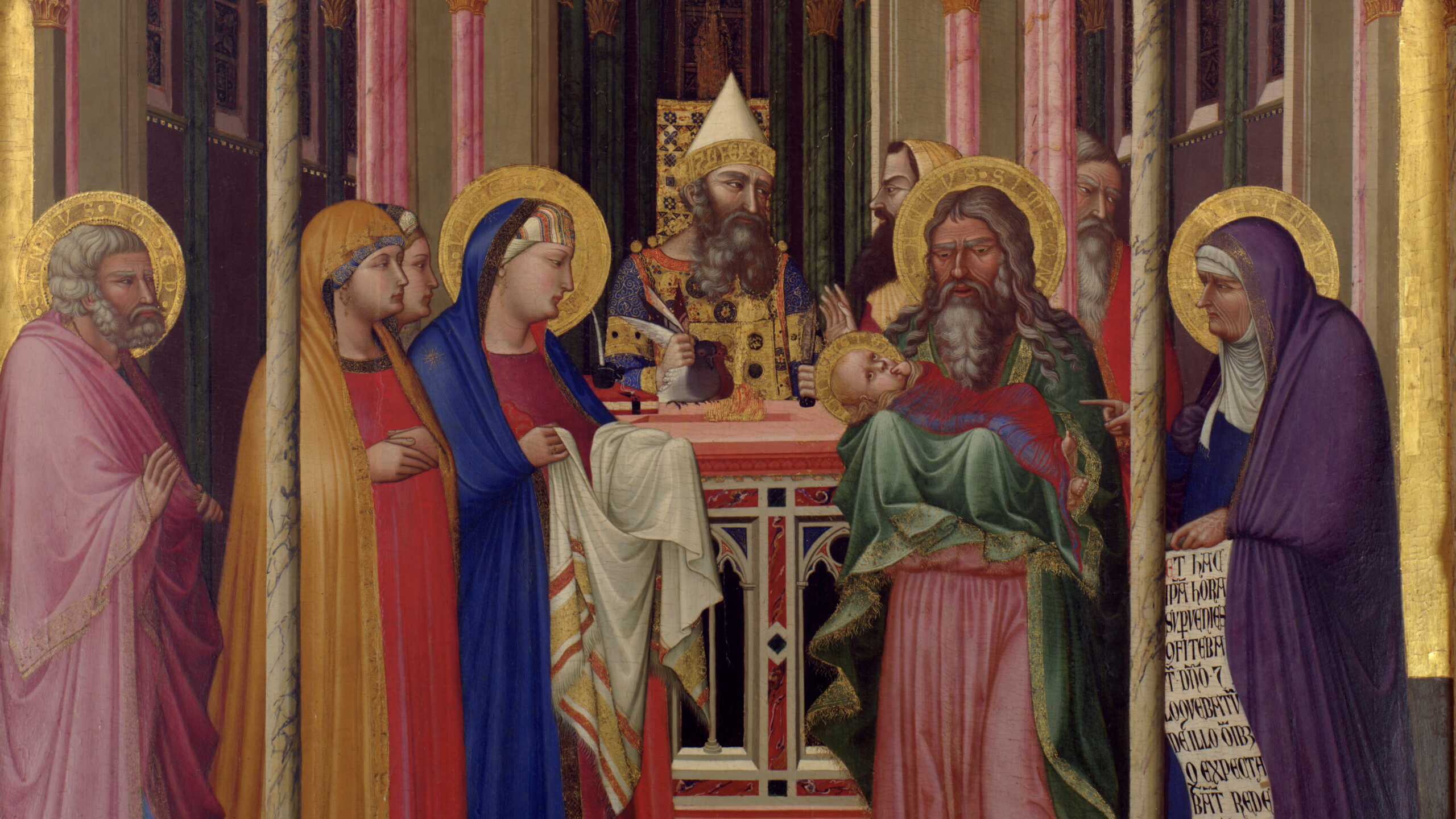
Today we have the privilege of celebrating the beautiful Feast of the Presentation and recall the day Mary and Joseph took Jesus to Jerusalem to present him in the temple and offer their humble sacrifice for Mary’s purification. The Gospel today provides the scene for us once again, and the words of the aged Simeon who recognized the baby Jesus as the Lord are still proclaimed nightly in the beautiful canticle we pray at Compline, the Nunc Dimittis.
This feast is bittersweet. Scripture provides a sobering counterpoint: On the one hand, there is the joy of Jesus’s birth and his first entry into the temple. On the other, there are Simeon’s prophetic words that Jesus will become a “sign of contradiction” and a source of division in Israel—and that his young mother will share in his passion, a sword piercing her heart. Can you imagine how our Blessed Mother must have heard those words? Of course, she knew the prophecies, but she was probably still rapt in wonder just forty days after giving birth to the incarnate Lord.
The consequences of the coming of the Messiah defy the cuteness of our manger scenes.
Meditating in front of the manger on the birth of our Savior is always a beautiful and tender thing, but Fr. Gabriel of St. Mary Magdalen placed Jesus’s birth in context in his classic work, Divine Intimacy. He wrote, “The bloody vision of the Cross is . . . mingled unexpectedly with the charming scene of the Nativity, reminding us that the tender Babe of Bethlehem is the divine Lamb who will one day be immolated for the salvation of the world.” The feasts of the martyrs we celebrated during the octave of Christmas already proved Simeon’s prophecy to be true. Mary was given little time to rest with the baby Jesus in her arms before the sword Simeon mentioned struck. The consequences of the coming of the Messiah defy the cuteness of our manger scenes.
Already on the second day of Christmas, the soft straw of the manger is replaced with brutal stones battering the body of the young Church’s first martyr. December 26 is the Feast of St. Stephen, and we read from the Acts of the Apostles about his stoning. Like Jesus had done, he was “working great wonders and signs among the people,” but also like Jesus, the people he was preaching to “could not withstand the wisdom and the spirit with which he spoke,” so they killed him. Stephen is the protomartyr, the first of thousands upon thousands. Think of all those now in Nigeria, and other places too, who are still being killed for their faith. Jesus is indeed a “sign of contradiction,” and those who can’t bear his teaching still rail against him—not only with words but with swords, bullets, and machetes.
Two days later on December 28, the scene becomes even more blood-soaked and horrific. It is the day we remember all the babies who died when the wicked King Herod, hearing rumors of the birth of a new rival king in Israel, ordered that all boys two years old and under in the region around Bethlehem be killed. There has been a lot of speculation about how many babies were actually killed in the massacre, but population estimates put the likely number of male children there at that time at maybe no more than twenty-five. These holy souls, though, were the precursors of the millions of infants massacred by those who engage in the act that by nature generates children and then claim sovereign dominion over the life they have engendered in the womb and order him or her killed. Estimates of the number of elective abortions in the US in 2014 alone totaled 1.14 million. The Blessed Mother’s heart must still be pierced with every abortion of an innocent child.
There is yet one more celebration of a martyr before the octave ends, and that is the martyrdom of St. Thomas Becket, who was murdered while celebrating Vespers in Canterbury Cathedral in 1170. He was killed by Henry II’s henchmen because he chose to remain faithful to Jesus and opposed the king’s attempts to claim royal authority over legal matters that properly belonged to the Church. The spirit of Becket remains strong in those who are called to resist governmental intrusion into the practice of religion: people like Mark Houck, arrested early one morning in 2022 when the FBI raided his home in Pennsylvania with guns drawn and charged him with violating the Freedom of Access to Clinic Entrances (FACE) Act, and seventy-four-year-old Rose Docherty, arrested in Scotland for holding a sign outside a Glasgow hospital and offering to talk with anyone considering abortion.
So many still pay a heavy price for their faithfulness to the holy child in the manger. There is no cuteness, no kitsch here. Somehow, cutesy kitsch seems to do an injustice to the reality of the Savior’s birth. Meditating on the Holy Family’s poverty in the stall in Bethlehem and in their poor offering in the temple gives us context for living with a detachment from comforts in order to serve Jesus in whatever way he might call us. After a lifetime of faithfulness and waiting in the temple for the promised one, Simeon and Anna were able to recognize the “light of revelation” to the Gentiles and the glory of Israel as he was carried in his mother’s arms. The beautiful, tender moment of Christ’s birth must be seen in the context of Simeon’s prophecy and the pierced heart of our mother Mary.
Catholic kitsch is soft and squishy. The birth of Jesus was not. Kitsch masks the hard reality of our call to fearlessly live the Christian life—to be, like Jesus, a sign of contradiction in a culture that celebrates death and scorns the protection of innocent life.
But there is one more feast celebrated during the octave, and it’s not the feast of a martyr. It’s the feast of the beloved apostle, St. John. St. Jerome tells an interesting story about him that is recalled on this day. He explains that when St. John was a feeble old man living in Ephesus as the bishop, he had to be carried to the church: “Not able to exhort the congregation at length, he was used simply to say at each meeting, My little children, love one another.” When asked why on every occasion he said the same thing, St. John replied, “It is the commandment of the Lord, and if this only be done, it is enough.”
St. John, the only apostle not to suffer a martyr’s death and the one entrusted by Jesus to care for his mother, reminds us that we are called to love and serve others in the imitation of the Christ child who, when he grew into his manhood, became a sign of contradiction, challenging the hypocrisy, pride, and hatred that surrounded him. If we can come to love like that, it is enough.
Simeon prophesied the consequences of challenging the status quo, and the martyrs followed Jesus to their deaths. There is no kitschy, cute manger scene that can capture the profound depth of Love resting in the hay, because he was not born to remain there but to die on the wood of the cross. Simeon proclaimed what he would become, and lest we forget it as we take in our cute manger scenes, the Church will remind us the very next day of the consequences of divine love.