
Who Are We and Where Shall We Go?
Every so often, Supreme Court justices find themselves away from the domesticated halls of Washington, DC’s neoclassical Temple of Justice and meander out to give speeches and interviews in the wild. In some cases, these forays are delightful engagements, as when Justice Amy Coney Barrett visited the University of Notre Dame to discuss her book Listening to the Law: Reflections on the Court and Constitution. In other outings, they are humorous affairs, such as Justice Antonin Scalia’s puckish speech offered at his granddaughter’s high school graduation. And still others generate inadvertent fireworks, as when Justice Sonia Sotomayor recently spilled criticism of Justice Brett Kavanaugh while speaking at the University of Kansas School of Law. Whether it is Justice Gorsuch celebrating The Fund for American Studies, Justice Kagan opining at Princeton University, or Justice Roberts chatting at Rice University’s Baker Institute, when The Supremes hit the road, it is always a show worth watching.
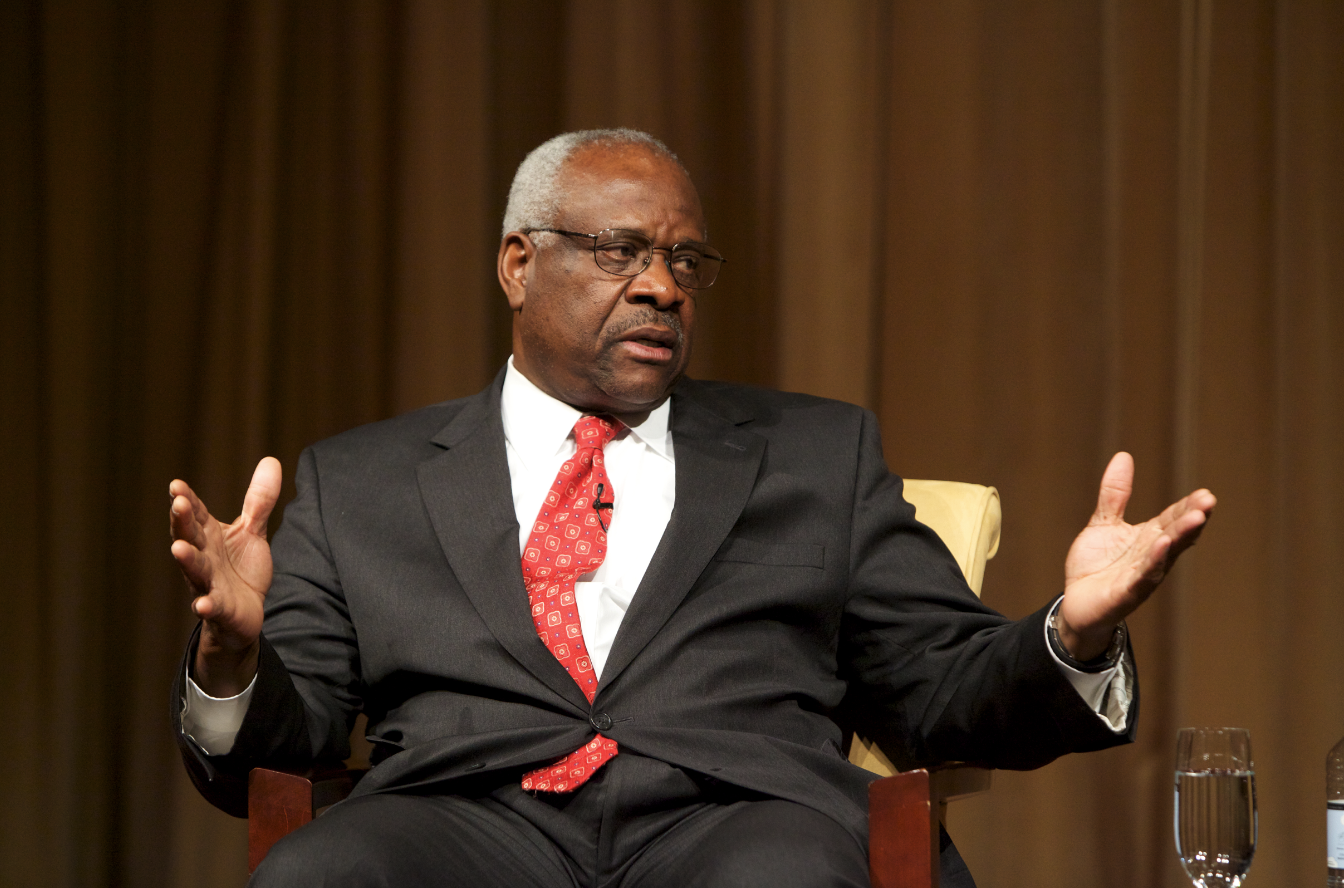
Justice Clarence Thomas’s recent speech at the University of Texas at Austin is no exception.
Ostensibly, the speech was written to serve three primary purposes: first, to celebrate the 250th anniversary of the Declaration of Independence and second, to commend the university for establishing its School of Civic Leadership. There, Thomas hoped the school’s efforts to “revitalize the teaching and research of Western civilization and the American constitutional tradition will lead the way in the reform of our nation’s colleges and universities.”
However, the third and most consequential purpose of Justice Thomas’s speech was to warn against the temptation to dismiss America’s first principles in exchange for a philosophically wayward, revisionist ideology.
To be sure, there are many noteworthy works released this year that explore the origins, nature, intent, and future of the Declaration of Independence. Among them are Matthew Spalding’s The Making of the American Mind, Brad Birzer’s The Declaration of Independence: A Radical Experiment in Liberty, Walter Isaacson’s The Greatest Sentence Ever Written, and Edward Larson’s Declaring Independence: Why 1776 Matters.
But Justice Clarence Thomas made the importance of this founding document simultaneously urgent and palpably personal.

Clarence Thomas was born in a one-room, dirt-floored wooden shack in the Jim Crow South of Pinpoint, Georgia. Abandoned by his father, raised by a struggling single mother, he landed in the home of his grandparents, Myers and Christine Anderson. Thomas, as he describes in his memoir, My Grandfather’s Son, learned the mean but worthy lessons of life under the unyielding tutelage of his grandfather. Myers was a self-made entrepreneur who delivered coal, oil, and ice from his truck. In his business, though not wealthy, he made ends meet. He answered to nobody but himself, and he was his own ruthless taskmaster. The lessons of healthy pride and hard work, self-discipline and the fear of God, made Clarence Thomas who he was. That, and the loving guidance of the Irish Catholic nuns at Thomas’s all-black St. Benedict the Moor Catholic School.
It was during his youth that the future Supreme Court justice first encountered the Declaration of Independence. And it assured him. The Declaration had a message that resonated with his grandfather, his teachers, and his own sense of self. Thomas recalled,
Throughout my youth, these truths were articles of faith that were impervious to bigotry and discrimination. Despite the multiplicity of laws and customs that reeked of bigotry, it was universally believed among those blacks with whom I lived, and who had very little or no formal education, that in God’s eyes and under our Constitution, we were equal. . . . This was also the case with my nuns, most of whom were Irish immigrants. Though not a literate man, my grandfather often spoke of our rights and obligations coming from God, not from architects of segregation and discrimination.
Notwithstanding the Supreme Court’s (“My court,” Thomas winced) 1896 Plessy vs. Ferguson decision—“separate but equal”—undermining the Equal Protection Clause of the Fourteenth Amendment and permitting over sixty years of entrenched racial segregation until it was overturned in Brown vs. Board of Education in 1954 and the Civil Rights Act in 1964, the young Clarence Thomas believed in the promises of the Declaration of Independence. He had hope. He trusted in his core that what Jefferson wrote and the signers assented to was that, indeed, “all men are created equal.” Indeed, “all men are endowed with inalienable rights.” Indeed, “governments derived their just powers from the consent of the governed.”
But knowing this is one thing.
Defending it is quite another.
Justice Thomas took his Supreme Court predecessors to task about what they knew and, yet, weren’t willing to defend.
It could not possibly—it could not possibly—have taken my court sixty years to know that Plessy was a hideous wrong and that racial discrimination was grossly incompatible with our color-blind Constitution. The justices must have known it all along. The right thing to do, as Justice Harlan spelled out in his lone dissent, was obvious as it so often is. Perhaps what stood in the way was cowardice. The justices may have been afraid of the societal consequences. They may have been afraid of coming under political fire. They may have been afraid of losing their social standing. They may have been afraid of bad press. . . . But in any case, for sixty disgraceful years, they made American children like me grow up in a racial caste system because it was easier to do nothing than to do the right thing.
When Americans look to Washington and wonder why it so often disappoints, it is not because there are too few people who know what is right, it is not because we lack the intellect, or the capacity, or the talent. It is, instead, because there are too few people who are willing to do what it takes to do the right thing to sacrifice the popularity, flattery, comfort, and security that are the purchase price for principle. It is because too few of us reflect the courage and commitment of that final sentence of the Declaration and so many seem to have forgotten how much others have sacrificed so this nation can endure. (emphasis added)
And Justice Thomas was emphatic:
[The Declaration of Independence] did not establish a form of government; that was the work of the Constitution that followed. But it stated the purpose of government. [That purpose is to] protect our God-given inalienable rights, rights that all individuals equally possess. (emphasis added)
But as much as the document was ingenious and lyrical and inspiring, Thomas went on to insist that the indispensable part of the Declaration of Independence comes at the end, when the signers “mutually pledge to each other our lives, our fortunes and our sacred honor.” Thomas explained,
Nothing in the Declaration of Independence, I now realize, matters without that final sentence. Without that sentence, the rest of the Declaration is but mere words on parchment paper—nice words, but nonetheless just words. What changed the world was not the words, but the commitment and spirit of the people who were willing to labor, sacrifice, and even give their lives—what Lincoln at Gettysburg called “the last full measure of devotion”—for the Declaration’s principles.

This devotion means everything. What we know is nothing if we aren’t willing to defend it. Justice Thomas continued:
It is that same devotion that built this country and carried us forward through our darkest hours. Think of how the devotion carried us from Independence Hall to Flanders Field into the beaches of Normandy. Think of the memorable scene in Band of Brothers when the American soldiers arrived at a concentration camp, saw the suffering, emaciated, desperate prisoners, unlocked the gates, and gave them food and blankets and warm embraces. The soldiers looked around and knew in their hearts that this is why we fight.
After outlining the meaning and intent of the Declaration of Independence and the dissonant but hopeful experience of a young black man under its shadow, Justice Thomas explained a modern threat to the first principles championed in the Declaration—principles that were the thirteen colonies’ reason for disagreement, for separation, for revolution from the very start.
That threat, according to Justice Thomas, is an early twentieth-century mindset called progressivism.
As we meet today, it is unclear whether [the Declaration’s] principles will endure. At the beginning of the 20th century, a new set of first principles of government was introduced into the American mainstream. The proponents of this new set of first principles, most prominently among them the 28th president, Woodrow Wilson, called it progressivism. Since Wilson’s presidency, progressivism has made many inroads in our system of government and our way of life. It has coexisted uneasily with the principles of the Declaration. Because it is opposed to those principles, it is not possible for the two to coexist forever.
Now, understand, this is not a shot at a political party. Rather, it is an address about first principles (whoever may adopt them). It is a battle of ideas, not primarily a battle of factions. Thomas explained,
Progressivism seeks to replace the basic premises of the Declaration of Independence, and hence our form of government. It holds that our rights and our dignities come not from God, but from government.
Lest one think this is not the case, a recent Senate Foreign Relations Committee confirmation hearing found a nominee for assistant secretary of state referencing the Declaration of Independence in his opening statement, saying that “all men are created equal because our rights come from God, our creator; not from our laws, not from our governments” (emphasis added). This elicited a response from a sitting senator, who asserted,
The notion that rights don’t come from laws and don’t come from the government, but come from the Creator—that’s what the Iranian government believes. It’s a theocratic regime that bases its rule on Shia [sic] law and targets Sunnis, Bahá’ís, Jews, Christians, and other religious minorities. They do it because they believe that they understand what natural rights are from their Creator. So, the statement that our rights do not come from our laws or our governments is extremely troubling.
Justice Thomas explored the history of progressivism with a special emphasis on President Woodrow Wilson and American philosopher John Dewey.
Progressivism was not native to America. Wilson and the progressives candidly admitted that they took it from Otto von Bismarck’s Germany, whose state-centric society they admired. Progressives like Wilson argued that America needed to leave behind the principles of the Founding and catch up with the more advanced and sophisticated people of Europe. Wilson called Germany’s system of relatively unimpeded state power “nearly perfected.” He acknowledged that it was “a foreign science, speaking very little of the language of English or American principle,” which “offers none but what are to our minds alien ideas.” He thus described America, still stuck with its original system of government, as “slow to see” the superiority of the European system.
Progressivism was the first mainstream American political movement—with the possible exception of the pro-slavery reactionaries on the eve of the Civil War—to openly oppose the principles of the Declaration. Progressives strove to undo the Declaration’s commitment to equality and natural rights, both of which they denied were self-evident. To Wilson, the inalienable rights of the individual were “a lot of nonsense.” Wilson redefined “liberty” not as a natural right antecedent to the government, but as “the right of those who are governed to adjust government to their own needs and interests.” In other words, liberty no longer preceded the government as a gift from God, but was to be enjoyed at the grace of the government. The government, as Wilson re-conceived of it, would be “beneficent and indispensable.” Progressives such as John Dewey attacked the Framers for believing that “their ideas [were] immutable truths good at all times and places,” when instead they were “historically conditioned, and relevant only to their own time.” Now, Dewey and the progressives argued, those ideas were to be repealed.
Progressivism seeks to replace the basic premises of the Declaration of Independence, and hence our form of government. It holds that our rights and our dignities come not from God, but from the government. It requires of the people a subservience and weakness incompatible with a Constitution premised on the transcendent origin of our rights.
While Justice Thomas uses the term progressivism, the dangers rest not primarily with political movements but with the ideas behind and enacted by political movements. “Ideas,” as American philosopher Richard Weaver insisted, “have consequences.” Ideas that our rights are conferred by the government—by man—and not endowed by our Creator, means that rights that were deemed transcendent and inalienable (life, liberty, property, pursuit of happiness, speech, press, assembly, and the practice of religious faith) are in fact temporal and vulnerable, and can be taken away by government, by man. And man, as we know, can be capricious. When Lord Acton declared, “Power tends to corrupt and absolute power corrupts absolutely,” and when James Madison wrote, “If men were angels, no government would be necessary. If angels were to govern men, neither external nor internal controls on government would be necessary,” they possessed a keen window into the caprice, the corruption, and the appetites of the human condition.
The dangers rest not primarily with political movements, but with the ideas behind and enacted by political movements.
Justice Thomas concludes with the words of President Calvin Coolidge’s speech one hundred years ago on the 150th anniversary of the Declaration of Independence. Coolidge, it seemed, had the same concerns Thomas does—concerns about fashionable revisionism and dangerous appetites.
If all men are created equal, that is final. If they are endowed with inalienable rights, that is final. If governments derive their just powers from the consent of the governed, that is final. No advance, no progress can be made beyond these propositions. If anyone wishes to deny their truth or their soundness, the only direction in which he can proceed historically is not forward, but backward toward the time when there was no equality, no rights of the individual, no rule of the people.
In listening to this speech by Justice Thomas, I was transfixed—transfixed by the hope residing in some ideas, and the danger lurking in others. Justice Thomas, it seems, put his finger on a crisis that we are left to resolve. Who are we? And where shall we go? As usual, the British Catholic sage G. K. Chesterton spoke astutely to our modern conundrum. First, about our crisis of identity:
We have all read in scientific books, and, indeed, in all romances, the story of the man who has forgotten his name. This man walks about the streets and can see and appreciate everything; only he cannot remember who he is. Well, every man is that man in the story. Every man has forgotten who he is. . . . We are all under the same mental calamity; we have all forgotten our names. We have all forgotten what we really are.
And, second, about our confusion regarding “progress”:
Progress by its very name indicates a direction; and the moment we are in the least doubtful about the direction, we become in the same degree doubtful about the progress. . . . In [the past] the direction may have been a good or a bad one, men may have differed more or less about how far they went, and in what direction, but about the direction they did in the main agree, and consequently they had the genuine sensation of progress. But it is precisely about the direction that we disagree. Whether the future excellence lies in more law or less law, in more liberty or less liberty; whether property will be finally concentrated or finally cut up; whether sexual passion will reach its sanest in an almost virgin intellectualism or in a full animal freedom; whether we should love everybody with Tolstoy, or spare nobody with Nietzsche; these are the things about which we are actually fighting most. . . . I do not, therefore, say that the word “progress” is unmeaning; I say it is unmeaning without the previous definition of a moral doctrine. (emphasis added)
Who are we? And where shall we go?
As Catholics, we are not political partisans but rather are beholden to God. Wherever the ideology flourishes that denies God or degrades man (be it from the political right, left, or center), the Catholic is called to defend the dignity of man and the glory of God. Our home is not of this world but our passing residence is. As such, we must ensure the questions we ask and truths we uphold serve God’s greater glory.
Who are we? And where shall we go?
These are the central questions with which Justice Thomas wrestles on the 250th anniversary of the Declaration of Independence.
May God help us choose aright—to know and to defend.