
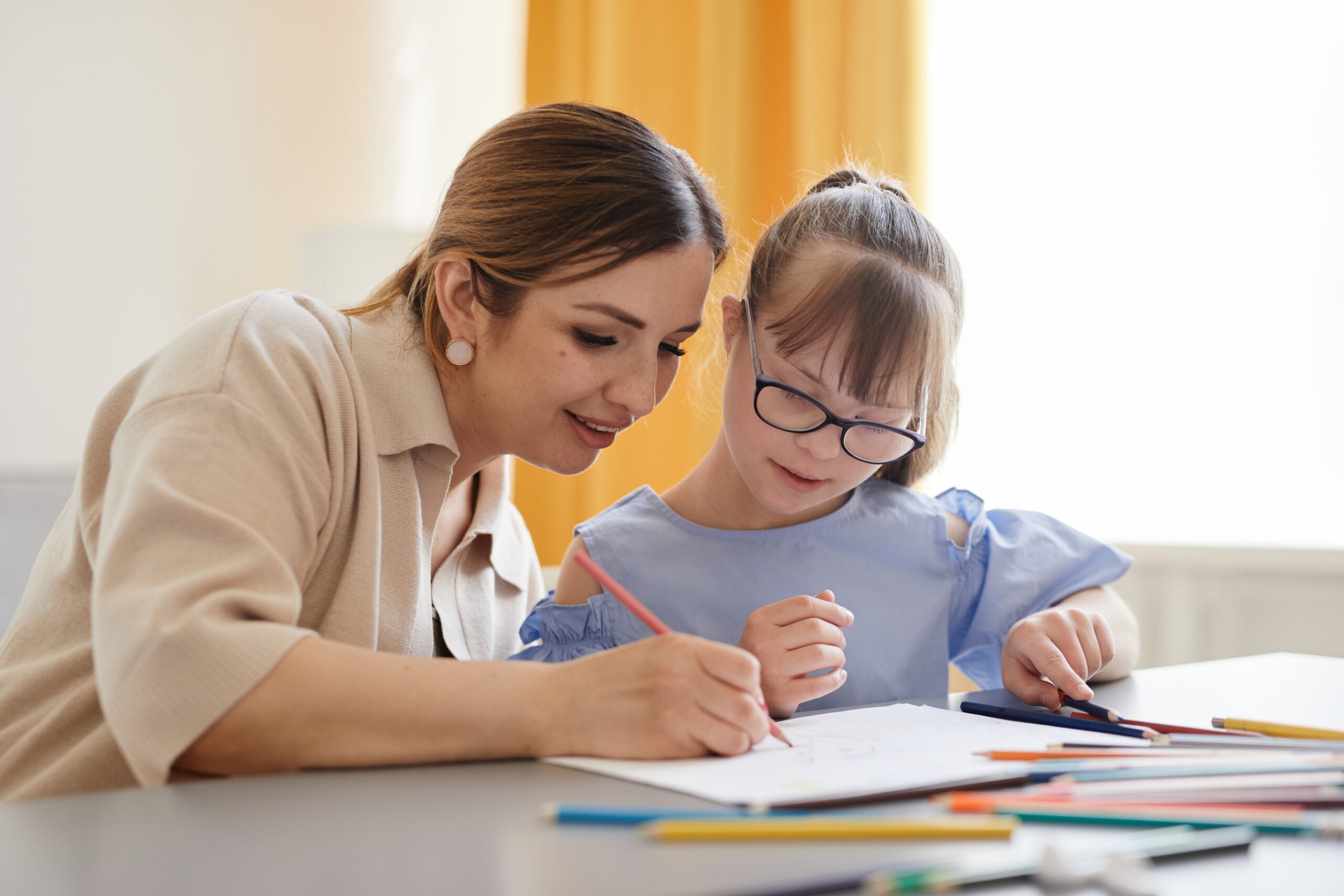
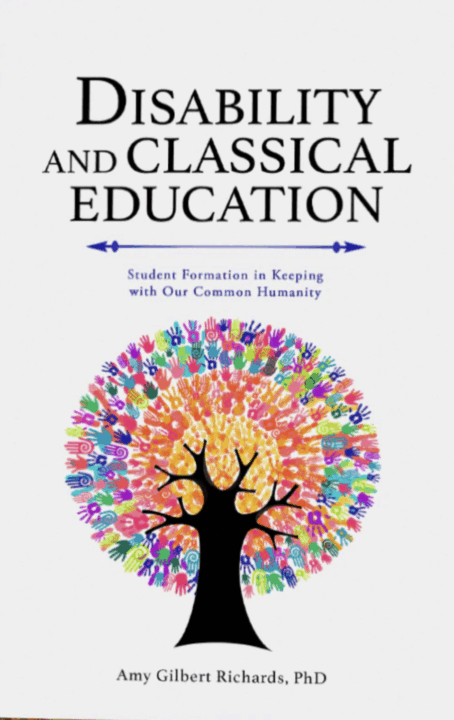
Research and practice around inclusion in Catholic education have increasingly moved beyond strategies and accommodations toward something deeper in recent years: a reexamination of what it means to teach, to learn, and to be human. Dr. Amy Richards invites us into that deeper terrain. Building on earlier reflections in her work Disability and Classical Education, she shifts the focus from theory to lived practice and what it actually looks like to shape classrooms where every student is genuinely welcomed.
At the heart of Dr. Richards’s work is a compelling vision of the classroom as a doxological space; one ordered toward wonder, attentiveness, and praise. Rather than reacting to differences as challenges to be managed, she proposes that educators begin by expecting them, even anticipating them, as part of the richness of human experience. This shift is not simply methodological; it is philosophical, even theological, requiring teachers to rethink long-held assumptions about ability, success, and the purpose of a Christocentric Catholic education itself.
What follows is a conversation that bridges that vision with practical reality. Dr. Richards gave a workshop at St. Jerome’s Academy in Hyattsville, Maryland. Drawing from years of experience working closely with K–12 teachers, Dr. Richards offered the teachers at St. Jerome concrete examples, formative exercises, and insights into how educators can move from abstract ideals to meaningful classroom transformation. The result is both challenging and hopeful: a vision of education rooted not in fixing students but in cultivating environments where every learner—and the community as a whole—can flourish.
Dr. Melissa Mitchell: I attended the community talk you gave after your workshop with Catholic teachers at St. Jerome Academy. I was familiar with your work from Mark Bradford’s article “Disability and Inclusion in Catholic Education.” His article introduced many of your ideas, and I see this interview as a continuation of that conversation.
What I really want to highlight here is what this looks like in practice: What does this vision of disability in classical education look like in the classroom, and how are you preparing teachers to live it out?
Dr. Amy Richards: That’s a helpful way to frame it. Once the ideas are firmly planted, the question becomes, What does this look like in practice?
My primary experience comes from teaching my own courses, especially the summer courses where I work closely with teachers. I’ve learned a great deal from them, particularly those with K–12 classroom experience, because they bring real-world insights back to our discussions. Since 2018, I’ve been listening to their experiences and learning how these ideas actually unfold in classrooms.
I would start with this: You can’t skip the philosophical step. Teachers consistently tell me how valuable it is to have time to step back, reflect, and ask deeper questions. Developing a shared philosophical, anthropological, and theological vocabulary gives us a way to diagnose and reapproach what’s happening in the classroom.
But then the key question is, what does it look like?
At its heart, it means orienting the classroom toward what I call a “doxological space,” a space ordered toward wonder and praise where lessons are planned in anticipation of difference. We’re no longer surprised by differences because we expect them. That shift gives teachers tremendous freedom to adapt: to rearrange the classroom, to rethink transitions, to experiment with sound, light, and structure.
Attentiveness to the individual becomes a gift to the community.
That’s incredibly helpful. Many teachers in the Word on Fire community are coming from different backgrounds; some unfamiliar with classical education, others still using traditional special education language. Could you give a concrete example of what this looks like?
Absolutely. In my courses, we move through three stages:
- Philosophical and theological foundations
- Shared terminology
- Practical classroom applications
One exercise I often give teachers is this: Think of a student you struggled to reach or one you connected with deeply. Then imagine you could redesign your classroom entirely to serve that student, without constraints. What would you change?
From there, we begin to build.
Let’s take a student on the autism spectrum: verbal, able to participate, but sensitive to light and transitions, and sometimes struggling socially.
In a typical “inclusive” model, the classroom stays the same, and we make accommodations for that student: giving schedules in advance, allowing breaks, and so on. These are good and necessary steps.
But in a doxological classroom, we begin differently. We ask:
- How does this student experience light and sound?
- Can we adjust the natural light for everyone?
- Can we replace a harsh transition buzzer with a gentler cue?
- Can we create a quiet space within the classroom—not as an exclusion but as part of the environment?
Instead of designing for one student alone, we design for everyone. The result is that what begins as an accommodation becomes a blessing for the whole class.
For example, a visual schedule posted for all students helps not just one child but everyone. A calm transition benefits everyone. A sensory corner becomes a resource any student might need on a difficult day.
Attentiveness to the individual becomes a gift to the community.
That’s what struck me when I first encountered your work, that shift from “fixing” the child to asking how we can better meet their needs. It’s such a transformative way of thinking, and yet it feels natural for teachers.
Yes, and that’s why it’s difficult to reduce this to a list of techniques. What we’re really talking about is the virtue of prudence with the ability to read a situation well and respond appropriately. That requires a posture of listening.
Ultimately, the classroom must be relational rather than transactional.
That’s beautifully said. I’m curious, what are some of the biggest “aha” moments you see in your summer courses?
The first is simply realizing how much there is to unpack.
We spend the first several days immersed in philosophical and theological foundations by exploring the history of disability, different models of understanding it, and what it means to be human. Teachers begin to uncover assumptions they didn’t even realize they had.
There’s often a deep shift from seeing disability primarily through a “medical model,” as something broken, to recognizing the limitations of that view. Even when we adopt more social models, those deeper assumptions can remain.
Giving teachers time to reflect, discuss, and question allows those layers to unfold. That’s where the real transformation begins.
And then you move into more practical applications?
Yes. In the second half of the course, we focus on particular learning differences—such as ADHD, autism, specific learning disabilities—and how to welcome these students from a strengths-based perspective.
For example, with dyslexia, we often focus on what students struggle with. But research suggests that many students with dyslexia have exceptional strengths in design and spatial thinking. In some contexts, those abilities would be considered highly valuable.
So we ask: What gifts might this student bring? And how do we support those gifts while also addressing areas of difficulty?
We also bring in practical tools like learning how to read an IEP so teachers can navigate both the human and institutional dimensions of their work.

That balance between philosophical depth and practical application seems so important.
It is. You need both. Teachers need a heart for their students and they need practical tools. Without both, it doesn’t work.
One thing that also stands out is the level of support you’ve received in developing this work.
Yes, I’ve been incredibly fortunate. The program leadership has been deeply supportive from the beginning. That kind of institutional backing makes a tremendous difference.
We’re even beginning to explore what it might look like to expand this work further and perhaps through an institute focused on this approach.
That’s wonderful. I think this work has the potential to reshape how many educators, Catholic and non-Catholic alike, think about their classrooms.
Amy, thank you so much for your time. This has been such a gift.
Thank you—it’s been a pleasure.
* * *
You can read more about the workshop in this article: “St. Jerome Academy and the Call to Inclusive Catholic Schools.”