
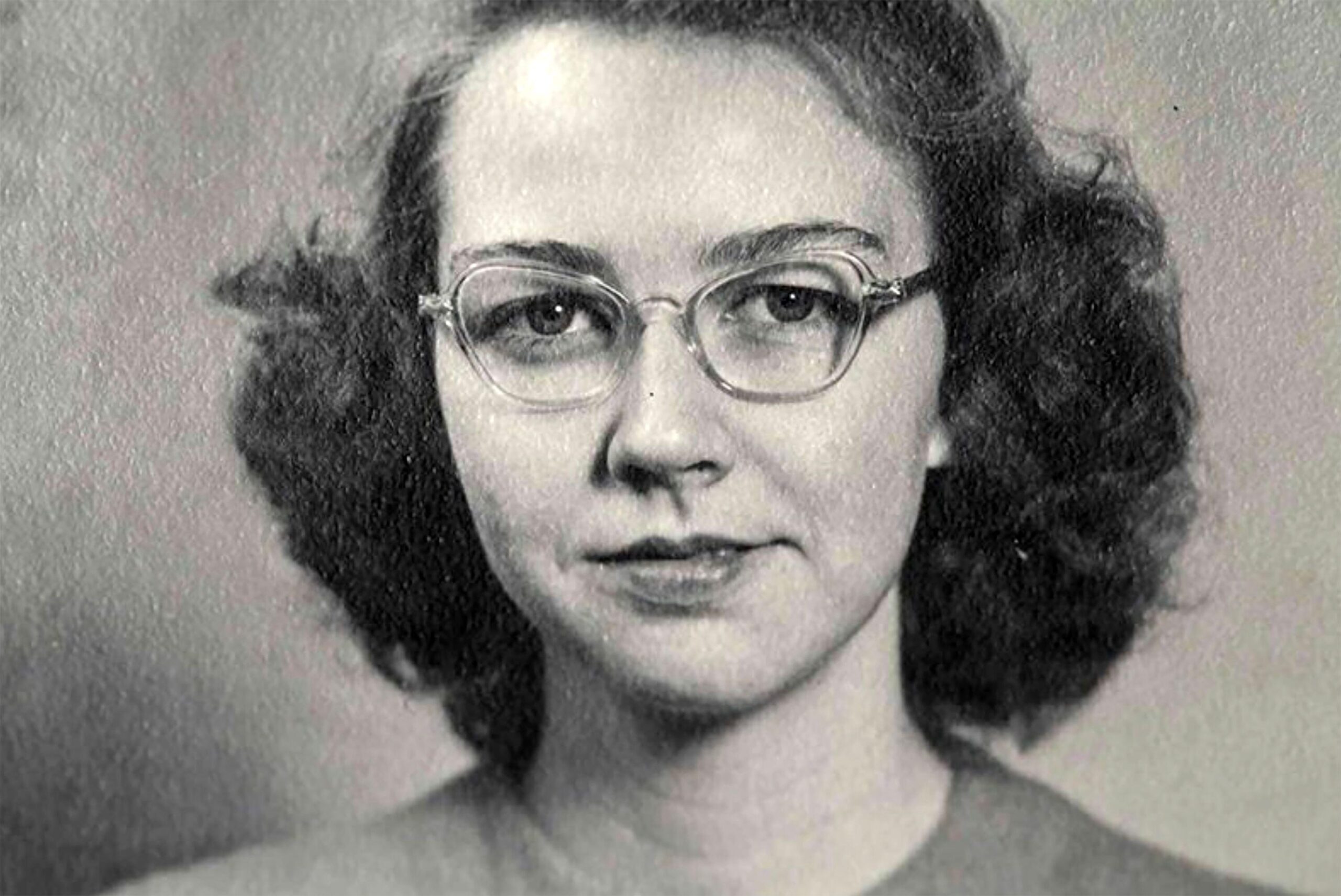
The following is a book review of Fr. Damian Ference’s No One Was Paying Any Attention to the Sky: Flannery O’Connor and Modernity (Wiseblood, 2025).
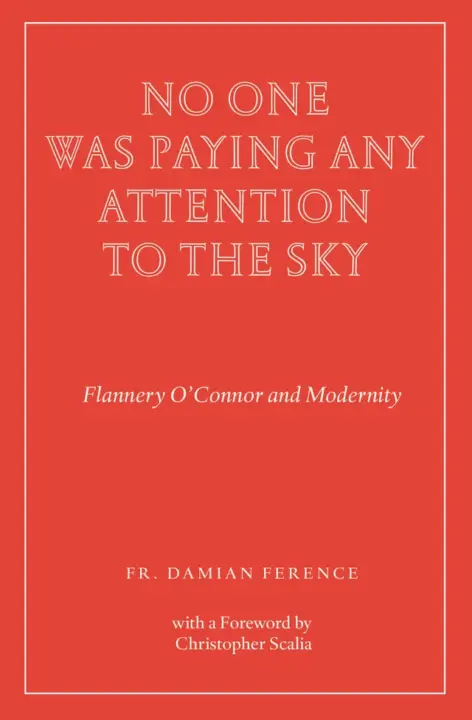
A philosophy professor at Borromeo Seminary and a priest of the Diocese of Cleveland, Fr. Damian Ference combines his considerable skill as a philosopher with his expertise in the work of Flannery O’Connor. His interest lies in showing how O’Connor expressed her concern for philosophical modernity in her correspondence, prose, and fiction. Accordingly, the book achieves several things at once: It is a handy primer on modern philosophy; it convincingly demonstrates O’Connor was aware of, and troubled by, modern philosophy; and it seeks to show how these concerns were expressed in O’Connor’s first novel, Wise Blood.
Fr. Ference’s book is cleverly titled, as it comes from one of the most profound passages in all of O’Connor’s writing. The line is found in Wise Blood at the beginning of chapter three. It is also the opening line in the recent film Ethan Hawke directed—Wildcat—about O’Connor and her writing. Here is that remarkable passage in context:
The black sky was underpinned with long silver streaks that looked like scaffolding and depth on depth behind it were thousands of stars that all seemed to be moving very slowly as if they were about some vast construction work that involved the whole order of the universe and would take all time to complete. No one was paying any attention to the sky.
Modernity
What is “modernity” and how should we understand it in this context? This concept philosophers love to pass around refers to the abrupt break between classical, Christian, and medieval philosophy, on the one hand. On the other, it refers to the Enlightenment’s philosophical attempt to redefine the nature of human beings and their place in a universe created by their maker. While this may have worked for William Harvey’s explanation of pulmonary and systemic circulation or Benjamin Franklin’s primitive experiments on the nature of electricity, science and mathematics have no special competence in explaining moral and theological truth.
“We are not our own light.”
Fr. Ference rightly notes that the single most important event in this break came with the French mathematician and philosopher René Descartes and those who followed him, including Baruch Spinoza and Nicolas Malebranche. Although he did not include it, Fr. Ference could have noted Malebranche’s appearance in O’Connor’s short story “Good Country People.” Hulga (aka Joy), O’Connor’s comically pathetic one-legged PhD in philosophy, makes an indignant reference to Malebranche:
To her own mother she had said—without warning, without excuse, standing up in the middle of a meal with her face purple and her mouth half full—“Woman! do you ever look inside? Do you ever look inside and see what you are not? God!” she had cried sinking down again and staring at her plate, “Malebranche was right: we are not our own light. “Mrs. Hopewell had no idea to this day what brought that on. She had only made the remark, hoping Joy would take it in, that a smile never hurt anyone.
As Descartes explained in his Discourse on Method, he decided he would place aside all that he knew and believed and only embrace what he could prove to himself by systematic reason. As a first step, he had to establish his own existence, which he did easily enough by famously concluding, “I think, therefore I am” (Cogito, ergo sum). Ultimately, he reached the conclusion that God also exists, but as I have warned my students, with tongue in cheek, “What if he had not been successful? What if Descartes had concluded that God did not exist? Where would the world be then?!”
O’Connor’s Response, Ference’s Project
Fr. Ference ably demonstrates how much O’Connor was taught by her reading of Catholic philosophers Romano Guardini and Étienne Gilson and how the two shaped her response to modernity. To be sure, Fr. Ference’s discussion is the clearest and most comprehensive of these influences available in O’Connor scholarship.
Among the several modernist ideas that concerned O’Connor is the idea of “mystery.” To update the Enlightenment philosophers—and suggest their relevance—we might say that the modernists promise the mysteries of human life will be cleared up once we find a good algorithm or two. By contrast, O’Connor astutely observed that the more we know, the more mystery we must acknowledge. The growth of mystery grows along a track that runs parallel to the growth of knowledge. In 1962, two years before her death, she wrote a correspondent, “Mystery isn’t something that is gradually evaporating.” O’Connor even commented, in respect to her fatal illness of lupus erythematosus, that if she had to have a disease, she might as well have a mysterious one.
Does he succeed, though, in demonstrating that Wise Blood is O’Connor’s fictional response to modernity?
Fr. Ference has no trouble explaining O’Connor’s concern for modern philosophy in her correspondence and prose. Does he succeed, though, in demonstrating that Wise Blood is O’Connor’s fictional response to modernity? The answer is that he does so reasonably well. Had this been a bigger project, he would have drawn upon more of O’Connor’s fiction to make his discussion even more comprehensive.
Fr. Ference also could have extended his book to show that Descartes, having undermined the basis of faith, ultimately sets in motion the deterioration of reason that Friedrich Nietzsche forewarned. Fr. Ference, however, explores this in his Understanding the Hillbilly Thomist. Besides, extending his discussion in that direction would have been overly ambitious and unnecessary for his thesis in No One Was Paying Any Attention to the Sky. The closest Fr. Ference comes in this study is his observation that modern philosophy is responsible for the “subordination of reason.” Today, “what is right” is typically outranked by “what is felt.” What is reasonable, then, is what I feel is right.
There are few complaints, if any, to be made about this book. On a few occasions, the author makes use of extensive indented quotes, a practice that, in general, should be avoided because it demands more work from the reader than the author should require. But then again, this monograph is not for the faint of heart, nor is it written for an audience whose primary reading comes from a smartphone. That said, those few long quotes are well chosen, and they flow quite well with the text and allow the author to follow his thesis in a succinct manner. It is inevitable in a project like this that there will be the occasional passage where the reader might wish for elaboration, but those are few and far between, certainly less than expected given the scope of the book. Overall, No One Was Paying Any Attention to the Sky is a singular contribution to O’Connor studies and should receive wide circulation.