

Earlier this year, Angel Studios, together with a star-studded cast, brought the life of Christ to the big screen with the animated King of Kings. Now, the Salvation Poem Project has thrown their hat in the ring with Light of the World, an animated film about Jesus’s ministry told through the eyes of the apostle John, who’s depicted not only as the youngest disciple but as a precocious thirteen-year-old boy.

Codirected by former Disney animator Tom Bancroft (Mulan, The Lion King), Light of the World foregoes the overwhelming digital effects increasingly on display in kids’ movies for the tried-and-true 2D animation of Disney’s golden era. The result is a warmer, hand-drawn aesthetic, one used both as a springboard into childlike levity and as a buffer for the gravity of the Gospel.
The film opens, appropriately, with the most beloved verse—“the Gospel in miniature”—of the beloved disciple: John 3:16. We’re then introduced to John, a spirited young teen enraptured by his mother’s retelling of the creation story—especially its contrast of light and darkness—and of Israel’s longing for a Messiah to destroy its enemies. Little does John know he will soon encounter this very Messiah in passing, and that he will fulfill all the promises made to Israel, but in the most unexpected way. As Mary of Nazareth counsels John at the Cana wedding—a glimpse into the mother-son relationship that, we later learn from John’s Gospel, Christ established on the cross (John 19:26–27)—“God rarely shows up in the ways you think he will.”

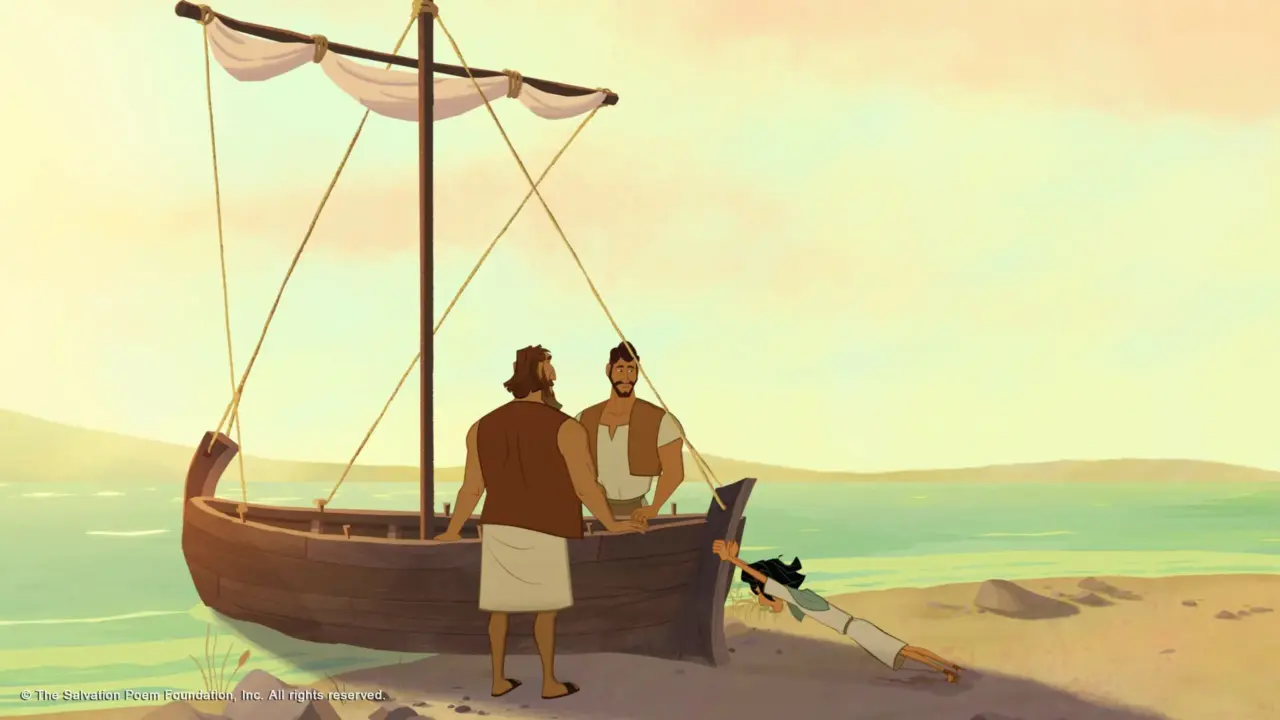
Through the eyes of the ardent young John, we follow Christ’s ministry flowing out from his baptism in the Jordan—one of most creatively executed scenes in the film. This first half of the movie takes a lighthearted approach to the light of the world: The scenes are peppered with comic relief (John the Baptizer robbing bees of their honey, one of the disciples nodding to Jaws at the miraculous draught of fish), and potentially scary moments like the healing of Mary Magdalene (see, for example, the same scene in the claymation The Miracle Maker) are handled with delicacy.


But the second half—as Christ prepares to be “baptized with the baptism that he is baptized with” (see Mark 10:38)—takes a more straightforward look at the darkness that gathers around him: The events of Holy Week are handled with an unvarnished and at times intense directness (e.g., while the filmmakers don’t show Christ being nailed to the cross, the violence is heard). This depiction of Jesus suffering cruelty and death might prove a bit too wrenching emotionally for younger viewers. But for those young people prepared to take it in, Light of the World offers a compelling portrait of the Gospel basics: the light of Christ, the darkness of sin and death, and the victory of the former over the latter. “The light shines in the darkness, and the darkness did not overcome it” (John 1:5). The reality of the cross is painful: The filmmakers make it a point to draw out, at the Crucifixion, Simeon’s prophecy that “a sword will pierce” the soul of Mary (Luke 2:35), and to the degree that we understand what Christ suffered and why, that same sword will pierce our soul also. But enveloping that pain—indeed present in it—is the ever-greater love of God. Kids no less than adults need to hear this Good News—and Light of the World effectively conveys it to them without softening it beyond recognition.
As with any film about Jesus, there are both opportunities missed (e.g. Christ saying “My body, my blood” at the Last Supper rather than, as recorded in the Gospels, “This is my body, this is my blood”) as well as opportunities seized (e.g., drawing out the connection between Genesis and Christ, the creation and the new creation, from the prologue of John). But on the whole, Light of the World is yet another noble offering of solid faith-based entertainment for young people. And it’s a sign of hope—not only for ultimate victory in Christ but also for cultural renewal, however tenuous or gradual, through his radiance: “The darkness is passing away and the true light is already shining” (1 John 2:8).