
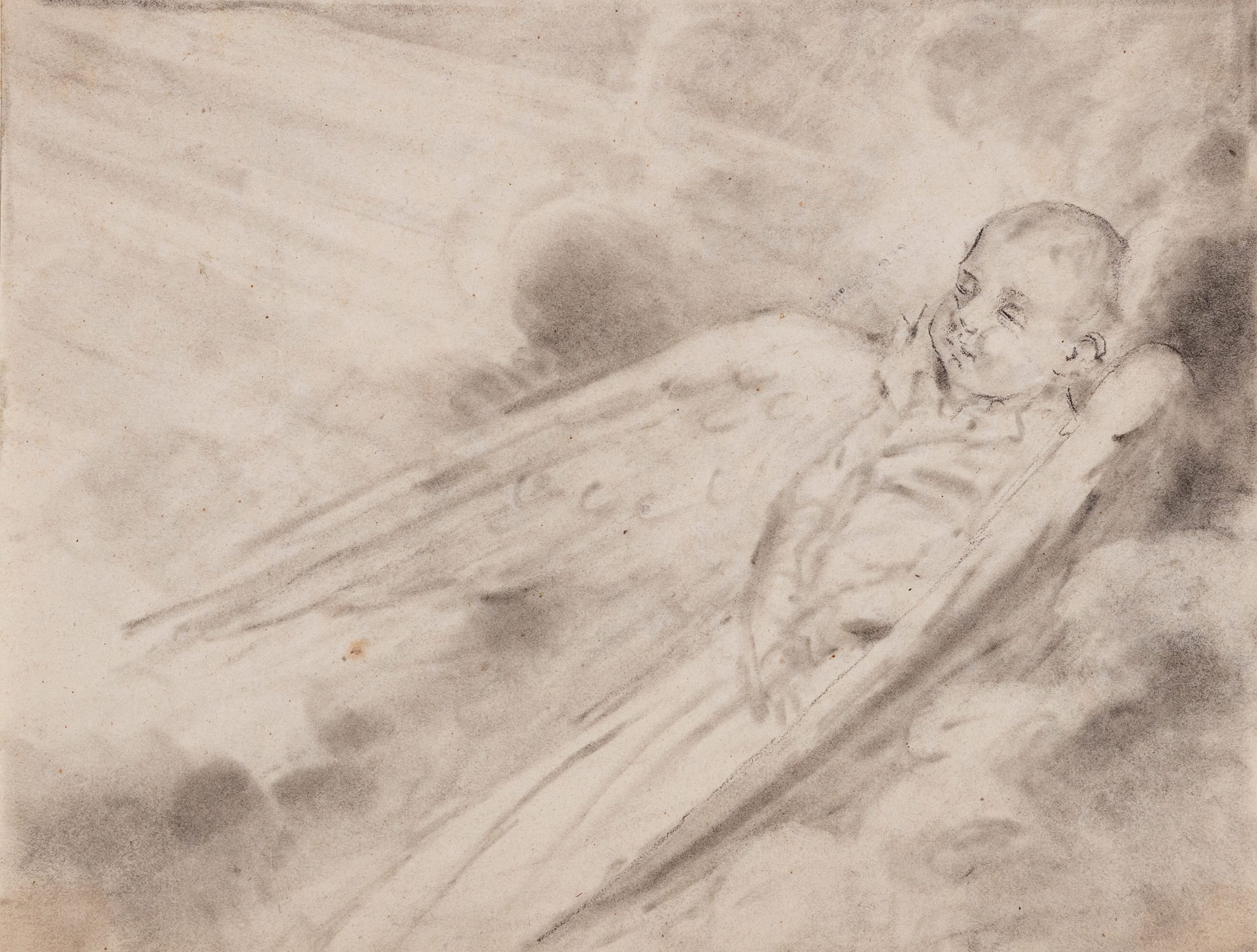
One of the hardest days of my life was when I lost my son Bosco Joseph Paul, who had trisomy 18 and passed away in childbirth. It was my wife’s and my desire to baptize him with water in the name of the Father, the Son, and the Holy Spirit as soon as he was born. We did not get that chance. While, somewhat like his patron saint Paul, he was “abnormally born,” Bosco was fully human from the moment of conception, endowed with an immaterial soul, in the image of God, and therefore destined for an end that transcends this world (cf. 1 Corinthians 15:8). Just how, then, should he and the millions of other children like him who died in early pregnancy loss and miscarriage be remembered? Should he be prayed for on All Souls Day? Or prayed to on All Saints Day?
At first blush, the unborn departed of Christian parents don’t seem to fit clearly in the liturgy of either feast. All Saints Day commemorates those who lived lives of heroic virtue, who with the angels rejoice in heaven, whose examples are commended to us for emulation, and whose intercession we can ask for. On All Souls Day, we pray for the faithful departed, recalling the Maccabean example of praying for the dead to be “loosed from sins” (2 Maccabees 12:45). The idea is that there are faithfully departed souls who are not yet saints and are in need of purgation, due to punishment due for sins committed or remaining attachment to sin. But the unborn have no personal acts of merit or demerit.
The document argues that there are grounds to hope God will save unbaptized babies, to whose mercy the Church entrusts them.
And yet it is possible for the very young, who have not been baptized and lack personal acts of merit or demerit, to be counted among the saints, for the Holy Innocents are among those commemorated on All Saints Day. While they received the baptism of blood, it is possible that the unborn of Christian parents can receive the baptism of desire from the desire of their parents. Before outlining that view, consider that in the history of theological opinion on the status of babes who died without water baptism, one can find few broad alternatives. First, the Augustinian view, the Thomistic view, and what might be called the post-conciliar view.
Augustine emphasized the need for baptism to be saved, a need that is highlighted in Scripture (Mark 16:16; John 3:5; Acts 2:38; 1 Peter 3:21; Romans 6:3–4; 1 Corinthians 15:22). For Augustine, the inevitable consequence of lack of baptism was hell for infants. But, he insisted, the punishment for them would be most mild as they had no personal sin, only original sin. To the objector that such would seem to be cruel, Augustine emphasized the inscrutable mysteriousness of God’s election of some men to salvation and not others, the righteousness of which cannot be questioned.
Thomas Aquinas softened this teaching. He argued that a person with only original sin deserved not the sensual punishment of hell but only the privation of the beatific vision. His idea was that original sin was the fault of human nature, not an individual fault. Aquinas posited that the separated souls of unbaptized children did not have the virtue of faith that comes with baptism, and so did not have knowledge of the supernatural end of beatific vision. But they do have a natural knowledge of what human happiness consists in and can enjoy a kind of felicity proportioned to their ungraced nature—but being ignorant of the supernatural end, they do not grieve over its loss. This, in short, was Aquinas’s idea: the limbo of children.

The post-conciliar view, summarized in The Hope of Salvation for Infants Who Die Without Being Baptized, issued by the International Theological Commission and approved by Benedict XVI, differs from both the Augustinian and the Thomistic. While continuing to affirm without question the need to baptize infants without unreasonable delay, the document argues that there are grounds to hope God will save unbaptized babies, to whose mercy the Church entrusts them. It leaves open the means by which this might be achieved.
It could be that through their suffering and death of the body, they have a kind of solidarity with Christ that is salvific. It could be that unborn victims of violence are saved analogously to the Holy Innocents, who received the baptism of blood. It could be simply a gratuitous gift of God extra-sacramentally, which could be analogized to the unmerited gift of grace God gave Mary. Or it could be that through its prayers for all people, including specifically for the unborn, the Church supplies the desire of the unborn for baptism, by which the baptism of desire could be achieved.
The document does not mention another possibility that I have defended, and which can be traced to the opinion of Cardinal Cajetan. Cajetan, commenting on the relevant question in the Tertia Pars of Thomas Aquinas’s Summa, argued that unborn infants do not receive baptism in re but in voto from their parents, who desire to baptize them. He contended that divine mercy was sufficiently capacious that it provides a path for salvation to all men. And indeed, is this not the clear teaching of Scripture? God “wants all people to be saved and come to a knowledge of the truth,” and Jesus “died for all” to bring this about (1 Timothy 2:4; 2 Corinthians 5:15). Scripture affirms that the “Father of mercies” is “rich in mercy,” the biblical ground upon which St. John Paul II argued that mercy is “the greatest of the attributes and perfections of God” (Ephesians 2:4; 2 Corinthians 1:3; Dives in Misericordia 13).
We know God can save through the baptism of desire, and we know that the same God who forms every infant in the womb can give sanctifying grace to those still in the womb.
If God’s mercy is unfathomably capacious, then it is fitting that God makes means available to the unborn to receive that mercy. We know God can save through the baptism of desire, and we know that the same God who forms every infant in the womb can give sanctifying grace to those still in the womb (Job 31:15; Jeremiah 1:5). Putting all this together, in the spirit of Cajetan’s view, I have contended that it is a special privilege of Christian parents who desire to baptize their children to supply the requisite voto, which they would supply in solidarity with the Church at a normal baptism.
Some have objected to Cajetan’s opinion, pointing out that Pope Pius V censored this passage from Aquinas’s Summa accompanied by Cajetan’s commentaries. But this does not necessarily amount to a condemnation; there any number of reasons Pius might have thought it prudent to censor the passage. Moreover, the Church has made clear that, while the theory of limbo is a valid theological opinion, we need to consider other opinions that better accord with the sensus fidelium of the faithful.
One could object that this “exception” to the rule that all infants need to be baptized by water undermines the urgency of the sacrament of baptism after birth and unravels the sacramental system administered by the Church. But that is silly. The desire for baptism in the parents, if real, will be carried out in all deliberate speed in normal circumstances. It is like saying that if the police officer grants a privilege to a man to drive twenty miles over the speed limit because he is transporting his laboring wife to the hospital, this would undermine and unravel traffic law. False. Necessity knows no law is a venerable principle of jurisprudence that it is fitting to assume has an analogate in the order of grace and mercy.
For these reasons, with all due humility and hope in the infinite mercy of our Lord, the Cooper family prays: St. Bosco Joseph Paul, pray for us.