
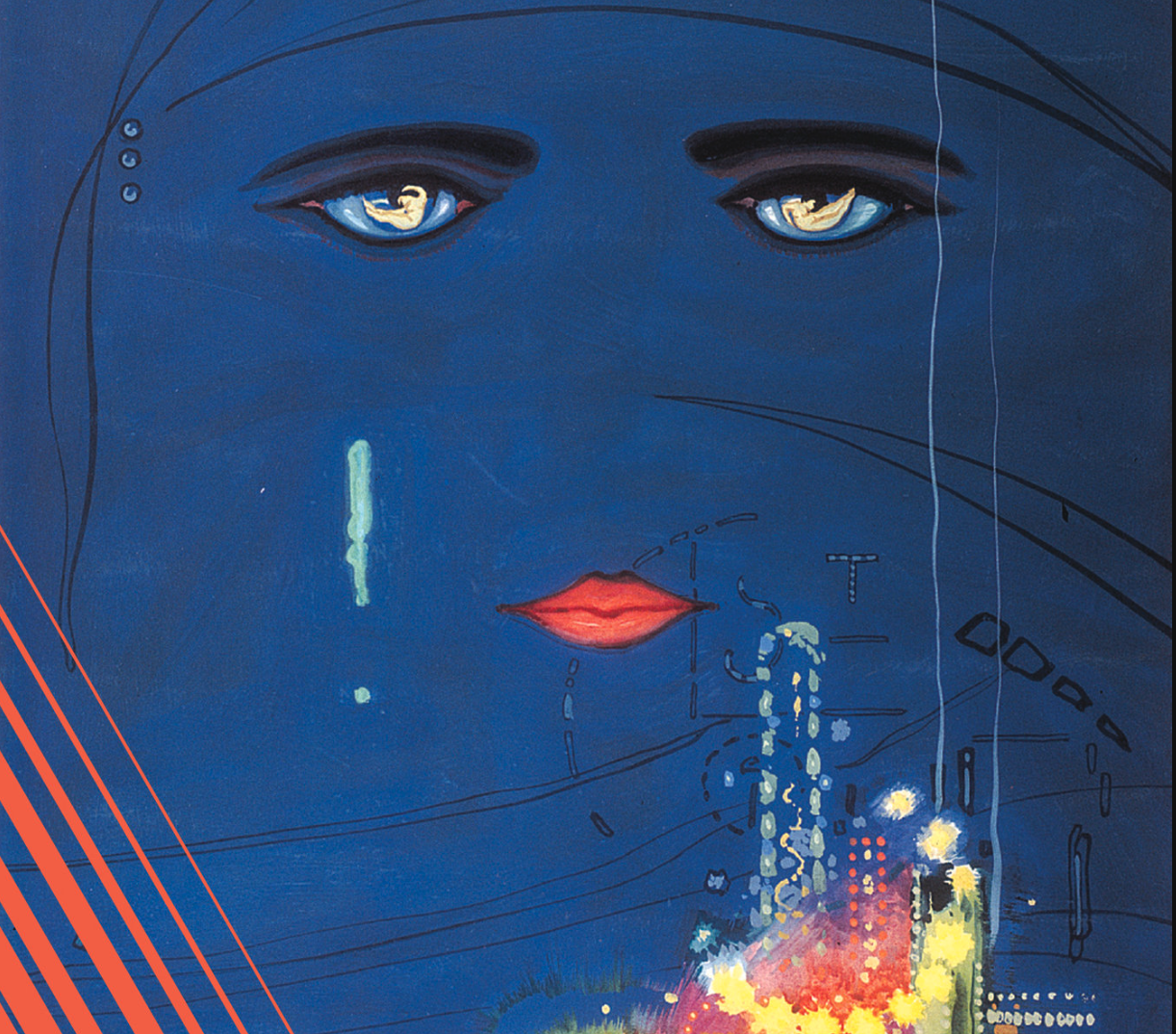
When a piece of literature has been as popular as has been F. Scott Fitzgerald’s The Great Gatsby, published 100 years ago and for decades now a mainstay of the high school English curriculum of the United States, it is easy for us to take for granted that we have understood it through the critical tropes that circle above it—“a novel of the Jazz Age,” “the dark side of the American dream,” “the tragedy of romantic love in an age of gritty realism.” For those of us who read the novel in high school but have not returned to it in the (many) years since, we might vaguely remember the unfortunate car accident that results in the death of Myrtle Wilson and the tragic misunderstanding that ends in the death of Jay Gatsby, perceived by the novel’s narrator, Nick Carraway, as the most noble figure amid the madding crowd of New York hedonists, who strive for success but lack any sense of loyalty to those who have helped them. What we may not remember, or may not have been taught in the first place, is what Gatsby really wants, and it is his great desire that drives forward the whole plot of the novel and reveals something of its author’s Catholic vision of the modern world.
I certainly recall learning nothing in high school English about F. Scott Fitzgerald’s Catholicism. As David King puts it, following Walker Percy, Fitzgerald was a “bad Catholic,” prone to excessive drinking from his college days at Princeton, which he later recognized hindered his ability to exercise his novelistic talents. Likewise, his relationship with the Church could only be described as broken, although he had his daughter, Scottie, baptized and requested she obtain for him a Catholic burial (which she eventually secured for him some years after his death). Despite his many sins, Fitzgerald retained a knowledge of sin for what it was, and, as Mike St. Thomas claims, “he clung more firmly to remorse than he did to sin,” which should be understood as a sign of hope. Although it might be simpler, especially from the vantage point of a putatively more secular age, to examine his novels without reference to his Christ-hauntedness, such reading obscures what is in the text of his fiction, especially what has become his magnum opus: The Great Gatsby.
The claim that The Great Gatsby is a Catholic novel should not be misunderstood to mean that it is a novel primarily about Catholics, one depicting a richly Catholic world of habited religious, or one written by a practicing Catholic. Rather, it is to say that what Fitzgerald wrote depicts the world of the Jazz Age, not to glorify its splendid debauchery (for it had splendor, that which we call in the Roman ritual of baptism the “glamor of evil”) but to reveal the emptiness of it, and the longing at the heart of that emptiness. “If I had to say what a ‘Catholic novel’ is,” Flannery O’Connor once wrote, “I could only say that it is one that represents reality adequately as we see it manifested in this world of things and human relationships.” Gatsby should be considered a Catholic novel because it represents the reality of the human heart and its longing, precisely through that longing’s corruption in the quintessential modern city, New York.
Jay Gatsby is a profound exemplar of both the American genius and its corruption . . .
As St. Augustine famously prayed to God in his Confessions, “Our hearts are restless until they rest in Thee.” Pope Leo XIV recently pointed out in his video broadcast to Chicago that “that restlessness is not a bad thing, and we shouldn’t look for ways to put out the fire, to eliminate or even numb ourselves to the tensions that we feel, the difficulties that we experience.” Professor of political philosophy Christopher J. Wolfe pointed out, commenting on this speech, that “every reader of Pascal knows—the human condition is unavoidably a restless one because we have a desire for eternity that cannot be fulfilled in this life . . . and the readers of Tocqueville know—we AMERICANS tend to be the most restless of all.” Jay Gatsby is a profound exemplar of both the American genius and its corruption because what he desires and pursues is the fundamental desire of humanity since the garden—namely, deification. His tragedy is that he attempts to become God without Jesus Christ, in whom alone this desire of ours finds its fulfillment.
While it may shock secular Americans to be told that what the Catholic Church is about in the world is making gods, this is (rightly understood) the heart of the Christian claim. In a speech two years ago at Harvard, Bishop Barron cited St. Athanasius, the great bishop of Alexandria, who argued in his work On the Incarnation that Christ “was made man that we might become God.” The Greek word Athanasius uses is θεοποιηθῶμεν (theopoiethomen), which combines the word for God and poiesis (“making”), from which we get “poetry.” We do not become God in nature or essence, for this would be for God to destroy our humanity, which he saw was “very good” (Gen. 1:31), but rather by grace God purifies and elevates us so that we may share in his divine life. In one of the first papal encyclicals, St. Peter says that God, through the great power of his promises to us, has made it so that we might “become partakers in the divine nature” (2 Pet. 1:4). This is the goal of the Christian life, of our liturgical prayer, our temporal and spiritual works of mercy: that we become more and more united to God the Father through his Son, our Lord Jesus Christ, and thus truly incarnate our adoption and participation in the divine life. Deification is not a reward delayed until after death for those who do good, a deferred blessing for the sufferings we endure in life, but rather, as St. John Paul II noted in Orientale Lumen, his apostolic letter on the Eastern Churches, “through the power of the Spirit who dwells in man deification already begins on earth; the creature is transfigured and God’s kingdom inaugurated.”
While readers of The Great Gatsby tend to think the plot is driven by Gatsby’s adulterous desire for his former beloved, Daisy Buchanan, Nick Carraway indirectly reveals that Gatsby’s love of Daisy is only an epiphenomenon of his more central desire, which is to become god by his own efforts. This is the central temptation, which Satan tailors in different forms to different personalities, but which is also shaped by the course of human history into which God descended in the Incarnation: “Take and eat,” and “you will be like God” (cf. Gen. 3:5). Temptation and sin are always parasitic on the good, corrupting that which God intends for us as gift in his time; the sin of Adam and Eve was not desiring to be like God, who has given so freely in creating what St. John Chrysostom called in his liturgy “the manifest and the hidden benefits bestowed upon us.” Rather, their sin was in attempting to appropriate by their own effort what could only properly be God’s gift to them.
Likewise, as Nick notes in chapter 6 of the novel, Gatsby fled the humble origins of his earthly parents and, exemplar of the “expressive individualism” of our age, “sprang from his Platonic conception of himself.” Right after saying this, however, Nick turns to present Gatsby in Christian language: “He was a son of God—a phrase which, if it means anything, means just that—and he must be about His Father’s Business, the service of a vast, vulgar and meretricious beauty.” Nick’s calling Gatsby “a son of God” implicitly criticizes Gatsby’s auto-idolatry, his attempt to father himself by his own conceptions. This attempt to play God does not occur only with reference to his own identity, however; after his affair with Daisy has begun, Gatsby reveals to Nick that he wants “nothing less of Daisy than that she should go to [her husband] Tom and say: ‘I never loved you’”—namely, an obliteration of the past three years of her life. When Nick warns Gatsby that “You can’t repeat the past,” the novel’s son of God “cried incredulously,” “Can’t repeat the past? . . . Why of course you can!” Gatsby is not content with the present love of Daisy: He must rewrite history, acting as its proper lord and re-interpreter, a god by his own effort.
Gatsby warrants rereading precisely because it illustrates how the modern world (including the United States) lives unrelentingly in the shadow of the Christian claim—namely, that God so loved the world that he sent his only beloved Son to live among us, die for us, rise from the dead conquering death by death, and send his Spirit among us to make us partakers in the communion of his own divine life. Much more could (and should) be said about the corruption of Gatsby’s desire for deification, which not only echoes that of earlier pagan heroes such as Homer’s Achilles but also presents a profound difference—namely, the relationship between God and passionate love (carefully examined by Pope Benedict XVI in Deus Caritas Est). For restless Americans and moderns, so in search of love, to know the shadow of what it is means already beginning to believe in the joyful Light.