

Pope St. John Paul II described marriage as a “path to sanctification,” a vocation to holiness. Through this sacramental covenant, spouses are called to mirror Christ’s love and “‘grow continually in their communion through day-to-day fidelity to their marriage promise of total mutual self-giving.’ This human communion is confirmed, purified, and completed by communion in Jesus Christ” (CCC 1644).
So, how can we grow in communion with Jesus in order to continuously grow in fidelity to our marriage promise?
For some musing this Valentine’s Day, I decided to ask a variety of Word on Fire team members how they work with their spouse to grow ever deeper in faith and holiness together.
* * *
Matt Franz, Email Marketing Manager
When most people hear the word “holiness,” they picture monks, silence, and an otherworldly calm. They imagine a life cleared of noise and interruption.
Family life with five sons is none of those things.
Emily and I do the obvious things: We pray together. We go to Mass every Sunday as a family. We fast together during Lent and do our best to order our home around the rhythms of the Church. I’ll admit, most times we fail, but the effort is there. These are all super important to us.
But the holiness in our family is far less tidy and structured. It shows up in joy and laughter at the end of a long day—in forgiveness offered quickly when we’re tired, short-tempered, the house is in chaos, and a remark is sharper than intended. It shows up in humility . . . a LOT of humility.
It’s being dead tired and choosing to pick up the house, make the lunches, and get the uniforms ready so your spouse doesn’t have to. It’s choosing patience over pride, unity over winning, love over being right. It’s found in apologizing to each other in front of our children, in starting over again and again, and in learning to carry one another’s weaknesses instead of resenting them.
Growing in holiness together hasn’t meant escaping the chaos of family life. It has meant discovering that God meets us precisely there.
Clare Sheaf, Senior Web Graphics Designer
As my husband Jacob and I are parents of a young toddler, living out the faith has changed and evolved from our dating days. In a busy season of refilling sippy cups and picking up half-crunched Cheerios off the floor, our time for structured and formal prayer is a little lacking. Thankfully, the Lord is the writer of our season, and so we have found new ways to grow as a couple in our lives of faith: most especially, our evening prayers with our eighteen-month-old daughter, Annie.
We keep the formula simple—an Our Father, Hail Mary, and Glory Be—before taking turns in free prayer, thanking the Lord for the blessings of the day and asking for his guiding hand over our to-dos, anxieties, or upcoming events. We finish by invoking our personal litany of saints.
Our most effective method of growing in our faith, however, seems to be just talking about it.
Depending on how bedtime has gone, it’s not always the quietest of prayer times, but it’s still a deeply valued time of our day to center ourselves on the Lord and refocus our priorities on him. Quite often, the evening prayer leads to deeper conversations after our daughter has gone to sleep, reflecting on what we mentioned during family prayer.
We have also valued our shared adoration hour. We’re blessed to be members of a parish that can boast over forty years of perpetual adoration. We “share” an adoration hour with my sister and her husband, and it typically means that each of the four of us gets one adoration hour a month. These are cherished nights for Jacob and I, as it usually moves from a quick “So how was ado?” to a deep and meaningful discussion about how the Lord spoke to us in the hour. Our most effective method of growing in our faith, however, seems to be just talking about it.
Discussing Jesus’s presence in our lives hasn’t always been casual, but it’s now woven through our day-to-day conversations—as commonplace as our conversations about what we need from Costco or what we’re reading that month. This practice of consistently discussing the Lord and his presence, rather than keeping that part of our lives isolated, has been most fruitful in our growth as Christians, keeping our minds on him even in the daily bustle of our lives.
Dr. Matthew Petrusek, Senior Director of the Word on Fire Institute
My wife and I try to make it to adoration together at least once a week. We also pray the Chaplet of Divine Mercy with our family—sometimes with our son piped in from his college dorm room—just about every evening. And, of course, we have Sunday Mass, though sometimes we arrive a tad late and end up in the cry room with our middle school and high school daughters, because, praise God, there are no more open pews in the nave. (Please don’t tell Fr. Steffes—I’m sure he’s never noticed!).
One thing we’ve learned after twenty-one years together is that there is no substitute for the objective grace you receive in sacramental marriage for keeping the flame alive and growing ever brighter.
Justin Kalan, Lead Software Engineer, and his wife, Clairemarie
The Liturgy of the Hours has been a part of our relationship from the beginning. It started accidentally: We met at a dinner party, and the hosts ended the evening with Night Prayer. I (Clairemarie) was distracted by the tall, handsome man in front of me, so I wasn’t very prayerful.
We later started attending daily Mass at the Cistercian Abbey where Justin’s brother was a monk. The monks prayed Morning Prayer and the Office of Readings before Mass, and we decided to come just a little earlier so we could join them. Why not? We’re there anyway. On our honeymoon, we prayed Morning Prayer by ourselves for the first time. We didn’t even have to get out of bed—we had our brand new domestic church right there! I relished in the fact that our prayer joined us to the whole Church and religious throughout the world, but it was also intimate—just me, my husband, and God. Praying just one of the Hours felt doable. I didn’t expect we’d ever pray more than that.
Our prayer joined us to the whole Church and religious throughout the world, but it was also intimate—just me, my husband, and God.
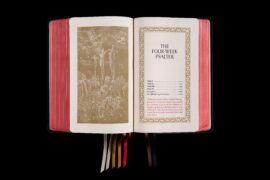
With little ones, the Hours became less perfectly consistent, but they fit more naturally into the rhythm of our day. We found ourselves praying more of them. True, sometimes we pray Morning Prayer while Justin is at work and I am cleaning, nursing, or driving to daily Mass. It still unites us with each other and the Church because we’re praying the same prayer. Evening Prayer brings our family together before toddler bedtime, and toddlers pray very actively! (Our Magnificat picture book helps.) Night Prayer is the calmest—just us two with God again, putting the little trials of the day in perspective and reminding us where to seek strength tomorrow.
It is hard to meditate attentively while praying the Rosary, but the poetry of the Liturgy of the Hours makes it easier. Sometimes, the psalms echo our joy, suffering, wonder, or fear. At other times, they’re mourning when we’re happy, or vice versa.
Either way, they move us to unite our brief day and its passing mood with the great prayer of the Church. The daily psalms anchor our time to eternity.
Emily Bandovich, Ecommerce Specialist
I think praying together every day is essential. It’s like a lifeline. Not only does it refocus our eyes on God in the midst of daily chaos, but it also definitely helps us grow closer together. Through hearing someone else pray, you really get to know the heart of the person. By sharing prayer intentions, you get to hear what is most deeply on their heart, like their concerns and worries that oftentimes you wouldn’t have known about, and you get to offer those petitions to the Father together. It is very beautiful. And it often sparks conversations that need to be had that maybe would not have come up otherwise.
On top of that, we try to go to adoration and confession together as frequently as possible. Sometimes it just helps to have that person to remind you, “Hey, it’s been a while since we’ve been to confession.” Inviting each other to the sacraments and making prayer an essential part of our day are the biggest things that come to mind.
Michael Adams, Senior Project Manager
Dei Verbum speaks of God’s revelatory act as a means for him to “invite and take them into fellowship with Himself” (DV 2). Growing in faith as a couple, then, can simply be understood as helping one another accept this invitation and deepen that fellowship. Yet, a natural tension can arise in all the lives of the faithful between the desire to grow in faith and life’s inevitable demands on one’s time, focus, and energy.
Mary and I felt this tension heightened in the early years of our marriage, especially after we welcomed our first child just one year in. Suddenly, we no longer had ample time or freedom to visit the adoration chapel, read, or simply sit in silence for an extended period of time, which challenged both of us after entering marriage with well-established habits that grounded and supported our faith. While this led us to try many grandiose ideas, there is one relatively straightforward habit rooted in Dei Verbum’s call to all faithful to study Sacred Scripture that has consistently helped us grow in faith together.
Dei Verbum explicitly encourages all the faithful, laity included, to study Sacred Scripture in order that their souls may be fed and hearts set on fire with love of God. Mary and I have taken this to heart, and to the best of our abilities, we attempt to read, study, and pray with Sacred Scripture together once a week. During this time, whether it be one hour or ten minutes, the formula is as follows. One of us opens in vocal prayer, asking the Lord to reveal himself through the Sacred Scriptures and to open our hearts to what he wishes to communicate to us in this moment. Then the other spouse slowly reads a passage from Sacred Scripture twice. During this time and for a short period of silence afterward, each of us prays internally and continues to ask God what he is attempting to reveal to us for the sake of our salvation. From there, we simply share the fruit of this prayer with one another.
This conversation ultimately leads each of us to set one goal for the coming week together. This goal comes with stipulations. First, it must be reasonably achievable—no goals of levitation, mystical encounters, or dozens of holy hours—the simpler the better, such as spending an extra few minutes in prayer, reading Sacred Scripture daily, doing a daily examen, or simply finding more to be grateful for on a daily basis. Second, we must have an advocacy plan for the goal. Not to be confused with an accountability plan, which focuses on ensuring someone does what they say they are going to do, an advocacy plan goes a step further by devising ways to help your spouse achieve their goals. This could mean doing the dishes so your wife can pray in silence for ten minutes, putting the kids down so your husband can read a book, check-ins at the end of each day, or something else.
This habit has proven effective for two reasons. First, when we engage the Sacred Scriptures through study and prayer, we participate in the very fellowship with God that Dei Verbum speaks of. Second, creating goals and advocacy plans makes us fight for each other’s faith. In this, our souls are truly fed, and our hearts are set on fire with more love for one another and God!
Andrew Tolkmith, Assistant Literary Editor
My wife and I first met at a Catholic college on the grounds of a Benedictine monastery. After we started dating, we would frequently go to daily Mass with the monks and share a weekly holy hour at the adoration chapel. We’ve shared a love of books from the beginning, so we have often read out loud together or pursued the same book at the same time, anything from the spiritual writings of St. Louis de Montfort to the fiction of Donna Tartt. One of our early fond memories from college was trying (and failing) to read Till We Have Faces by C. S. Lewis. When we were preparing for marriage, Three to Get Married by Fulton Sheen and A Severe Mercy by Sheldon Vanauken proved to be critical guides.
Since we were married four years ago and started having children, the Rosary has provided a strong foundation to our prayer. On the day of our wedding, our priest blessed rosaries made by Benedictine monks, and we have used them ever since. To lean on our Lady while dwelling on the mysteries of Christ’s life has been both a dependable routine and a tremendous source of contemplation. We’ve committed to giving heightened attention to the liturgical seasons as well, taking solace in wonderful traditions like St. Andrew’s Christmas Novena during Advent.
One gift we’ve been particularly grateful for is to share the burdens that each of us has carried through our lives. We both have our own past wounds and griefs that remain with us over time, and to reckon with those realities together has offered a unique opportunity to grow in faith: to realize the love of God and to learn to give into him when he beckons. More and more, the lyrics from “The Field” by Former Ruins bear fruit in our experience:
This side of the eschaton
What is it You ask of us
But to let You press upon
Our necks Your lighter yoke?
Rachel Bulman, Book Publicist
Jason and I grow in faith through our mutual love of Christ and prioritize our relationships with God over even our relationship with one another. We have real and authentic discussions about needing a few minutes for prayer or silence or reading alone because we each know that in order to be good spouses to one another, we must first be good children of God—known and loved by him before we can know and love one another.
In addition to authentic discussions and asking for help when we need it, we both pray the Liturgy of the Hours and spend a lot of time reading. Sometimes we read the book together, but most of the time, it’s one of us reading something and sharing it with the other for discussion. It’s a really beautiful practice. And while not directly “holy,” we do “set apart” intentional time to spend together, practicing a weekly date, which is something we have done since we got married. It doesn’t have to be fancy, but it does have to be intentional. Whether that’s dinner out, coffee on the back porch, a walk through the neighborhood, grocery shopping together, or going out for a drink, that time has to be crafted to speak heart-to-heart, give and receive affection, and simply be with one another without distraction.