
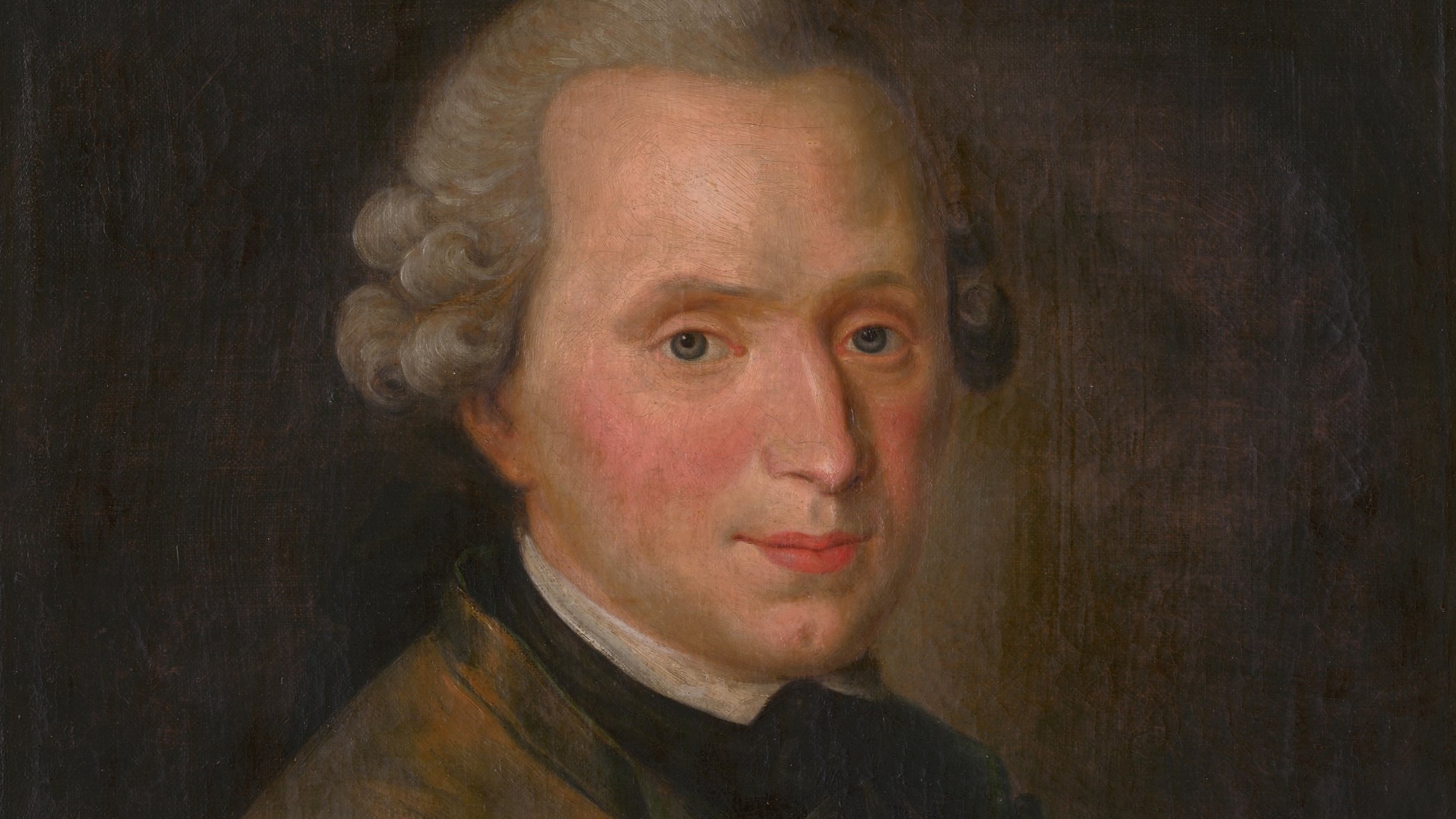
The philosopher Dr. Sebastian Ostritsch was scheduled to give a lecture entitled “Is God’s Existence a Matter of Rational Understanding? Thomas Aquinas vs. Immanuel Kant” at the Jesuits’ Munich School of Philosophy on November 27, 2025. But after protesting students took to social media, university officials canceled his lecture. The students had threatened to disrupt the lecture, reminded everyone about what happened to Charlie Kirk, and characterized Ostritsch as one of those terrible “Fundamentalisten.” For those whose German is rusty, Alvin Plantinga explains the cognitive content of the term “fundamentalist.” It refers to someone “considerably to the right, theologically speaking, of me and my enlightened friends.”
As is so common among fundamentalists, Ostritsch holds a doctorate summa cum laude from the University of Bonn, teaches philosophy at Heidelberg University, and writes academic books about German idealism. Obviously, the man is a rube.
Although Ostritsch’s lecture was banned at the Munich School of Philosophy, he was able to give his lecture recently at the University of Notre Dame. So, what is Kant’s critique of Aquinas, and why does Ostritsch think Kant’s critique fails?
Summarizing one Kantian objection to Aquinas’s cosmological argument, Ostritsch notes that Kant thought that “the cosmological proof secretly presupposes the ontological proof, which he claims to have dismantled. Therefore, Kant believes the cosmological proof to be doomed as well.” Before Kant, Aquinas also argued that the ontological proof fails. So, if the cosmological proof implicitly requires the ontological proof to work, then the cosmological proof fails.
But Ostritsch points out:
It is true that the first three ways, and most explicitly the third, end with a being whose existence is necessary. However, there is no compelling reason to understand this necessity as a conceptual or logical necessity, as it occurs in the ontological proof of God. For the necessity of God’s existence, which Aquinas arrives at in the first three ways, is not the result of a definition or conceptual analysis. Thomas does not derive from the concept of “God” that God exists, as one can infer from the concept of a “bachelor” that he must be an unmarried man. Rather, Aquinas deduces the necessity of God from empirical, sensible phenomena. If one wanted to give a name to the kind of necessity to which the first three ways lead, it would perhaps be most appropriate to speak of a “metaphysical” necessity, which, however, must not be equated with a purely logical or semantical kind of conceptual necessity.

In other words, the ontological proof is arguing that the concept of God includes the existence of God. So, there is a conceptual necessity in moving from the concept of God to the existence of God. Someone who denies God’s existence is like someone who claims that a bachelor is married. By contrast, the necessity of God that Aquinas speaks about in the Third Way is not a conceptual necessity but an ontological necessity. The necessity in question is not a matter of what our minds think on pain of contradiction (conceptual necessity) but what reality must be, regardless of what our minds think (ontological necessity).
A second critique Kant gives of cosmological arguments for God’s existence is based on Kant’s epistemology. Kant thought we can know only appearances (phenemena), but not the things in themselves (nouemena). But the cosmological arguments move from the appearances of movement (the First Way) and of causation (the Second Way) to a conclusion that there must be an unmoved mover and an uncaused cause. But the unmoved mover/uncaused cause is not an appearance but rather is a thing in itself. So, if we can know only appearances (phenemena), then we can never know the things in themselves, including God the unmoved mover and uncaused cause.
Ostritsch notes, “This line of reasoning is wholly dependent on the thesis that we cannot use the concept of a cause to draw conclusions beyond the realm of sensory experience. . . . With regard to the cosmological proof of the existence of God and Aquinas’s first three ways, Kant’s argument is, however, quite weak. It presupposes the truth of his own, presupposition-laden philosophical system.” In responding to Hume, Kant takes as good money Hume’s criticism of the principle of causality. But Elizabeth Anscombe gave us reason to reject Hume’s skepticism about causality, a view at odds also with scientific realism. Ostritsch advocates a Thomistic take on epistemology in which we can know things in themselves and not merely appearances.
Ostritsch’s new book Serpentinen is, so far, available only in German. But we can hope that Ostritsch’s defense of Aquinas’s Five Ways to God soon appears in English. And we can hope that critiques of Kant are no longer crimes calling for cancellation.