
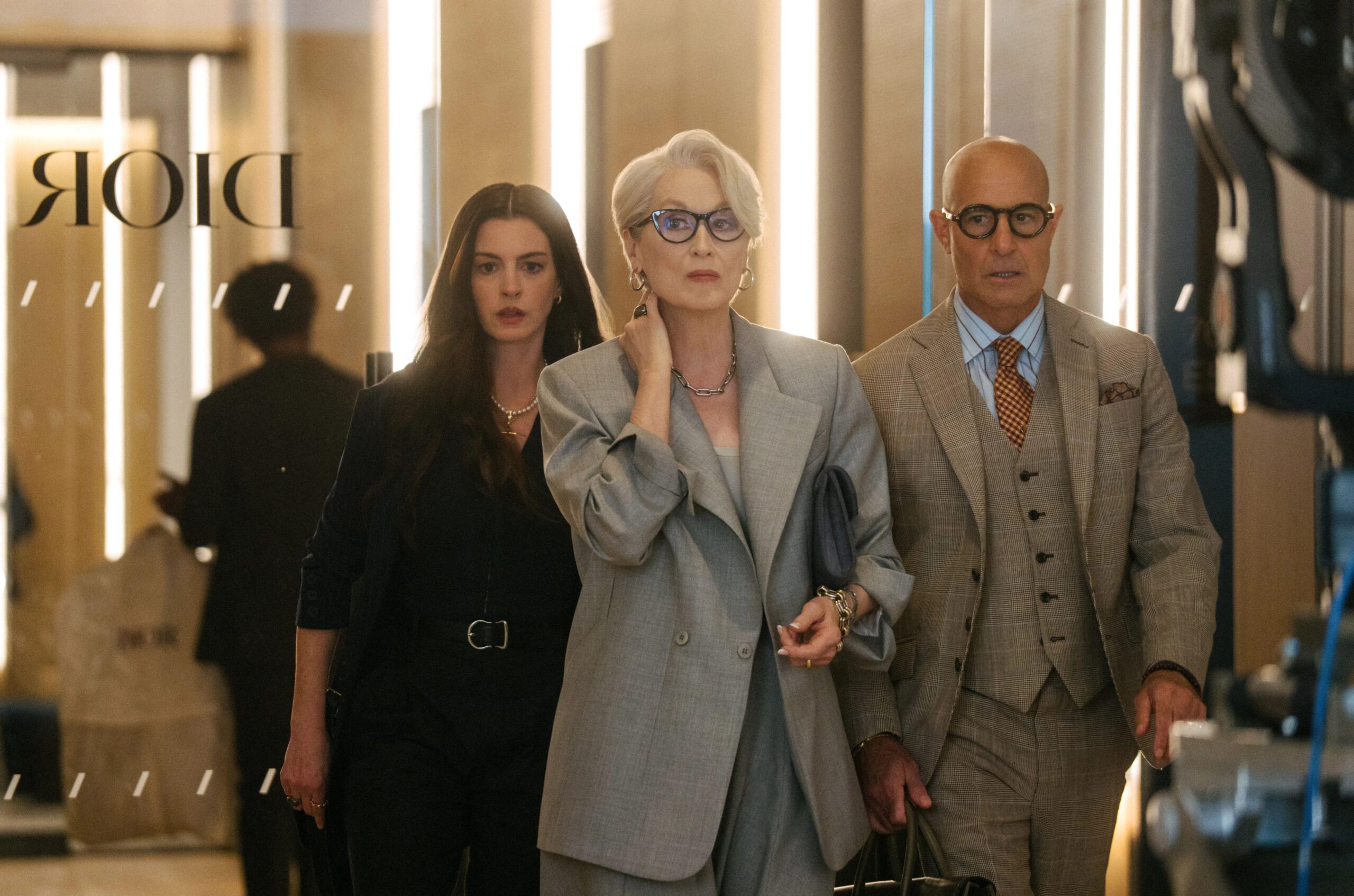
Though much praise and criticism have already been penned for The Devil Wears Prada 2, what particularly caught my attention in the film was a fleeting scene between Meryl Streep and Kenneth Branagh, who plays Miranda Priestly’s supportive (and new-to-audiences) husband, Stuart. Toward the end of the film, Miranda has discovered that a position she was promised and her beloved magazine, Runway, have been sold to a rich entrepreneur by the deceased owner’s apathetic son. In a human moment—mirroring the one she had in Paris in The Devil Wears Prada, where Andy Sachs (Anne Hathaway) comes upon a makeup-less Miranda whose marriage is falling apart—Miranda turns to Stuart and asks, “And if I leave . . . what happens? What will I have?” To this he simply answers, “What do you have? We have the twins. We’ve got one very badly behaved dog . . . and umm . . . you have me.”
But it was not this scene’s tender exchange that excited me as much as the book Stuart was holding in his hand when he said it, ostensibly his plane reading—Niall Williams’s 2019 novel, This Is Happiness. “I’m reading that!” I whisper-shouted in the theater when I saw the book come on screen. Amid the product placements of Starbucks cups and a slew of designer clothes and accessories, there was this book.
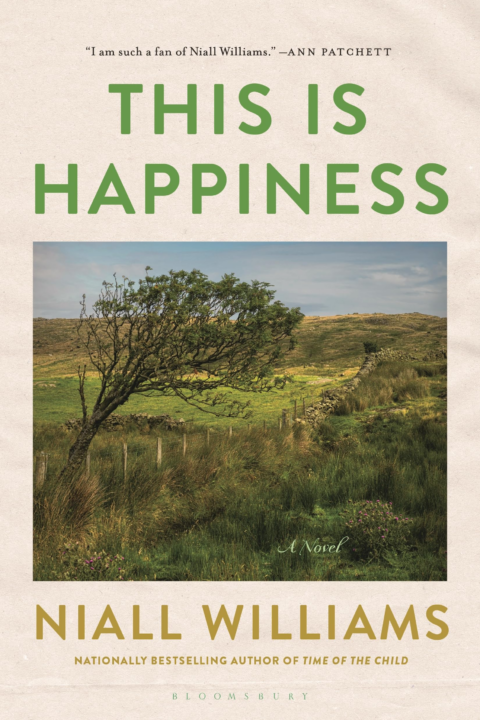
At first glance, this novel’s appearance may seem a rather insignificant detail to the film’s overall plot. But I’d venture to suggest that the book is actually a symbol of the beauty of human creativity and a call to privilege the human in our technological advances, much like Pope Leo’s call in Magnifica Humanitas when he says, “We must lovingly safeguard the grandeur of humanity bestowed upon us and revealed in its fullness in Christ, the splendor of which no machine can ever replace. True progress always stems from a heart open to others, an intelligence willing to listen and a will that seeks what unites rather than what separates” (MH 15).
“You could stop at, not all, but most of the moments of your life, stop for one heartbeat and, no matter what the state of your head or heart, say This is happiness, because of the simple truth that you were alive to say it.”
Throughout The Devil Wears Prada 2, one senses the tension between the human and the technological. The film opens upon journalist Andy Sachs and all of her colleagues getting fired by text from their newspaper. She finds that the shifts in the media landscape have also affected the fashion industry. When she returns to Runway, art director Nigel Kipling makes the comment that the magazine has become digitized, something people can passively scroll through while they’re taking a bathroom break. As we plunge deeper into the twenty-first century, we’ve become, as Pope St. John Paul II says in one of his poems, “always condensing yet hungry for content” (“Man of Intellect”). And, as previously mentioned, one of the main tensions of the film is that Runway and its parent organization fall into jeopardy when they’re sold to an entrepreneur who believes even the models can be replaced by AI. Notably, he speaks of progress and technology’s ever-escalating expansion in rather bleak terms: “The future just comes rushing at us like . . . well, like the lava of Pompeii. Our job is just to let it take what it wants to take. One day it’s going to come and it’s going to smother us all.”
Standing perhaps in direct opposition to this outlook is the plot of Niall Williams’s This Is Happiness. The fact that a physical book appears at all in a world conquered by the screen, the prefabricated, and the digital is telling in and of itself. But the choice of Williams’s novel is something more. Both in its storytelling and its richly textured poetic prose, it is a masterpiece of inspired human creation.
Set in a small Irish town in the twentieth century, the story takes place during an extraordinary summer where it both stops raining for a few months—Williams opens the book with a gorgeous description of this ever-precipitating landscape—and the advent of a new technology: the installation of electricity. It is a book in which some of the main characters opt out of electricity, despite being warned by those installing it, “Ye’ll be in darkness. . . . Ye’ll be left behind. The rest of the world will move on. Not you. Your neighbours will have it. You won’t. You’ll be in nothing but hardship and loneliness” (360).
This has been the siren song—and subtle threat—of so many of our emergent technologies. Social media. The latest phone. The ability to use AI tools to support us in our mundane tasks in order to “free us” to be ever more efficient. To resist is to be, we are told, left behind. And yet, the narrator of This Is Happiness, Noel Crowe, says, “Beneath the pinholed heaven, the night was God-dimensioned and monumental before electric light” (284). For all we can and have gained by technological advancement, there are also things we have lost, will lose. Today, we perhaps risk further diminishing our ability to live in the present moment, to meet the world with wonder and gratitude, to behold our fellow human beings in all their messy splendor.
Stuart’s call to Miranda—and to us—is to consider the book’s title, which is explained in the novel in this way: “You could stop at, not all, but most of the moments of your life, stop for one heartbeat and, no matter what the state of your head or heart, say This is happiness, because of the simple truth that you were alive to say it” (283–284). Miranda may lose her job, but she will still have those most precious to her. And this fact, despite all the heartache of potentially losing her life’s work, holds room for happiness.
While a turn of events saves Miranda’s job and her work from becoming an operation of artificial intelligence, this moment of reckoning, and the presence of a literary masterpiece holding a story in which the tenderness and goodness of human relationships figure more prominently than technological advancement, underscores the need for the human. As Pope Leo XIV says of our world today,
More gravely, the pervasive technocratic paradigm in which we are immersed, and that is amplified by the digital revolution and AI, threatens to normalize an anti-human vision. In that vision, the fullness of life is equated with having more, reducing weakness, eliminating uncertainty and exerting total control. When efficiency becomes the ultimate measure of value, human beings are tempted to see themselves as a project to be optimized rather than as persons called to relationship and communion. (113)
I close this article with a passage from the end of This Is Happiness, which uses the metaphor of electricity to describe the power of human connection:
And it did not matter that all of this would pass, that’s what occurred to me. It didn’t matter this time and place would be gone . . . that [everyone I knew] would be gone but be like remembered music or the amassed richness of a life lived. Because at that moment I understood that this in miniature was the world, a connective of human feeling, for the most part by far pulsing with the dream of the betterment of the other, and in this was an invisible current that, despite faults and breakdowns, was all the time being restored and switched back on and was running not because of past or future times but because, all times since beginning and to the end, the signal was still on, still pulsing, and still trying to love.
As we think of what we’d most like to advance in our world, may it be this—the strength of our love for one another. Beyond all our technological advances, our human ability to love is what matters, and it will outlast all things.