
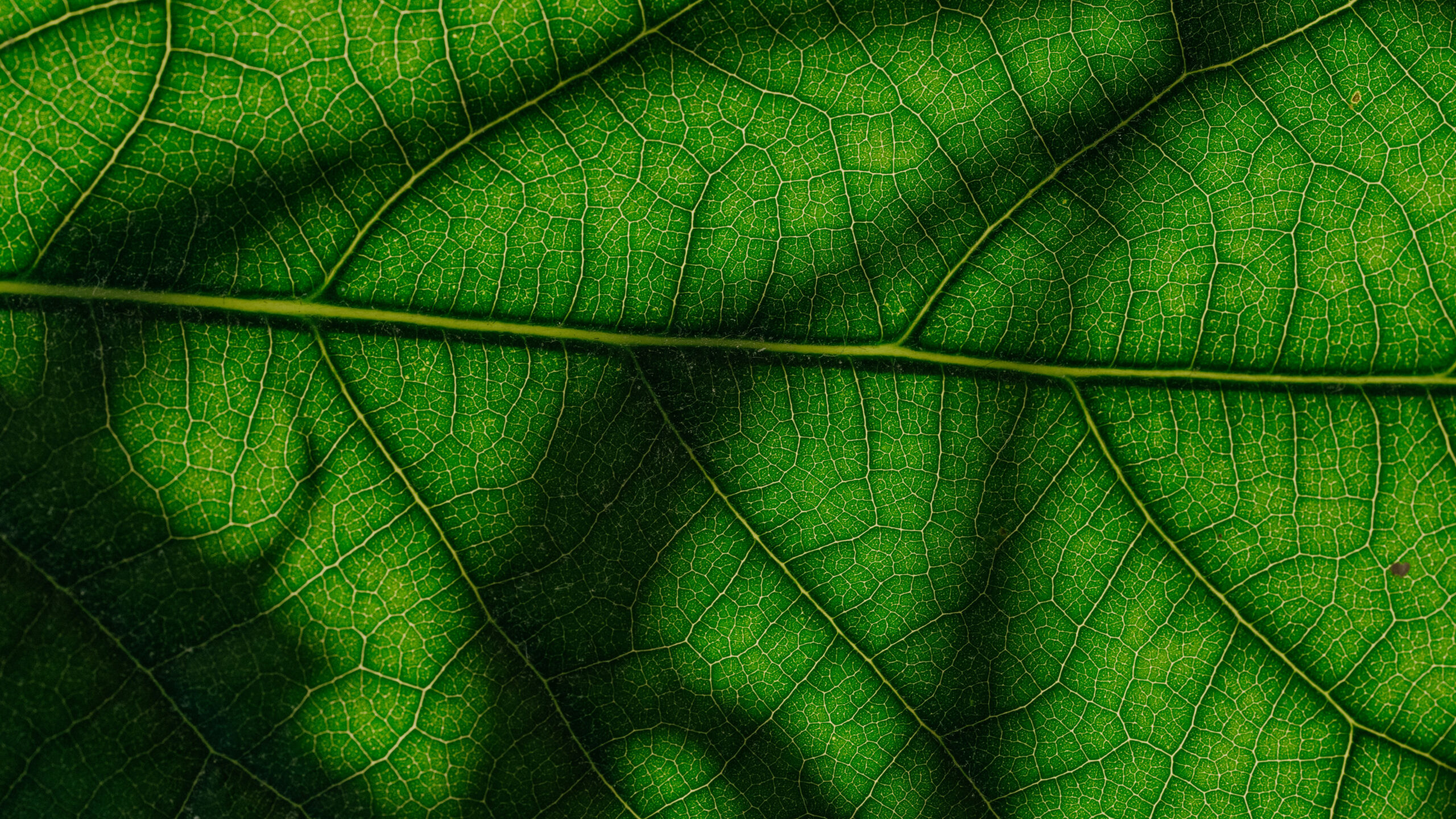
All the energy in the human body comes from the sun. The sun’s energy is staggeringly abundant: “A single second of the sun’s fiery energy could power everything that happens on Earth for a million years.”1 Yet our bodies cannot directly use any of the sun’s energy to power our vital internal processes. We are completely dependent on an intermediary: photosynthesis.
Photosynthesis is performed by plants, algae, and cyanobacteria. In photosynthesis, the electromagnetic energy from sunlight is harnessed and transformed into chemical potential energy in sugars. Those sugars are then used by the photosynthetic organisms, as well as the organisms that eat them (and the organisms that eat those organisms), to power the “thousands of chemical reactions, collectively known as metabolism.” Every time we “move or think,” we are using energy that came to us from the sun through photosynthesis.2
God’s life and love are everywhere; they are infinitely more abundant than the energy from the sun. God “not only gives [his creatures] being and existence, but also, and at every moment, upholds and sustains them in being, enables them to act and brings them to their final end” (Catechism of the Catholic Church 301). Yet human beings after the fall cannot have direct, intimate communion with God, any more than we can directly eat sunlight, without God providing the intermediary “photosynthesis” of divine revelation.
Adam and Eve were created in intimate union with God, evocatively expressed by the garden of Eden. In the beginning, eating—or not eating—photosynthetic organisms signified both biological and spiritual life: “The Lord God took the man and put him in the garden of Eden to till it and keep it. And the Lord God commanded the man, saying, ‘You may freely eat of every tree of the garden; but of the tree of the knowledge of good and evil you shall not eat, for in the day that you eat of it you shall die’” (Genesis 2:15–17 RSV). Biological life was sustained by eating, and spiritual life was sustained by loving obedience.
Jesus is the “photosynthesis” that makes it possible for us to receive God’s life and love—the Holy Spirit—in an intimate fashion once again.
Through our first parents’ disobedience, intimate spiritual communion with God was disrupted, and this disruption was described as expulsion from the garden of Eden and the “tree of life” (Genesis 3:22–23). Biological life also became much more difficult to maintain: “Cursed is the ground because of you; in toil you shall eat of it all the days of your life” (Genesis 3:17). Here we find the beginning of the universal experience of hunger.
As our bodies hunger for food, so our souls hunger for our lost communion with God: “The desire for God is written in the human heart, because man is created by God and for God; and God never ceases to draw man to himself. Only in God will he find the truth and happiness he never stops searching for” (CCC 27). Through the proper exercise of our reason, we can come to the knowledge of a “personal God” (CCC 35), much as we might recognize that the energy we need for biological life comes from the sun. But without God making himself available to us, we would continue to starve spiritually:
By natural reason man can know God with certainty, on the basis of his works. But there is another order of knowledge, which man cannot possibly arrive at by his own powers: the order of divine Revelation. Through an utterly free decision, God has revealed himself and given himself to man. This he does by revealing the mystery, his plan of loving goodness, formed from all eternity in Christ, for the benefit of all men. God has fully revealed this plan by sending us his beloved Son, our Lord Jesus Christ, and the Holy Spirit. (CCC 50)
Jesus is the “photosynthesis” that makes it possible for us to receive God’s life and love—the Holy Spirit—in an intimate fashion once again.
Photosynthesis takes place in the chloroplasts of photosynthetic cells. The intricate chemical structures of these chloroplasts will only respond to certain wavelengths of sunlight, transforming their “pure, massless” electromagnetic energy3 into chemical potential energy in the form of sugars. Chloroplasts do not absorb light in the green portions of the visible light spectrum but rather reflect it, which is why plants appear green to our eyes. The Blessed Virgin Mary was perfectly attuned to the will of God in the way that chloroplasts only react to certain wavelengths of light. She was thus able to serve as the “chloroplast” in which the invisible God, who “dwells in unapproachable light” (1 Timothy 6:16), became enfleshed as Jesus Christ (see Luke 1:38).
In the Incarnation, the “electromagnetic energy” of divinity—the “light of the world” (John 8:12)—took on a tangible human body. In his Passion, Death, and Resurrection, Jesus offered that body in sacrifice as edible, chemical potential energy: the Eucharist, the bread of life. “The bread that I will give for the life of the world is my flesh” (John 6:51). Indeed, the cross of Jesus is often described as the tree of life from the garden of Eden, signifying its power to restore our intimate communion with God.
As photosynthesis captures energy from light and converts it into food that our bodies can use, the Eucharist offers our souls the divine life in a form that we can receive: “What material food produces in our bodily life, Holy Communion wonderfully achieves in our spiritual life” (CCC 1392). In the Eucharist, gifts of physical photosynthesis—bread from wheat and wine from grapes—converge perfectly with the gift of divine “photosynthesis,” or revelation: Jesus Christ. As energy from food powers our bodies, the energy of the Eucharist powers the Church, the Body of Christ, with the Holy Spirit. Let us always remain connected to that Body, for apart from him, we can do nothing, but in him, we bear much fruit, and our joy will be full (see John 15:5, 8, 11).
1 Chris Woodford and Steve Parker, Science: A Visual Encyclopedia (DK Children, 2014), 192.
2 Heather Ayala and Katie Rogstad, General Biology (Classical Academic Press, 2020), 100. Italics in original have been removed.
3 Ayala and Rogstad, General Biology, 118.