
The souls of the righteous are in the hand of God . . . For though in the sight of others they were punished, their hope is full of immortality.
—Wisdom 3:1, 4
The Commemoration of All Souls marks a day of hopefulness, of coming together as a whole Church to intentionally pray for our faithful departed.
Though little is known about the experience of souls in purgatory, it’s been illuminating to read a couple literary explorations of this state: Dante’s Purgatorio, which aims to bring us through the landscape of purgatory; and, more recently, Tolkien’s short story, “Leaf by Niggle,” which does something similar with a focus on the journey of one (seemingly) ineffectual artist, Niggle, from life into the spaces beyond life.
What did Tolkien himself have to say about this story? In a letter to his publisher Stanley Unwin in early 1945, Tolkien writes the following:
Since you have seen ‘Leaf by Niggle’—I was going to advert to it myself, as part apologia, part confession—I need say no more. Except that the story was the only thing I have ever done which cost me absolutely no pains at all. Usually I compose only with great difficulty and endless rewriting. I woke up one morning (more than 2 years ago) with that odd thing virtually complete in my head. It took only a few hours to get down, and then copy out. I am not aware of ever ‘thinking’ of the story or composing it in the ordinary sense. (Letter 98)
A few things are striking here. Unlike his typical experience with writing, this piece came to Tolkien pretty much complete. As a writer, when I hear this, I pay attention. The inspiration that involves little toil is rare, and for me, this is a sign that the piece is all the more meant to be shared because, as Tolkien alludes, the story comes from beyond him: “I am not aware of ever ‘thinking’ of the story or composing it in the ordinary sense.”
Secondly, his wry comment that “Leaf” is “part apologia, part confession” makes sense in light of other letters to his publisher. Tolkien struggled to keep up with the multitude of tasks daily life required, like teaching and marking papers at Oxford, tending to his family, and making progress on his translation and writing projects. The result was often burnout, health setbacks, and missed deadlines. So many of his letters to his publisher and colleagues begin with apologies for the delay in his response or deliverables, which for most of us probably feels all too relatable! In a letter from 1962, Tolkien complains to Rayner Unwin (who took over the business after his father) about the Puffin edition of The Hobbit in which the word “dwarves” was edited to read “dwarfs” (a real bother to Tolkien as an expert in philology) and notes a few other misprints. At the end of the letter, he says, “I am sorry to inflict such nigglings on you (I am a natural niggler, alas!) which will not seem to anyone else as important as they do to me.”
What seems unfinished to us in this life may be continued in the next in ways beyond our imagining.
Niggle, too, is also taken up by details and struggles to manage time. We learn within the first two paragraphs of the story that he has a journey to make that he doesn’t want to make and that he is a rather unsuccessful painter because “he had many other things to do.” He’s often interrupted by his ailing neighbor, and, Tolkien tells us, “he was kind-hearted, in a way. You know the sort of kind heart: it made him uncomfortable more often than it made him do anything.”
Typically a painter of individual leaves, readers learn Niggle has been captured by a greater vision:
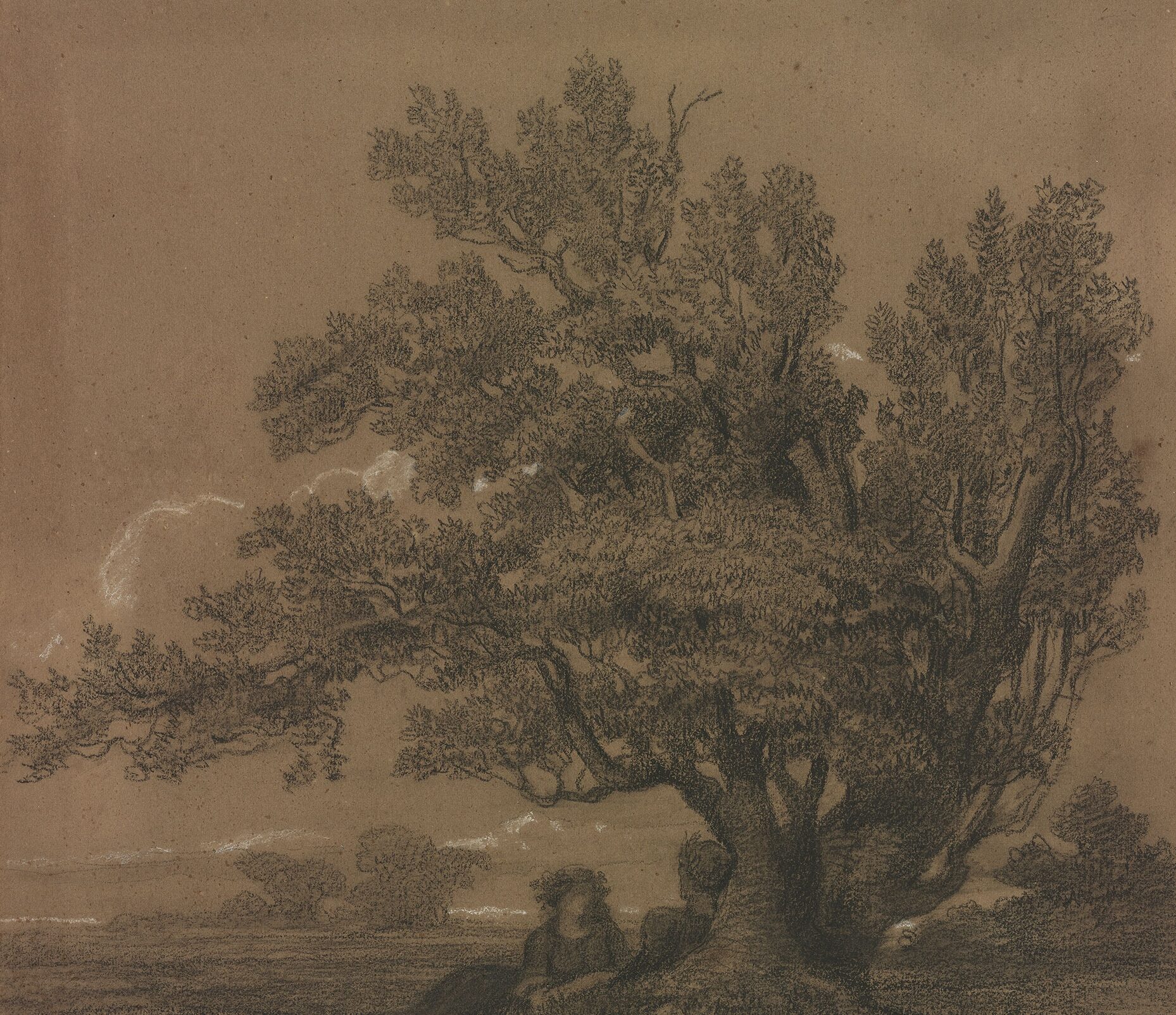
There was one picture in particular which bothered him. It had begun with a leaf caught in the wind, and it became a tree; and the tree grew, sending out innumerable branches, and thrusting out the most fantastic roots. Strange birds came and settled on the twigs and had to be attended to. Then all round the Tree, and behind it, through the gaps in the leaves and boughs, a country began to open out; and there were glimpses of a forest marching over the land, and of mountains tipped with snow.
The time for his journey comes, of course, at an unexpected hour. And the double pain of this moment is that his masterpiece is used for the utilitarian purpose of patching his neighbor’s roof.
We then enter into the strange purgatorial space that comprises the first stage of Niggle’s journey. There aren’t a lot of visual details in this space. Niggle is often in the dark. He’s tasked with odd jobs. All sense of time and place is lost. But here Niggle learns discipline: “He was becoming master of his time; he began to know just what he could do with it. There was no sense of rush. He was quieter inside now, and at resting-time he could really rest.”
Having experienced a healing of his relationship with time and rest, Niggle passes through this space into a vibrant and increasingly familiar place, which heals his relationships with others and his artistic vision. Niggle gets off a train and soon finds himself cycling through, wonder of wonders, the landscape of his own masterpiece! The great Tree he could not complete in life stands there complete. And what is more, he sees his leaves: “All the leaves he had ever labored at were there, as he had imagined them rather than as he had made them; and there were others that had only budded in his mind, and many that might have budded, if only he had had time.”
Interestingly, this detail of the leaves leads him to think about his neighbor, Parish, not as an interrupter but as a collaborator. “Some of the most beautiful—and the most characteristic, the most perfect examples of the Niggle style—were seen to have been produced in collaboration with Mr. Parish: there was no other way of putting it.” Niggle realizes there are parts of this landscape that need “continuing,” and this work cannot be completed alone. “What I need is Parish,” Niggle says. “There are lots of things about earth, plants, and trees that he knows and I don’t. This place cannot be left just as my private park. I need help and advice: I ought to have got it sooner.” Parish appears and the two learn to work together as they were unable to when they were neighbors.
What strikes me deeply about this story is the autobiographical detail that Tolkien shares in his letter to his aunt Jane Neave, to whom he sent a copy of “Leaf by Niggle” in 1962. After speaking about the ease of writing this piece and of a beloved poplar that inspired the great tree of Niggle’s world, he says:
Also, of course, I was anxious about my own internal Tree, The Lord of the Rings. It was growing out of hand, and revealing endless new vistas—and I wanted to finish it, but the world was threatening. And I was dead stuck, somewhere about Ch. 10 (Voice of Saruman) in Book III . . . and I did not know how to go on. It was not until Christopher [his son] was carried off to S. Africa that I forced myself to write Book IV, which was sent out to him bit by bit. That was 1944. (I did not finish the first rough writing till 1949, when I remember blotting the pages . . . with tears as I wrote. I then myself typed the whole of that work all VI books out, and then once again in revision (in places many times), mostly on my bed in the attic of the tiny terrace-house to which war had exiled us from the house in which my family had grown up.) (241)
Taken alongside this detail, “Leaf by Niggle” almost reads prophetically. Tolkien, like Niggle, created a masterpiece, and like Niggle’s painting, it has become a place through which others have journeyed, healed, and dwelt for a time. At the end of “Leaf by Niggle,” Niggle’s life work, as experienced during his lifetime, is referred to as a “glimpse” of the real. It becomes a place for those making the journey to the Mountains (which though present within Niggle’s original picture also mark a place beyond it, a place that if not heaven, is closer to it). As one voice from the purgatorial realm says of Niggle’s picture-turned-place, “It is proving very useful indeed. . . . As a holiday, and a refreshment. It is splendid for convalescence; and not only that, for some it is the best introduction to the Mountains.”
It moves me greatly to ponder the role of the artistic life in Niggle’s purgatorial experience. That his art serves as a portal through which others pass on the road to salvation is incredible! Also incredibly encouraging is the possibility that what seems unfinished to us in this life may be continued in the next in ways beyond our imagining. Niggle is forgotten in the world, but his life as an artist is important in the next.
In the 1962 letter to his aunt, Tolkien makes clear that “Leaf by Niggle” “is not really or properly an ‘allegory’ so much as ‘mythical.’ For Niggle is meant to be a real mixed-quality person and not an ‘allegory’ of any single vice or virtue.” And this person, in certain senses, bore resemblance to Tolkien. As his daughter, Priscilla Tolkien, explains it,
[“Leaf by Niggle”] is autobiographical in that it concerns the life of an artist and how an artist is to respond both to the pressures of his absorption in his creative ideas and to the demands of living an ordinary life in the ordinary world; in other words how is he to enjoy living in the life of the imagination while at the same time remaining a moral being sensitive to the needs of other people. This was a situation my father faced throughout his adult life: he was the breadwinner in a family with four children, he earned his living by working extremely hard as an academic scholar and teacher, and for many years had to take on extra work in order to meet his financial commitments.
So, on this Commemoration of All Souls, “Leaf by Niggle” can help us reflect on purgatory with hope. While no work of fiction can encompass the reality of this state, its illustration via the imagination of the writer brings forth certain truths about the state itself. Jason M. Baxter’s comment on Dante’s imaginative rendering of purgatory in the introduction to his translation of Purgatorio could certainly be applied to “Leaf by Niggle”: “Purgatory is a place . . . where the green of the landscape is starting to get into the hearts of the penitent, in the form of hope.”
What was given when Tolkien received this little story midway through his struggle with The Lord of the Rings was hope: hope that all his labors, and even his nigglings, would not be for nought, and hope that the Lord uses everything for our good.