
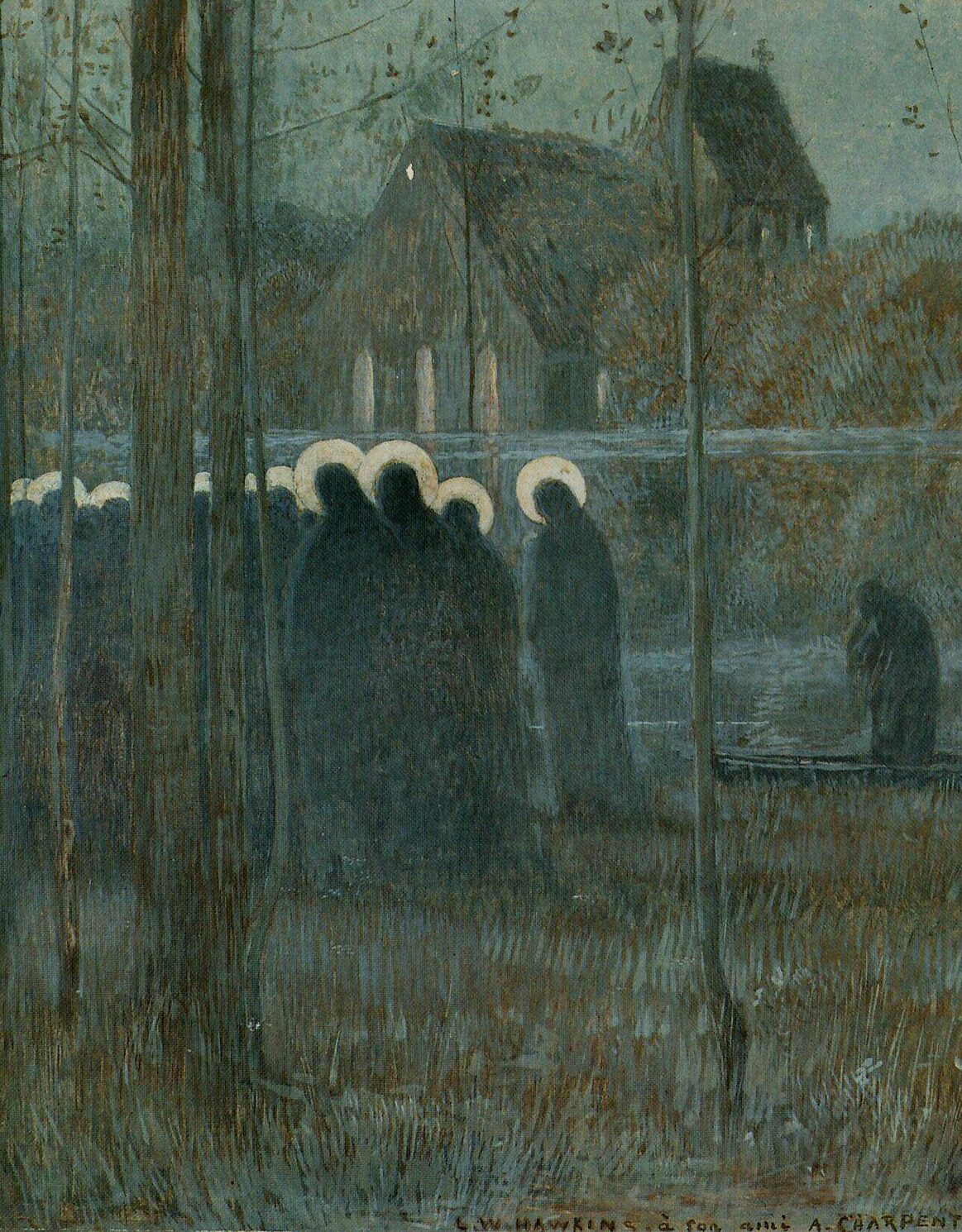
Every November 2, the Church celebrates the Feast of All Souls (a.k.a., the Commemoration of All the Faithful Departed). Typically, the entire month of November is a time when we collectively and consciously remember to pray for the dead even more intensively than we already do throughout the year.
In honor of this feast, I would like to highlight evidence in favor of praying for the dead in Sacred Scripture and Sacred Tradition. This ancient practice is, of course, connected to the Catholic doctrine of purgatory. After all, if there are souls in purgatory, then praying for them seems easily justifiable (at least to all but the most contrarian of interlocutors). Hence, I will count evidence for purgatory as evidence in favor of praying for the dead.
To start, I would like to consider the Jewish historical and religious context shortly before and during the time of Jesus. At that time, there were disagreements between different Jewish sects regarding the afterlife. As Carol Bakhos, professor of Jewish studies at UCLA, writes, “According to Josephus, Second Temple-period Jewish sects debated the reality of bodily resurrection. While the Sadducees and Essenes rejected the notion, the Pharisees adopted it. . . . In the Gospel of Mark, Jesus is said to have supported the Pharisaic view against that of the Sadducees.” In fact, as Bakhos reports in a separate article, “The Pharisees [and the Essenes] . . . believed in an afterlife in which reward and punishment would be meted out. The Sadducees, in contrast, rejected the notions of fate and of an afterlife.” In brief, the Sadducees did not believe in any afterlife (resurrected or otherwise); the Essenes believed in an afterlife but not in a bodily resurrection; the Pharisees believed in both. On this matter, Jesus affirms the position of the Pharisees. (Note: Some accounts say that the Essenes did believe in resurrection, but for our purposes, the dispute between the Sadducees and the Pharisees suffices.)
There is also evidence that some Jews during the Second Temple period believed in a kind of purgatory (intermediate state) as well as in intercession for the purification of souls therein. On this point, Kaufmann Kohler’s entry on “Purgatory” in the Jewish Encyclopedia cites a late first/early‑second century AD work called the Testament of Abraham:
The idea of an intermediate state of the soul, release from which may be obtained by intercession of the saints, is clearly dwelt upon in the Testament of Abraham, Recension A, xiv., where the description is given of a soul which, because its good and its evil deeds are equal, has to undergo the process of purification while remaining in a middle state, and on whose behalf Abraham intercedes, the angels joining him in his prayer, whereupon the soul is admitted into paradise.
Kohler thinks such a belief is even more clear in teachings of the followers of the Pharisee named Shammai, who died around 30 AD. Kohler also cites a rabbinic source (Sifre Deuteronomy), which—although it dates to around the third or fourth centuries AD—purports to present earlier teachings: “The same view, that atonement should be made for the dead, is expressed in Sifre, Deut. 210.”
The practice of praying for the dead, which we particularly emphasize during the month of November, has always been a part of the Church’s life.
As Joe Heschmeyer remarks, “Jewish people before Jesus and the Jewish people today pray for the dead. . . . There’s differences in details, but the idea that those who die and are in an imperfect state of purification benefit from our prayers to make them right with God is very much a part of Jewish belief.”
A key piece of evidence for this is found in 2 Macc 12:38–45, which records events that took place around 163–161 BC during the Maccabean revolt. After a battle, Judas Maccabeus commands that the bodies of fallen soldiers be collected. It was then discovered that the deceased warriors had all been carrying “sacred tokens of the idols of Jamnia, which the law forbids the Jews to wear.” In light of this tragic discovery, the survivors
turned to supplication, praying that the sin that had been committed might be wholly blotted out. The noble Judas . . . also took up a collection, man by man, to the amount of two thousand drachmas of silver, and sent it to Jerusalem to provide for a sin offering. In doing this he acted very well and honorably, taking account of the resurrection. For if he were not expecting that those who had fallen would rise again, it would have been superfluous and foolish to pray for the dead. But if he was looking to the splendid reward that is laid up for those who fall asleep in godliness, it was a holy and pious thought. Therefore he made atonement for the dead, so that they might be delivered from their sin (2 Macc 12:42–45).
In his book Truth is a Synthesis: Catholic Dogmatic Theology, Mauro Gagliardi argues, “The passage indirectly affirms that the dead may be found in the great beyond in a condition that is neither one of definitive salvation nor one of definitive condemnation. It is possible therefore to pray for them, so that they may be freed from the sin on the day of the resurrection. The Church always prays in the Liturgy for the living and also for the dead.”
Relatedly, an entry in the Jewish Encyclopedia argues that practices attested to in the Memor-book of Nuremburg were “not borrowed from the Christian Church, but are a product of Jewish piety; for it has always been customary in Israel to remember the dead, to pray and to present offerings for them.” In fact, the authors of this entry claim that the Christian practice was rooted in early Jewish practice, noting that “many passages in the Church Fathers indicate that the prayers for the dead were Jewish in origin, and date from the time of the Apostles, who were Jews.”
There certainly is testimony in the Church Fathers affirming the practice of praying for the dead. Tertullian (d. 220 AD), commenting on Matt 5:25–26, interprets the passage as referencing what we would call purgatory. As Gagliardi reports, Tertullian
had spoken of a place where the faults of sins are expiated prior to the corporeal resurrection at the end of times: “If we understand the ‘prison,’ of which the Gospel speaks, as the underworld, and ‘the last penny’ (Matt 5:26) as the smallest defect that has to be atoned for there before the resurrection, there will be no doubt that the soul suffers in the underworld some retributory penalty, without denying the complete resurrection, when the body also will pay or be paid in full [De anima 58]. (919).
Elsewhere, Tertullian writes, “No one who ‘has journeyed away from the body,’ dwells immediately with the Lord, unless he is to turn aside thither from the privilege of martyrdom [De resurrectione carnis 43]” (Gagliardi, 919–920).
In Epistle 51.20, St. Cyprian of Carthage (d. 258 AD) compares and contrasts those who go immediately into heavenly glory with those who, though saved, must “by long suffering for sins . . . be cleansed and long purged.” Continuing, he says, “It is one thing, in fine, to be in suspense till the sentence of God at the day of judgment; another to be at once crowned by the Lord.”
Similarly, Pope St. Gregory the Great (d. 604 AD) teaches, “As for certain lesser faults, we must believe that, before the Final Judgment, there is a purifying fire. He who is truth says that whoever utters blasphemy against the Holy Spirit will be pardoned neither in this age nor in the age to come. From this sentence we understand that certain offenses can be forgiven us in this age, but certain others in the age to come” (referencing Matt 12:31; quoted in CCC 1031).
St. John Chrysostom lends an important Eastern Christian voice: “Let us help and commemorate them. If Job’s sons were purified by their father’s sacrifice, why would we doubt that our offerings for the dead bring them some consolation? Let us not hesitate to help those who have died and to offer our prayers for them” (Hom. in 1 Cor. 41:5; quoted in CCC 1032).
Mauro Gagliardi thinks that the early Christian liturgy is particularly important proof:
The ancient Christian custom (attested to from the very beginning) of praying for the deceased and celebrating the Holy Mass for them, as documented earlier, is even stronger evidence than these patristic attestations. How can one explain this custom if not for the conviction of faith, held without a doubt, that the dead can receive a benefit from such prayers? Faith in the existence of temporary penalties due to sins and not yet paid in life—penalties that must be satisfied after death and can also be satisfied through the prayers of the living—is thus implicitly expressed in this custom (920).
Jean-Hervé Nicolas concurs, “From the perspective of tradition, what is the most anciently attested . . . is prayer for the dead, especially the offering of the Eucharist for them. Here, the affirmation of purgatory is not found in a dogmatic formula but, instead, as a practice of prayer implying such an affirmation. Lex orandi, lex credendi” (Catholic Dogmatic Theology, book 2, 503).
Further evidence is found in the Christian catacombs dating as early as the first century up to the early fifth century. Some inscriptions are quite explicit about praying for the deceased, including prayers for “liberation from sin,” and, “sometimes the writers of the epitaphs request visitors to pray for the deceased,” according to the Catholic Encyclopedia. That entry rightly notes that “so overwhelming is the witness of the early Christian monuments in favour of prayer for the dead that no historian any longer denies that the practice and the belief which the practice implies were universal in the primitive Church.”
In brief, the practice of praying for the dead, which we particularly emphasize during the month of November, has always been a part of the Church’s life. We do well to add our prayers and sacrifices to those of the faithful throughout the centuries in supplication to God on behalf of all the souls that have departed before us. May they rest in the peace of Christ!