
The house down the street is decorated with an array of tombstones of different shapes and sizes strewn across the front yard. Strings of purple lights hang across the roof. It’s all been there for about three months in preparation for the family’s favorite—and apparently only—religious holiday, Halloween. Drive around the city but take care of giant spiders, zombies, reawakened corpses, skeletons, and Grim Reapers. All Hallows’ Eve has been commercialized into oblivion, thus illustrating the Christian concept that evil has no substance of its own; rather, it is a perversion of what is good. Although it may be all in good fun, such gory paraphernalia dismiss the reality of evil by treating it flippantly.
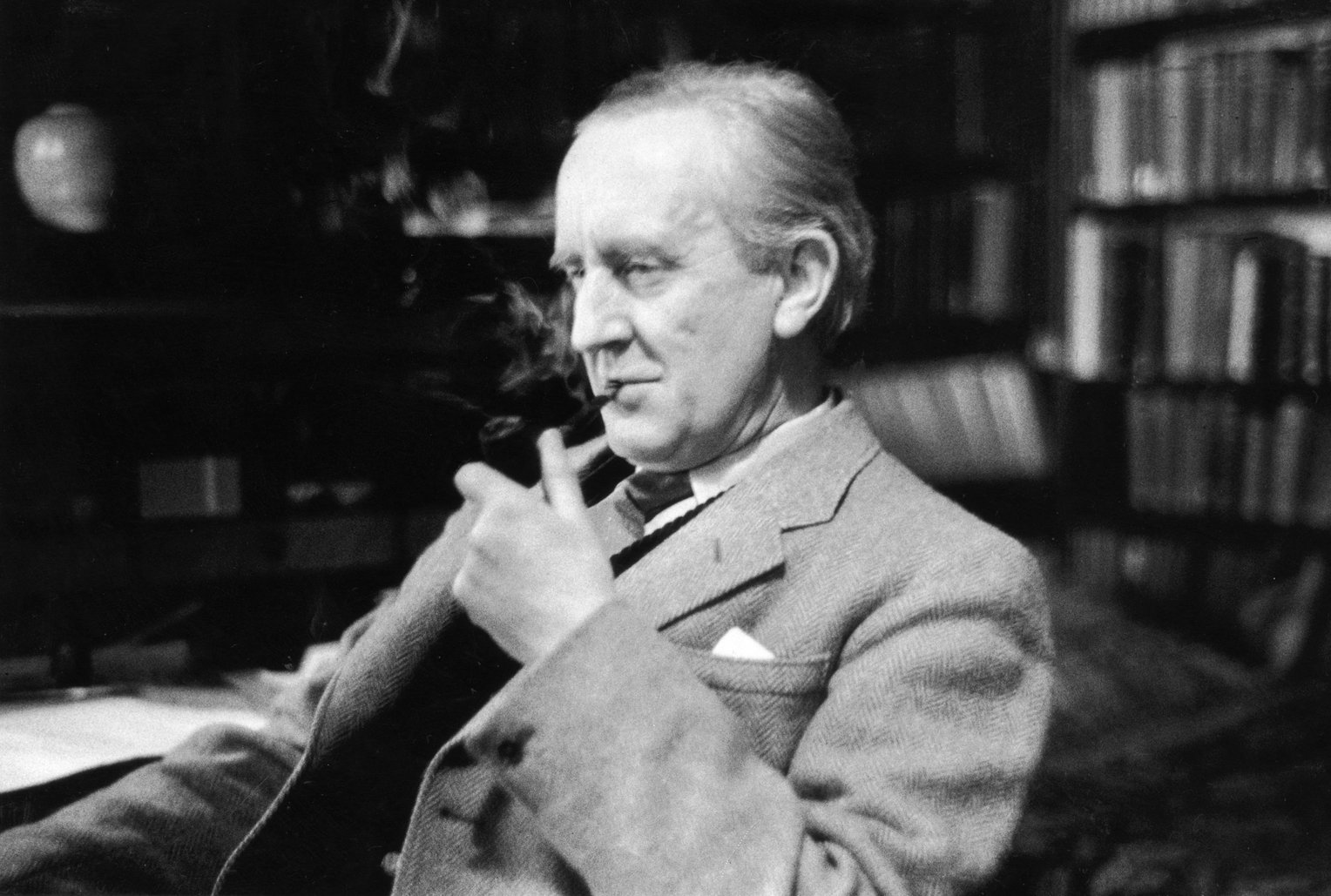
In the first half of the twentieth century, based at Oxford University and occasionally meeting at the Eagle and the Child pub, were one of history’s most productive friendships. This group, the Inklings, have played an astonishing role in explaining and defending, through prose and fiction, the Christian life. What better opportunity than the end of October to visit or revisit several of their publications to see what they might tell us about spiritual malevolence? The Inklings offer no systematic teaching on the issue, and it is beyond the scope of this essay to try to draw a comprehensive theology from their writing. It is within reach, however, to tease out vital principles on spiritual warfare that are essential in these perilous times. They did not always agree, but even the tensions between their respective contributions are instructive.
Charles Williams: “We Wrestle Not Against Flesh and Blood”
The core members of the Inklings were C. S. Lewis, J. R. R. Tolkien, Charles Williams, and Owen Barfield. In his upcoming book Tolkien and the Inklings: Men of the West, scholar Bradley J. Birzer notes that among the four, Williams may have done the most to sharpen his fellow Inklings’ sense of evil, especially C. S. Lewis, although Tolkien’s contributions may be the most elegant and far‑reaching.
Williams’s excursions to the dark side, though—risky as they were—may have enabled him to bring to his colleagues a keen awareness of the spiritual backdrop of everyday life.
If C. S. Lewis’s personality sometimes left his colleagues off balance, neither is Charles Williams easily understood, especially given his interest in the occult. Williams’s excursions to the dark side, though—risky as they were—may have enabled him to bring to his colleagues a keen awareness of the spiritual backdrop of everyday life. Granted, Williams’s fiction is an acquired taste, and some may not find it to their liking. His talent, though, lies in impressing upon the reader that, as the Apostle explains, “our struggle is not against enemies of blood and flesh” (Eph 6:12).
Williams’s first published novel, War in Heaven, as the title implies, is a contest between good and evil, involving interaction between everyday life and the timeless spiritual world in which a priest struggles against a satanic cabal. C. S. Lewis called War in Heaven a “spiritual shocker.” All Hallows’ Eve involves a foul mystic, “Simon the Clerk,” who while advancing toward his “spiritual enthronement” is successfully opposed by Lester. Recently deceased, Lester has limited interaction with the living, including her living husband, Richard. For his part, Richard perceives “a breach of spiritual law” that produces an awareness of something “so full of vileness that he almost fainted.” In a perversion of the Holy Trinity, Simon is tripartite as he exists in three different locations. In Williams’s book The Place of the Lion, a rift has occurred in the barrier between the natural and the supernatural, allowing an invasion of malicious entities who must be beaten back by benevolent forces.
C. S. Lewis: Temptation and Truth
C. S. Lewis’s novel That Hideous Strength, the third of his “Space Trilogy,” was deeply influenced by Williams. Indeed, it employs the same theme of life transpiring against a backdrop of good and evil forces. Truth and humility are potent forces of good in the fight against evil.
Lewis’s The Screwtape Letters reminds us that devious temptation lurks around every corner. In the first letter in the collection of thirty-one letters between Screwtape and his nephew Wormwood, the elder demon explains the best strategy against a human being is to keep him ignorant of the very existence of the demonic.
Whereas That Hideous Strength involves the supernatural, The Screwtape Letters is more mundane, as long as you can imagine letters between an avuncular demon and his protégé. (It may be easier to think of email or texting.) In “Letter 6,” Screwtape advises Wormwood to urge the “patient” to constantly fret about the future rather than focus on the present. “Letter 14” reveals that the human virtue that the scheming devils fear most is humility.
Although it might not seem so, Lewis greatest contribution to spiritual warfare may be The Abolition of Man. Using the Tao (from the ancient Chinese philosophy and religion of Taoism) as a symbol of the universal timeless character of truth, the book is a refutation of relativism. The book develops, Lewis writes, “the doctrine of objective value, the belief that certain attitudes are really true, and others really false.”
Objective certainty is the foundation of the religious life—or simply a good life. Yet the modern spread of cultural relativism denies the existence of good and evil. Some lament that we live in a post-truth society in which truth is good only insofar as it serves an immediate purpose. Lewis makes an important connection; namely, that personal character rests on objective truth. Otherwise, what does courage defend, and why is honor given? Of what does wisdom consist? And where are the principles upon which Prudence draws to make difficult decisions? Lewis famously observes,
In a sort of ghastly simplicity we remove the organ and demand the function. We make men without chests and expect of them virtue and enterprise. We laugh at honour and are shocked to find traitors in our midst. We castrate and bid the geldings be fruitful.
Notably, in The Abolition of Man, it is higher education that Lewis holds responsible for “de-bunking” the inherited wisdom that students may bring to the classroom that only makes them vulnerable to propaganda. A better explanation of higher education today would be hard to find: witless college students engage in protests-cum-riots about issues they barely understand.
The task of the modern educator is not to cut down jungles but to irrigate deserts. The right defence against false sentiments is to inculcate just sentiments. By starving the sensibility of our pupils we only make them easier prey to the propagandist when he comes.
Tolkien: The Ebb and Flow of Evil
The Lord of the Rings is shot through with unambiguous references to evil; to be sure, the quest of the Fellowship is to destroy Sauron’s greatest weapon. In LOTR, Tolkien is not merely addressing “evil men” or “evil deeds,” but “evil,” having an identity of its own; he employs “evil” as a noun, not only as an adjective.
The author sets the tone early in the saga:
It seemed that the evil power in Mirkwood had been driven out . . . only to reappear in greater strength in the old strongholds of Mordor. The Dark Tower had been rebuilt, it was said. From there the power was spreading far and wide, and away far east and south there were wars and growing fear. Orcs were multiplying again in the mountains. Trolls were abroad, no longer dull-witted, but cunning and armed with dreadful weapons. And there were murmured hints of creatures more terrible than all these, but they had no name.
Aragorn warns, “There is evil afoot . . . and the West is no longer safe.” The fight, moreover, is ongoing, as Aragorn explains, “Other evils there are that may come; for Sauron is himself but a servant or emissary. . . . Hardly has our strength sufficed to beat off the first great assault. The next will be greater.”
Tolkien is not merely addressing “evil men” or “evil deeds,” but “evil,” having an identity of its own; he employs “evil” as a noun, not only as an adjective.
Aragorn thus warns of a kind of dynamic ebb and flow of evil among men and women. Arguably, at this moment in history, we are witnessing a flow. The tide, moreover, is still coming in. We fear to ask what the high tide will bring.
Finally, Tolkien asserts that the fight against evil is undertaken with different spheres of responsibility. The Screwtape Letters concerned Tolkien because he thought his companion should keep a healthy distance from the study of the demonic; at best, such inquiries should be carried out by those with the proper training, and in some cases, ordination. Flannery O’Connor echoed Tolkien’s warning when she wrote that for most of us, “A working knowledge of the devil can be very well had from resisting him.”
This chain of command, so to speak, is also illustrated by the “palantíri”: think of it as a Middle Earth Facetime call. Alternatively called the “Seeing Stones,” they show real objects or events, but they may do so selectively. The stones enable individuals to see one another and communicate—but only those of a “great strength of will” dare to use them, and even then, they might do so at their peril. What was shown, moreover, could be more important than what was selectively presented. In LOTR, a palantír has fallen into the enemy’s hands (Sauron), making the use of all other existing stones hazardous. Denethor, steward king of Gondor, has another stone, and it drives him to self-immolation. The hobbit Pippin’s life is put in peril when he sneaks a look through a palantír, but Gandalf saves him from destruction.
Yet later, Gandalf announces that Aragorn, the “Returning King,” would keep the palantír as it would facilitate his reign over Middle-earth “to see what is passing in his realm, and what his servants are doing.” It seems that we ordinary hobbits should leave the palantíri to those who are better equipped for its use.
“St. Michael the Archangel, Defend Us in Battle”
It has become commonplace for priests and the congregation to recite the prayer to St. Michael after Mass. It started on October 1, 1884, when Pope Leo XIII experienced a vision of demonic forces attacking the Church. Immediately after Mass, he went to his office and penned the original, longer version of the prayer to St. Michael and mandated it be recited by priests and the congregation after every Low Mass. The practice fell into disuse after Vatican II, but in his Regina Coeli address on April 24, 1994, thirty years after Leo XIII introduced the prayer, Pope John Paul II revived the use of the prayer. He said, “I ask everyone not to forget it, and to recite it to obtain help in the battle against the forces of darkness and against the spirit of the world.”
The regular recitation of any prayer can become perfunctory, so it may be useful to recite the longer original version of the prayer once a week or so. The shortened version consists of fifty-nine words, but the original prayer spans 606 words, making it hard to skip through while distracted by the fourth-grader’s low math score or yesterday’s triple bogey on the fourteenth hole. The first and last paragraphs may whet your appetite:
O Glorious Prince of the heavenly host, St. Michael the Archangel, defend us in the battle and in the terrible warfare that we are waging against the principalities and powers, against the rulers of this world of darkness, against the evil spirits. Come to the aid of man, whom Almighty God created immortal, made in His own image and likeness, and redeemed at a great price from the tyranny of Satan.
[ . . .]
Let us pray. O God, the Father of our Lord Jesus Christ, we call upon Thy holy Name, and as supplicants, we implore Thy clemency, that by the intercession of Mary, ever Virgin Immaculate and our Mother, and of the glorious St. Michael the Archangel, Thou wouldst deign to help us against Satan and all the other unclean spirits who wander about the world for the injury of the human race and the ruin of souls. Amen.