
Not long ago, we witnessed a breakthrough. Over two years after being abducted in a Hamas-led surprise attack in southern Israel, the last living hostages (of an original 250) were finally released. This unfolded as part of a broader cease-fire arrangement between Israel and Hamas, which includes the hostage-prisoner exchange, a military drawdown, humanitarian aid delivery, and broader efforts at stabilization, governance, demilitarization, and economic development. As the gunfire stops and the recovery and reform begin, there are no shortage of questions about what comes next. As Elliott Abrams, a senior fellow for Middle Eastern Studies with the Council on Foreign Relations, broods, “As world attention turns away when the fighting stops, these intractable issues will be no less difficult to solve than they have in the past decades.”
And so the questions begin.
Who will lead Gaza? How will reform be implemented? Who will secure the humanitarian aid and how will the peacekeepers be protected from violence? What involvement will the greater Middle Eastern nations have in this endeavor and what are their agendas/angles? What will be the United States’ role in this process and how long will it last? Will this peace last? And what are the ramifications, not only in days to come but in decades to come?
I don’t know the answers to these important and vexing questions.
In a likely apocryphal but telling quote, the young Winston Churchill, serving as secretary of state for the colonies in 1921–1922, lamented, “Peace in Ireland and the Holy Land?! I am to do in a year what all the prophets, saints, and diplomats have failed to do for centuries?” Others have described the disentangling of the problems and passions of the Middle East as nothing less than a modern-day Gordian knot. Famed physicist Richard Feynman spoke generally about the human predilection for overconfidence: “The first principle is that you must not fool yourself and you are the easiest person to fool.” But perhaps the words of the Nobel Prize–winning Polish poet Wisława Szymborska captured our current uncertainty best in what she claimed were the three words that formed the beginning of all she wrote: “I don’t know.”
I don’t know the answers to these important and vexing questions.
No one does.
But here is what I do know.
When Jesus Christ sat with the holy and the unholy—Pharisees and scribes, tax collectors and sinners—and unfolded his parables of the lost, he taught us something we all saw recently on our television screens. When the shepherd discovers one of his hundred sheep is lost, he goes in earnest, passionate search of it. When the woman loses one of her ten coins, she lights the lamp and sweeps vigorously in search of it. And when the father of the prodigal son knows his beloved son has gone away, he earnestly prays for and longs for him.
And what happens when the lost are found?
Rejoicing.
The shepherd hoists the sheep onto his shoulders and calls friends and neighbors, exclaiming, “Rejoice with me because I have found my lost sheep.” When the woman discovers her missing coin, she calls friends and neighbors, exulting, “Rejoice with me because I have found the coin that I lost.” And when the father discovers his son coming from a distance on the path home, he runs to him and rejoices to his servants,
Quickly bring the finest robe and put it on him; put a ring on his finger and sandals on his feet. Take the fattened calf and slaughter it. Then let us celebrate with a feast, because this son of mine was dead, and has come to life again; he was lost, and has been found. (Luke 15:22–24)
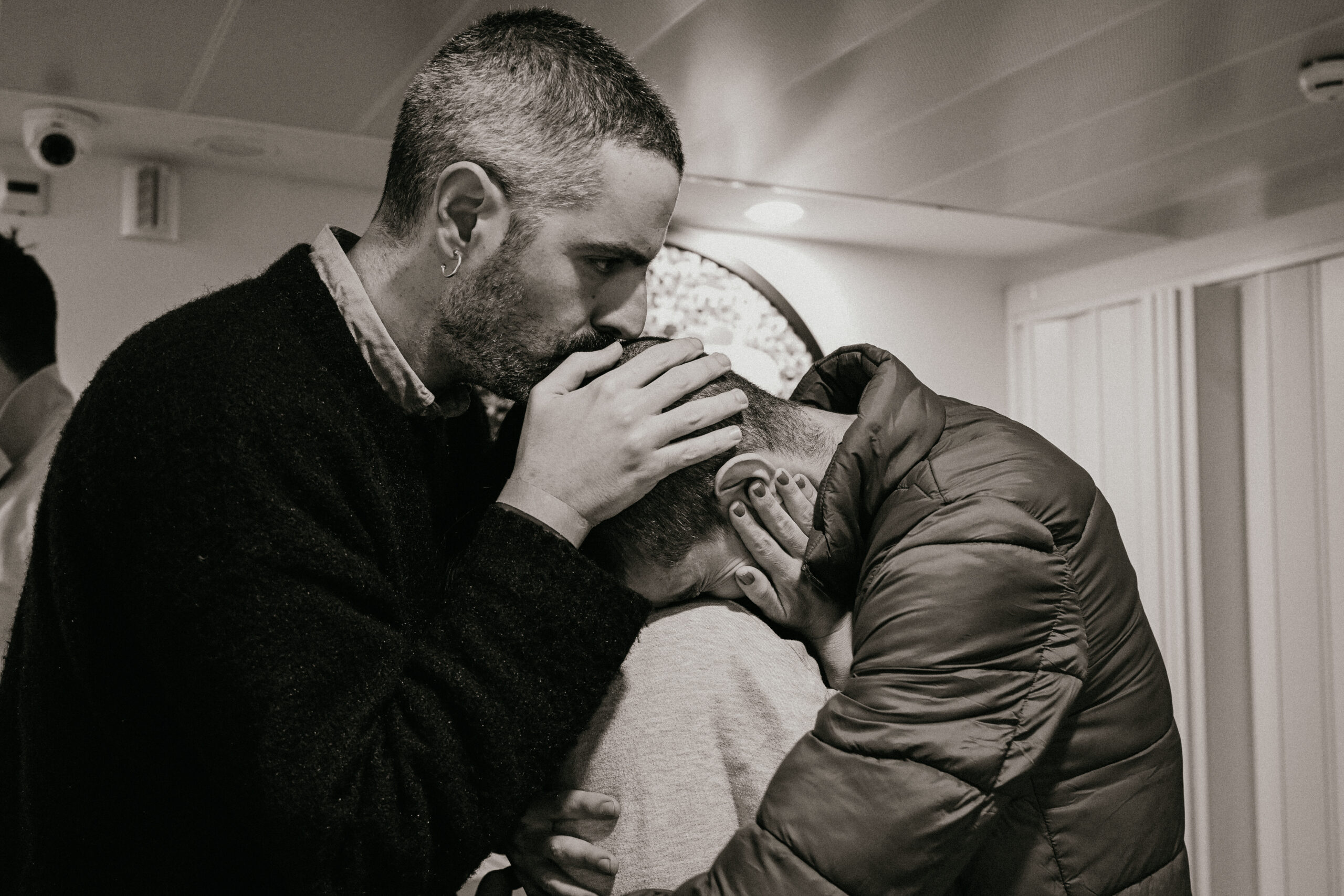
That’s what I saw on the faces of mothers and fathers, wives and siblings, children and friends as they embraced their lost one with wailing and tears and smiles and laughter. The lost one has come home.
This is love. This is hope. This is joy.
Stunning. Staggering. Unexpected. And indescribable.
I don’t know a lot about what will come next. But to borrow from John Keats, I am comfortable living for a time in a state of “negative capability,” a state thick with “uncertainties, mysteries, doubts, without any irritable reaching after fact and reason.”
Because in those moments of reunion, I saw God. And that is enough for now.