
The pilgrims follow by the sacred waters
And arm in arm go the sons and daughters
The drums are rolling and forward bound
They’re calling spirits up from the groundAnd there’s a magic in the sound of their name
Here come the Irish of Notre Dame.
—Cathy Richardson, “Here Come the Irish”
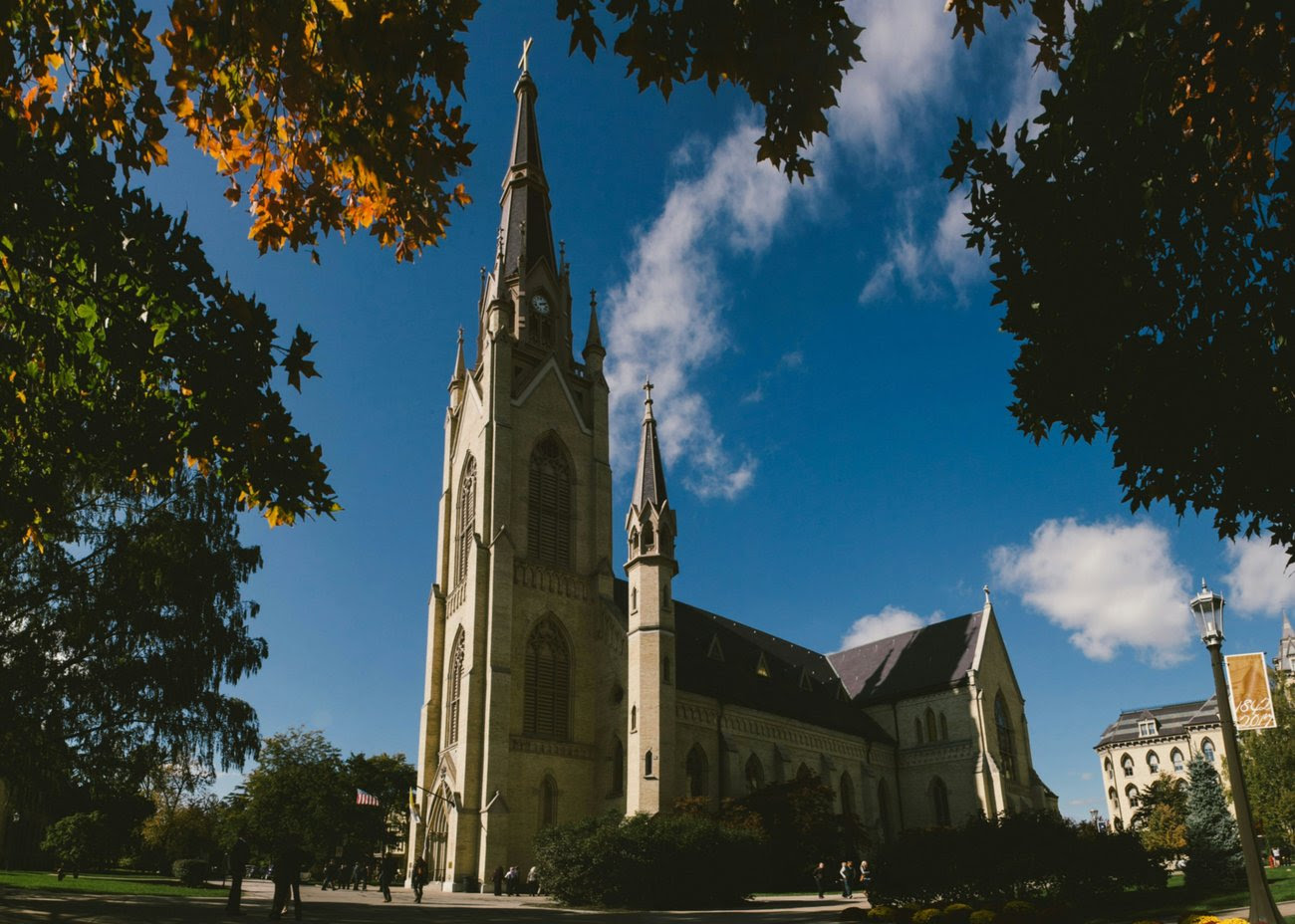
Two weeks ago on a Sunday morning, when my wife and I arrived for Mass at the University of Notre Dame’s Basilica of the Sacred Heart, I almost tripped as we walked through the narthex.
There were backpacks piled everywhere.
As we entered the nave to find our daughter (a Notre Dame student) saving our seats (she had to arrive forty minutes early), we were struck by the sheer number of students. Dozens and dozens of catechumens and candidates participating in the Order of Christian Initiation of Adults (OCIA) populated the reserved front bank of pews. Scores of other students sat quietly or knelt in prayer throughout the basilica. Well-dressed and quiet, they were either alone or with a group of friends. While a few visiting parents (like us) accompanied their college-aged children, most students were present to worship of their own volition. And throughout the Mass, forty to fifty people stood in the back of the basilica.There simply wasn’t enough room to sit.
During the Mass, a handsome young man ascended the stairs of the Neo-Gothic pulpit and read from the fifteenth chapter of Sirach,
If you choose, you will keep the commandments and so be faithful to his will.
He has set fire and water before you; put out your hand to whichever you prefer.
A human being has life and death before him; whichever he prefers will be given him.
For vast is the wisdom of the Lord; he is almighty and all-seeing.
His eyes are on those who fear him, he notes every human action.
A lovely young woman read from the second chapter of First Corinthians,
Brothers and sisters:
We speak a wisdom to those who are mature,
not a wisdom of this age,
nor of the rulers of this age who are passing away.
Rather, we speak God’s wisdom, mysterious, hidden,
which God predetermined before the ages for our glory,
and which none of the rulers of this age knew;
for, if they had known it,
they would not have crucified the Lord of glory.
The priest’s homily reflected on Jesus’ teaching that he had come to fulfill the law, not abolish it. Have high standards, father encouraged. Students, he puckishly warned, should beware the trap of setting low standards in scoring “just high enough” on the final exam to get an A in the class. To, likewise, comfortably “settle” in one’s spiritual life would be a dangerous and deadening philosophy.
The greatest risk in the modern world of distraction and uncertainty, missteps and misunderstanding is to forget who and what we are.
And when Holy Communion was being distributed, the choir loft (populated by, you guessed it, college students) softly intoned Chesnokov’s stirring “Salvation is Created.”
The rest of the weekend was spent on or around campus. We strolled by St. Olaf’s ice chapel—now partially melted—where, less than a week before, nearly two thousand students (including my daughter) gathered for an open-air Mass. It was a Mass so eagerly attended that the priests ran wildly short of the Eucharist. We toured the Raclin Murphy Museum of Art where we saw Gustave Doré’s riveting bronze sculpture, The Madonna; Paul Henry Wood’s captivating Absolution Under Fire, portraying Fr. William J. Corby, the chaplain at the Battle of Gettysburg and future President of Notre Dame offering God’s forgiveness to a kneeling Irish Brigade during the Civil War; and Rembrandt van Rijn’s etching, Christ Disputing with the Doctors, portraying the Lord of Creation humbling the scholars of the age. We cheered the Notre Dame women’s basketball team on to victory after which we threw our arms around each other and sang the words of the alma mater,
Notre Dame, our Mother,
Tender, strong and true,
Proudly in the heavens,
Gleams thy Gold and Blue.And our hearts forever,
Praise thee, Notre Dame;
And our hearts forever,
Love thee, Notre Dame!
Finally, we found our way back to my daughter’s dorm room where, amid walls adorned with posters and a banner of a smiling Marcus Freeman boasting, “Our coach is hotter than your coach,” there was a crucifix hanging and a dispenser of Holy Water—fixed on the door jamb by her lovely roommate on the day she arrived—filled with fresh blessed water.
From the woman who cleaned our hotel room and yelled, “Be blessed!” to the young lady at Hammes Bookstore who sold me Fr. James Connelly’s The History of the Congregation of Holy Cross and insisted, “You know, the whole world would be a better place if people believed in morals,” the University of Notre Dame breathes Catholicism.
This is what I saw at Notre Dame.
Recently, consternation has descended upon both the Notre Dame campus and the greater Catholic world surrounding the hiring of a scholar (as chair of a notable Notre Dame Institute) who is known for outspoken views that run counter to Catholic social teaching. In response, essays have been penned, statements have been made, and prayers have been prayed. A recent question that has become a refrain asks, “Has Notre Dame lost its way?” Today, I learned, this scholar has withdrawn herself from consideration.
But as the dust settles from this upset, I turn quietly back to the Sunday my wife and I spent with my daughter on campus. What is the true culture we have discovered on this campus? My daughter’s experience and our own (as parents) at Notre Dame has been rich in both faith and reason. To be sure, academic excellence and Catholic orthodoxy, academic freedom and good-faith dialogue, a cherishing of the past and a hope for the future are what drew us to this great university. After all, our faith is replete with the intellectual and spiritual giants of St. Thomas Aquinas and St. Augustine, St. Hildegard of Bingen and St. Teresa Benedicta of the Cross, St. Jerome and St. Catherine of Siena. As Catholics, we know what intellectual brilliance and heartfelt faithfulness look like together. They are the full fabric of the faith.
Now, if you are wondering how the Catholic faith truly fares at Notre Dame, I would invite you to come down and see. Sit in Mass and feel the word of God wash over you. Glance across the pews at the college students becoming Catholic (by the scores) in a world running away from faith. Walk through the Morris Inn or the bookstore and engage workers who carry kindness on their lips and God in their hearts. Lose yourself in the sacred art of the Raclin Murphy Museum with its celebration of Mary as Mother and Christ as Child. Sit in a hall with world class theologians and philosophers (and professors of other disciplines) who don’t coldly deconstruct God, but who engage him as the greatest of all studies—the origin of the true, the good, and the beautiful. And stay long enough after a dazzling sporting event to drape your arms across the shoulders of family, friend, or fellow Irish fan singing the familiar strains of the alma mater.
And our hearts forever,
Love thee, Notre Dame!
G. K. Chesterton once wrote, “We are all under the same mental calamity; we have all forgotten our names. We have all forgotten what we really are.” My friends, the greatest risk in the modern world of distraction and uncertainty, missteps and misunderstanding is to forget who and what we are.
What I saw at Notre Dame reminded me. And it is extraordinary when we remember.
Our Lady, pray for us.