
All Scripture citations are from the Acts of the Apostles unless otherwise noted.
The truth of the resurrection of Christ is central in the Acts of the Apostles. One of the ways we see its importance is in two speeches given by St. Paul. The first speech appears in Acts 13, where Paul addresses a Jewish synagogue, and the second is his famous speech to the Athenians in Acts 17. Although the resurrection of Jesus is central to both speeches, they are quite different from each other, and in each Paul employs unique rhetorical strategies. Comparing and contrasting Acts 13 and 17 is helpful in order to appreciate the centrality of the resurrection of Jesus for Paul, as well as the various strategies he deploys for its proclamation.
Acts 13: Paul’s Speech in the Synagogue
Paul’s speech in the synagogue in Antioch in Pisidia (modern-day Turkey) occurs during his first missionary journey and marks his first major speech in Acts. As Paul prepares to give his speech in the synagogue, he enjoys some advantages:
- He shares a common religious, cultural, and linguistic heritage with his audience. He can say to them, for example, that God “chose our ancestors” (13:17).
- Paul gives his speech within the context of a synagogue liturgy on the Sabbath. During the liturgy, the “law and the prophets” are read (13:15).
- After the reading of the law and prophets, an invitation is extended to Paul and his companions by the synagogue officials: “My brothers, if one of you has a word of exhortation for the people, please speak” (13:15).
Thus invited, Paul stands and begins his speech, which has three basic parts. First (13:16–25), Paul walks his audience through the salvation history of Israel, beginning with the exodus and going up to the time of King David. This is a history with which they would have been familiar. In rapid succession, Paul calls to mind the exodus, the time of the judges, the prophet Samuel, Saul, and finally David. Speaking of David, Paul tells his audience, “From this man’s descendants God, according to his promise, has brought to Israel a savior, Jesus” (13:23). Importantly, Paul first introduces Christ as Sōtēr, “Savior,” and emphasizes how all the salvation history of Israel has led to Christ.
Paul has to convey to his audience the theological importance of the resurrection.
Second (13:26–33), Paul proclaims to them the “word of salvation” concerning the passion of Jesus. He tells how Christ was rejected by his own people, who “by condemning him . . . fulfilled the oracles of the prophets that are read sabbath after sabbath” (13:27). Although innocent, Christ was condemned and executed. When all that had been written about him had been accomplished, “they took him down from the tree and placed him in a tomb” (13:29). Paul has now arrived at the center of his speech and is in position to proclaim the truth of the resurrection:
They took him down from the tree and placed him in a tomb. But God raised him from the dead, and for many days he appeared to those who had come up with him from Galilee to Jerusalem. These are now his witnesses before the people. (13:29–31)
Third and finally (13:34–41), Paul has to convey to his audience the theological importance of the resurrection. One of his tactics is to juxtapose two Scriptures, Isaiah 55:3 and Psalm 16:10. What can at first look like a random juxtaposition of Old Testament texts turns out to be a nuanced reading of Scripture in light of the resurrection. It is worth spelling out Paul’s argument in this last part, by which he proclaims the risen Christ as the hesed of God.
Paul quotes Isaiah 55:3 and Psalm 16:10 from the Septuagint (the Greek translation of the Hebrew Scriptures). Both of these verses share a key word, put in bold below:
And that he raised him from the dead never to return to corruption he declared in this way, “I shall give you the benefits assured to David.” That is why he also says in another psalm, “You will not suffer your holy one to see corruption.” (13:34–35)

The words in bold are “the benefits” from Isaiah 55:3 and “holy one” from Psalm 16:10. In Paul’s Greek, “the benefits” and “holy one” are the same word, hosios. Moreover, this same Greek word in both verses is being used to translate the Hebrew word hesed, one of the most important words in the Bible. Hesed is an extraordinarily rich word and is often translated as “loving-kindness.” In the Hebrew Bible, hesed is a primary attribute of God.
What is the upshot of all this? Paul is asserting that Christ is the one being spoken to in the prophecy of Isaiah 55:3 and that “the benefits” (i.e., hesed) promised by God are in fact the resurrection itself. This, in turn, means that the risen Christ bears the hesed of God. In virtue of the resurrection, all of God’s hesed becomes concentrated, as it were, on Christ, who now embodies God’s loving-kindness. Hence Paul’s quotation of Psalm 16:10. Christ is God’s “Holy One,” (i.e., the one bearing hesed) and so would never see corruption. God’s loving-kindness and mercy are incorruptible and are vindicated as such in the resurrection of the Lord.
Acts 17: Paul’s Speech in Athens
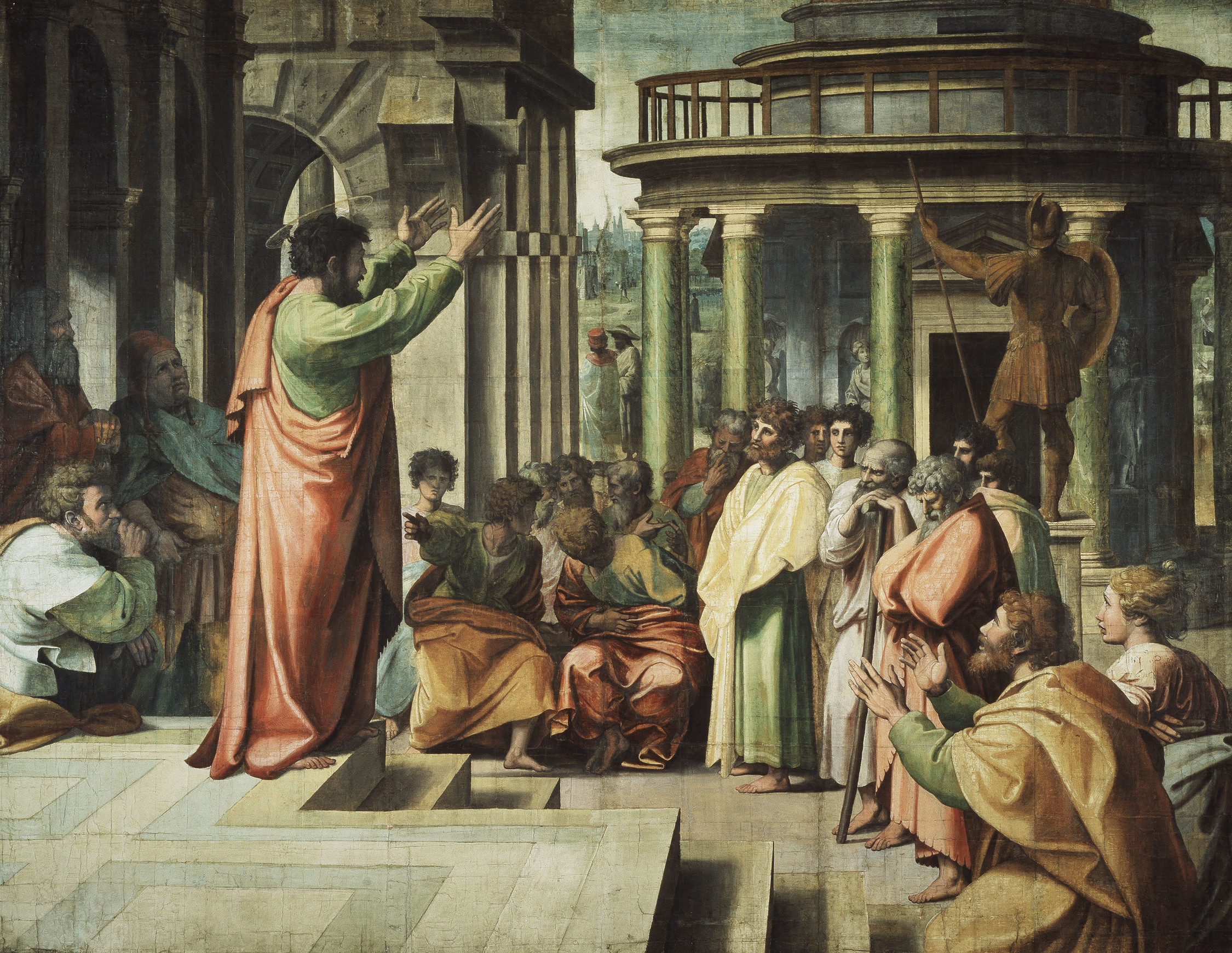
Let’s turn to Acts 17, the second important speech. By the time Paul arrives in Athens, he is in the midst of his second missionary journey. Once again, Paul must proclaim the resurrection of Jesus. However, the scene and context of his speech in the Areopagus of Athens is vastly different from that of the synagogue speech in Acts 13. Here, he faces some formidable disadvantages:
- Although Paul speaks Greek (see 21:37) and so shares a common language with his audience, his audience is entirely pagan. There is no common religious heritage to which Paul can appeal in his speech, and so he will be unable to draw simply and directly upon the Hebrew Scriptures.
- A bit of Paul’s firebrand personality shines through, giving the speech and surrounding context a slightly polemical tone. As Paul walks impatiently around Athens, Acts tells us that “he grew exasperated at the sight of the city full of idols” (17:16). He begins to debate daily in the “public square” (i.e., the Athenian agora) anyone and everyone, including Epicurean and Stoic philosophers (17:17–18).
- The Epicureans and Stoics mock him, wondering who this strange person is who keeps speaking of “Jesus” and “resurrection” (17:18). They think Paul has some “new teaching” (17:19) and are intrigued. Acts tells us that the Athenians and foreigners used their time for nothing else than the telling and hearing of new things and hoped to be entertained by what Paul had to say. There is a sense in which Paul is portrayed as a kind of new Socrates, bearing news about things divine.
Paul is undaunted by such challenges . . .
Paul is undaunted by such challenges, and brought thus into the Areopagus by the philosophers of Athens, he begins his speech. As with his speech in Acts 13, Paul’s speech in Athens can be divided into three parts. First, Paul has to establish a beachhead, a point of contact, between the Gospel he proclaims and the pagan Greek culture. He finds his launching point from within the Athenian culture itself:
Men of Athens, I see that in every respect you are very religious. For as I walked around looking carefully at your shrines, I even discovered an altar inscribed, ‘To an unknown god.’ What therefore you unknowingly worship, I proclaim to you. (17:23)
Paul will begin by proclaiming the unknown god to them, whom they already obliquely worship. Who is this unknown god? Paul proclaims him with a number of titles:
He is the maker of the world and all that is in it (17:24). As maker of all things, he is in no way contained or encompassed by created reality.
He is Lord of heaven and earth and so dwells “not in sanctuaries made by human hands,” for no such fabricated dwelling could hold him. This is a God who stands, as it were, outside of all created reality and is not to be numbered among the things that have been made. As supreme Lord of all, he is not served by human hands, as are the many false gods of the Athenians (17:24–25).
He is the giver of life, breath, and everything to all. He made the whole of the human race and fixed the times, seasons, and boundaries of the world (17:25–26). As such, this God is near to men. That is, far from being a remote and disinterested deity, God is accessible, “‘For in him we live and move and have our being,’ even as some of your poets have said, ‘for we too are his offspring’” (17:27–28).
He is the judge, who has overlooked former times of ignorance but now demands repentance from all people everywhere: “Because he has established a day on which he will ‘judge the world with justice’ through a man he has appointed, and he has provided confirmation for all by raising him from the dead” (17:30–31).

The second thing to remark about Paul’s speech is his direct appeal to Athenian culture. This is of a piece with his overall strategy of evangelizing a pagan audience. He notes, but does not outrightly condemn, their religiosity and instead refocuses their attention on the unknown god, as already noted. But also, Paul weaves Greek poets into his proclamation of the nearness of God and directly quotes the poet Aratus of Soli: ‘For in him we live and move and have our being,’ even as some of your poets have said, ‘for we too are his offspring’ (17:28).
Why is Paul able to incorporate Greek culture into his project of proclaiming the risen Christ? He can do so because he knows that the light of the Gospel does not wash out and obliterate the natural light of human reason. Human reason is capable of knowing certain truths about God, truths to which Paul appeals in his speech. The light of the Gospel, however, is a healing and elevating light. Grace raises the human mind to grasp truths that are unattainable by reason alone. Paul’s incorporation of those elements of Greek culture that are suitable to his proclamation of the Gospel lends him a certain credibility and helps prepare his audience to accept the new and higher light of faith. In the dictum of St. Thomas: Grace does not destroy nature but perfects it.
The light of the Gospel, however, is a healing and elevating light.
Third and last, Paul closes his speech with the proclamation of the risen Christ. It is noteworthy that Paul does not directly name Jesus during his speech. Instead, he tells the Athenians that the resurrection is a manifestation of God as supreme judge of the world, whose judgment will now be brought about “through a man he has appointed.” This man is, of course, Christ the Lord, and Paul tells them that God has provided “confirmation for all” by raising him from the dead (17:31). This confirmation is made available to the Athenians through the testimony and preaching of Paul.
Both Acts 13 and 17 show us Paul’s masterful rhetorical skills, by which he draws from the surrounding culture in which he finds himself to aid his central proclamation of the risen Jesus. In this way, Paul is a model for preachers and evangelists today, who like him can bring the healing and purifying light of the resurrection to gather the many desperate and diffracted lights of the surrounding culture.