
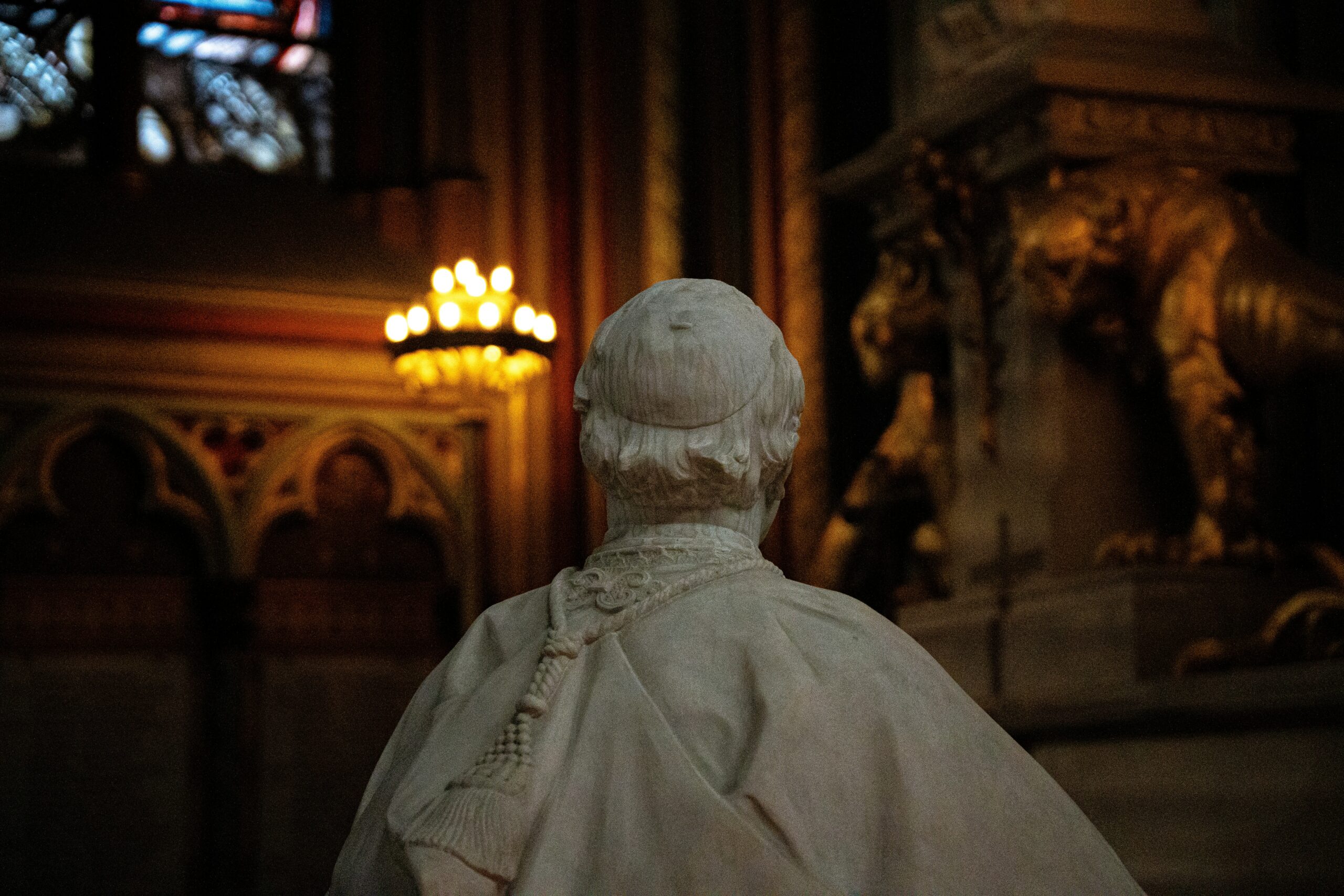
As the world awaits the first encyclical from the new pope, Catholics should pick up encyclicals from past vicars of Christ. Though their Latin names may suggest otherwise, these encyclicals—or papal letters—aren’t just for theologians to enjoy. I began reading them as a high school student and discovered, to my surprise, encyclicals are both accessible and comprehensible to the average Catholic: a free way to better understand the current pope, Church history, and the moral and intellectual life of the Church.
As early Church history shows, the apostles and their successors have always used letters to instruct, correct, and commend the faithful. Some of the most well-known passages of the New Testament come from the apostle Paul’s epistles to various Christian communities: those in Rome (the letter to the Romans), Corinth (the two letters to the Corinthians), and Philippi (the letter to the Philippians), for example. Other New Testament letters were written by the first pope himself (the two letters of Peter), the beloved disciple (the three letters of John), and leaders of the early Church.
The term “encyclical” comes from a late Latin term for “circular” or “general,” denoting an important letter from the pope, copied by and forwarded from one bishop to the next. Though not infallible by nature, encyclicals convey vital messages from the vicar of Christ, whose wisdom extends far beyond his particular pontificate.
The more recent tradition of papal encyclicals dates back to Pope Benedict XIV, who wrote dozens of encyclicals throughout his pontificate, his first being Ubi Primum in 1740—a letter unfolding the duties of bishops. Beginning with Pius IX in the 1840s, popes more frequently used encyclicals to clarify Church teaching, especially in response to some pressing religious issue or cultural concern. Notable recent encyclicals include Francis’s Laudato Si (on our stewardship of the Earth), Benedict XVI’s Deus Caritas Est (on God’s nature of love, and all this means for Christians), and John Paul II’s Evangelium Vitae (on the sacredness of all human life). The names of encyclicals come from a phrase—e.g., John Paul II’s “faith and reason” or “Fides et Ratio”—in the first few words of the letter. Originally written in Latin, encyclicals are translated into many languages and posted publicly on the Vatican’s website.
Though encyclicals have the bishops of the Church as their primary audience, all Catholics can—and should—benefit from reading these letters. My high school theology teacher frequently assigned us encyclicals for class reading. Though we were well formed by our Catholic education, none of us were biblical scholars or moral theologians—just average seventeen-year-olds with a standard level of reading comprehension.
The Church opens the riches of her moral and intellectual tradition to all the faithful, for these riches belong to them as members of the Body of Christ.
I was not alone among my classmates in finding this experience formative in my understanding of the current pontiff and my place in the Church’s ongoing moral and theological dialogue. Through Laudato Si, Pope Francis became more concretely my teacher, father, and shepherd.
Read Encyclicals to Understand Our Pope
Our current pope took his name from Leo XIII, who is most well known for his 1891 encyclical Rerum Novarum, a foundational document in Catholic social teaching. In Rerum Novarum, or “Of New Things,” Leo XIII explained to the Church what a just society looked like in the wake of the Industrial Revolution. Though written more than a century ago, the pope’s language remains clear and compelling to twenty-first-century readers. In the introduction to the encyclical, Leo XIII paints an image of a world not unlike our own in which “vast expansion of industrial pursuits and the marvelous discoveries of science” couple with “prevailing moral degeneracy” to unmoor society from the common principles by which it was once governed.
Leo XIII lays forth a set of ideas to both resolve strife in the workplace and guide the faithful toward everlasting peace in heaven. These principles—the Catholic Church’s response to the economic and social upheaval of the modern world—are just as vital to our present society as they were in Leo XIII’s time.
In the encyclical, the pope enumerated core rights of the human worker, including private property and just, livable wages (RN 4–7, 9). He discussed the dignity of both worker and employer, citizen and state, laying out their duties toward one another (RN 20). He encouraged Catholics to improve the condition of the working class, but only by “rightful means”—an important limitation for today’s social activists (RN 55). Above all, Leo XIII encouraged the faithful to see the supernatural dimension of promoting a just society.
“Justice demands that, in dealing with the working man, religion and the good of his soul must be kept in mind,” Leo XIII wrote (RN 20). He later added, “Since the end of society is to make men better, the chief good that society can possess is virtue. Nevertheless, it is the business of a well-constituted body politic to see to the provision of those material and external helps ‘the use of which is necessary to virtuous action’” (RN 34).
In this remarkable document, Leo XIII asserted the Church’s central role in providing and promoting moral and monetary charity, of teaching men how to live together as good stewards of the earth and wayfarers on the way to heaven.
The new pope, Leo XIV, will undoubtedly draw on his nineteenth-century predecessor’s legacy: something he himself has already acknowledged.
“Pope Leo XIII in his historic encyclical Rerum Novarum addressed the social question in the context of the first great industrial revolution,” Pope Leo XIV said in an address to the College of Cardinals on May 10. “In our own day, the Church offers to everyone the treasury of her social teaching in response to another industrial revolution and to developments in the field of artificial intelligence that pose new challenges for the defence of human dignity, justice and labour.”
By reading encyclicals like Rerum Novarum, Catholics can understand and appreciate the ways Leo XIV’s papacy reflects and extends Leo XIII’s concern for a just society.
Read Encyclicals to Better Engage with the Church
I came of age in an unprecedented era of media coverage of the papacy and all that emanated from the Chair of St. Peter. Needless to say, with such intensive coverage, there was no shortage of interpretation and misinterpretation, self-serving bias and crafty revisionism.
When my high school theology teacher handed us Francis’s 2015 encyclical Laudato Si, I had no idea what to expect. In many ways, I hardly knew Pope Francis. My views of him were formed, in part, by media headlines and hearsay, which competed at times with the fidelity and trust in the Holy Father that I had been raised to have.
Laudato Si opened a whole world to me. It was beautiful. Beginning with the words of St. Francis from which the encyclical gets its name—“Praise be to you, my Lord”—Pope Francis wrote about our stewardship of the earth and God’s creatures (LS 1). His heart bled for the ways modern civilization has trampled upon the natural world but also human beings. The powerful exhortations of Laudato Si revealed Francis’s heart to me: In a whole new way, I saw him as a father, rightly concerned for the physical and moral implications of human carelessness and sin.
The commentary Francis offered on the danger of relativism, our responsibility toward the created world, and the antidote to a consumerist “throwaway” culture are still relevant now, ten years after the encyclical was published.
Later in high school, I had the privilege to see Francis in person several times while in Rome for Holy Week. The experience moved me, especially because of how tangibly I felt Francis’s fatherhood when he waved to the crowds in St. Peter’s Square or extended his blessing after a Wednesday general audience. I owe so much of this to my theology teacher, who exposed us to Francis’s mind and heart through the encyclical Laudato Si.
Conclusion
Catholics often mistakenly believe their lay or non-academic status excludes them from the intellectual life of the Church. The Vatican is deliberate in making hundreds of years of encyclicals available to the public, free and translated into many languages, on its website. The Church opens the riches of her moral and intellectual tradition to all the faithful, for these riches belong to them as members of the Body of Christ.
So print out Benedict XVI’s Spe Salvi (“Saved in Hope”) to reflect on in this Jubilee Year of Hope, or tackle Paul VI’s Humanae Vitae with a friend. Watch Catholic concepts like “social teaching” or “a culture of life” come alive to you as you read their primary sources. Better engage with the moral and intellectual life of the universal Church, so you can discover new depths in your spiritual life and share those depths with others.