
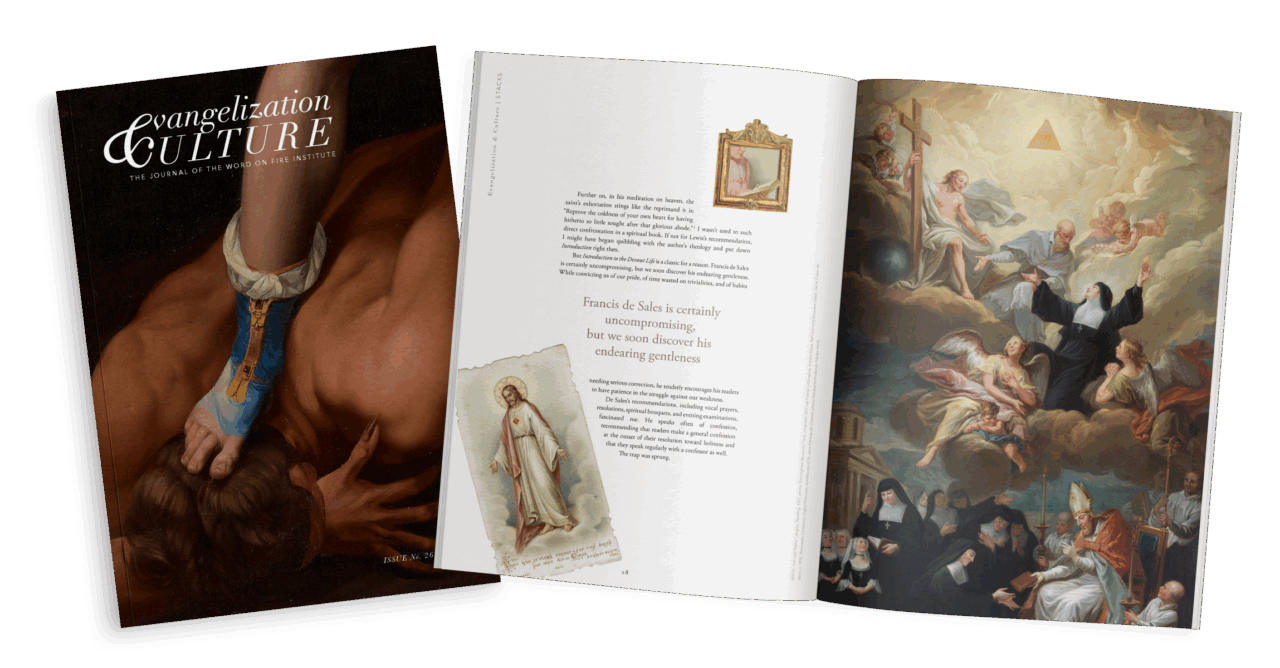
The following features the “Film” column published in the Word on Fire Institute’s Evangelization & Culture journal, Issue 26: Saints.
A man steps into a confessional.
“I’m going to kill you, Father. I’m going to kill you ’cause you’ve done nothing wrong.”
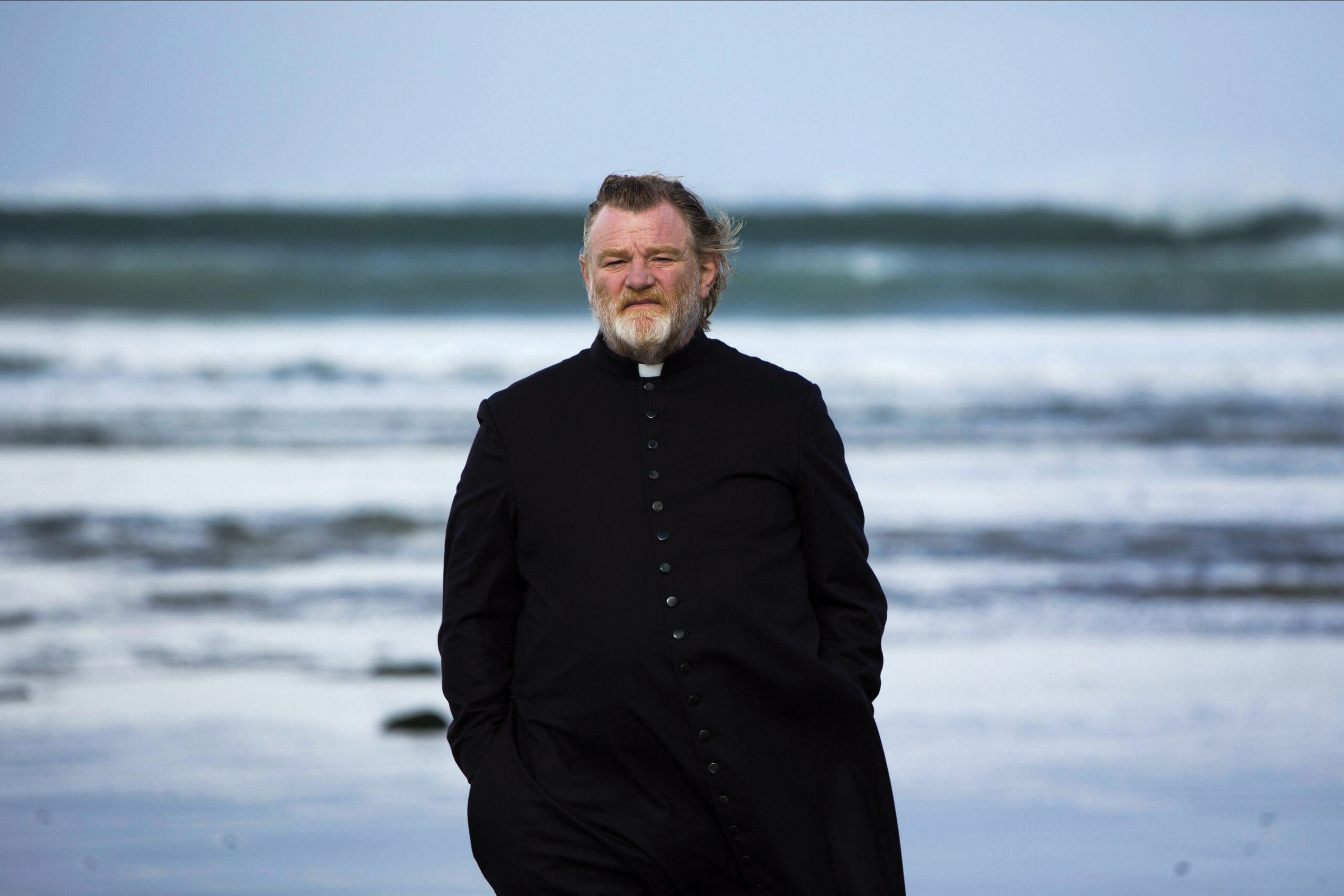
John Michael McDonagh’s 2014 drama Calvary is not for the faint of heart. The film unfolds as a grisly who-will-do-it, pitting the gritty-but-kind Fr. James Lavelle (Brendan Gleeson) against a cast of parishioners who hate him and everything he stands for.
Foremost among them is the mysterious man in the confessional who confesses to Lavelle not his own sins but the atrocities of another. A different priest—now dead—sexually abused him for years of his childhood. The details of his suffering alone earn Calvary its R rating. Now as an adult, the abused seeks his own victim, singling out Lavelle as a sacrificial offering to his altar of searing fury.
“There’s no point in killing a bad priest,” he tells Lavelle. “But killing a good one? That’d be a shock, now.”
The man—whose identity Lavelle at once guesses but the viewer does not—ushers the good priest into his own Passion Week, choosing the following Sunday as the day of reckoning. Lavelle’s coastal Irish village yields a long list of embittered suspects, all of whom seem irredeemable.
Will it be twenty-something Milo, who quietly admits his lust is driving him mad?
Will it be the butcher, who cleaves meat and beats his cheating wife?
Will it be the bankrupt bartender with a grudge against the Church, the sodomizing police inspector, or the disgraced banker with nothing left but money?
The parallel—and more compelling—story that emerges from the wreckage of the parishioners’ lives is one of sin, forgiveness, and modern sainthood.
Ever since a man stepped out of his tomb one Sunday morning, goodness has surprised in a way evil never will.
From the beginning, Calvary presents a curious idea, one that goes against many of our modern sensibilities: Virtue is interesting; vice is boring. We see it most clearly through the eyes of one of the most openly anti-Catholic characters, an unbelieving doctor who proclaims some lives “less sacred than others” and later extinguishes a cigarette on a bloodied human heart in a petri dish.
Standing outside the hospital where Lavelle has just administered last rites to one of his patients, Dr. Harte acknowledges to Lavelle, “The atheistic doctor, it’s a clichéd part to play. There aren’t that many good lines. One part humanism to nine parts gallows humor. Playing you, though, now, that might be interesting . . . the good priest.”
For a little while, Harte and his townsmen’s laundry list of sins delivers shock and intrigue. There’s domestic abuse, self-harm, and substance abuse galore; then adultery, sodomy, pedophilia, and pornography; never mind the looming murder. But very quickly badness becomes passé and predictable, and goodness—in large part through Lavelle—emerges as a real source of fascination, both to the townspeople and to the viewer.
Lavelle’s fellow priest, Fr. Leary, retreats from the townspeople wide-eyed in horror, never to fulfill his mission of evangelization. His sin is one of omission, for which Lavelle holds him in utter contempt. Lavelle instead strides into the no-man’s-land of his parishioners’ souls to offer sight to the blind.
At one point, Lavelle tells his wayward daughter (his wife died before he became a priest): “I think there’s too much talk about sins, to be honest. And not enough talk about virtues. . . . I think forgiveness has been highly underrated.”
The good priest acts out this exacting forgiveness both personally and through his ministry. It costs Lavelle everything. For better or for worse, this mercy is magnetic—those around Lavelle alternate between childlike wonder at this other way of life and a gleeful, malevolent desire to drag Lavelle into their muck.
Ever since a man stepped out of his tomb one Sunday morning, goodness has surprised in a way evil never will. More shocking to the villagers than a local serial killer’s dreadful crimes is Lavelle’s choice to visit him in prison. More shocking to the viewer than the car crash that killed her husband is the devout Teresa’s meek and trusting response to this terrifying new cross.
Lavelle struggles against the nihilism his parishioners latch onto and against his own proclivities to anger and drink. But he persists in seeing the imago Dei in both others and himself.
The brazen Veronica, who openly cheats on her husband with the town mechanic, voices what most in the village feel about themselves.
“I’m a lost cause, Father,” she tells Lavelle.
“No one is a lost cause,” he replies. She lets him have the last word.
In one scene, the gay prostitute Leo taunts Lavelle, who regards his offer with boredom and disapproval. But later, when Lavelle comes across him in the town bar, he shows a real concern for the young man—especially after Leo mentions offhand his own story of childhood sexual abuse.
“Do you need help? Are you okay?” Lavelle asks him.
“There’s nothing wrong with me, Fada,” Leo replies, annoyed. “I’m feeling fine.”
But before the movie is through, the viewer gets a brief glimpse of Leo again, sitting on the edge of a rumpled bed after a hookup, deep in thought. Goodness has arrested him—will he take up its call?
The modern saint must be bold, yet gentle; sensitive, yet unafraid; just, yet merciful; conscious always of the world beyond our own.
As Lavelle’s Passion Week winds on, each day bringing its own horrors—and glimmers of grace—he makes no serious attempt to contact the police about his death threat. Perhaps he senses some greater justice at work. Though the movie takes place in Ireland, it is set in the wake of the sex abuse crisis in the American Catholic Church, and Lavelle is cognizant that “sorry” is not enough. He stands silent before the mysterious Pontius Pilate of the Irish village, sentenced to death for a crime he did not commit.
Calvary is no classic saint film. The grim and gritty life of Fr. James feels far more true to life than the pastels and choral soundtracks of other saint movies—and is all the more heartrending for it. McDonagh depicts the modern crisis of meaning with a hero who appreciates all of its horror. What Calvary largely leaves out is Lavelle’s relationship with Christ: The priest appears first and foremost as a man of principles. This in part broadens the audience of the film beyond the already devout to those whose lives more closely resemble those of the villagers—searchers who will discover something absolutely enthralling in Lavelle’s witness.
But a watchful viewer will discover hints of Lavelle’s intimacy with the One who gives him strength. The priest’s daughter, when she visits, observes that his room has no photographs, not even of his late wife. The only image is the Lord’s, on a crucifix hung above a kneeler in the room. Christ alone is his comfort.
There is no real escaping the cross in a movie named Calvary, though Lavelle has his figurative moments in the Garden of Gethsemane. Suffering is inescapable, but the good priest chooses the “better part” of suffering for his God rather than in defiance of him. And because of it, Lavelle’s life is a triumph—an explosion of virtue and mercy and staggering goodness.
Though fictional, Lavelle’s life gives the viewer something of a road map to sanctity in the midst of cynicism, indifference, and blazing hatred. “If he can do it,” the viewer is right to reason, “so can I.”
The modern saint must be bold, yet gentle; sensitive, yet unafraid; just, yet merciful; conscious always of the world beyond our own. To ascend the heights of Golgotha in the twenty-first century, turn to Calvary.