
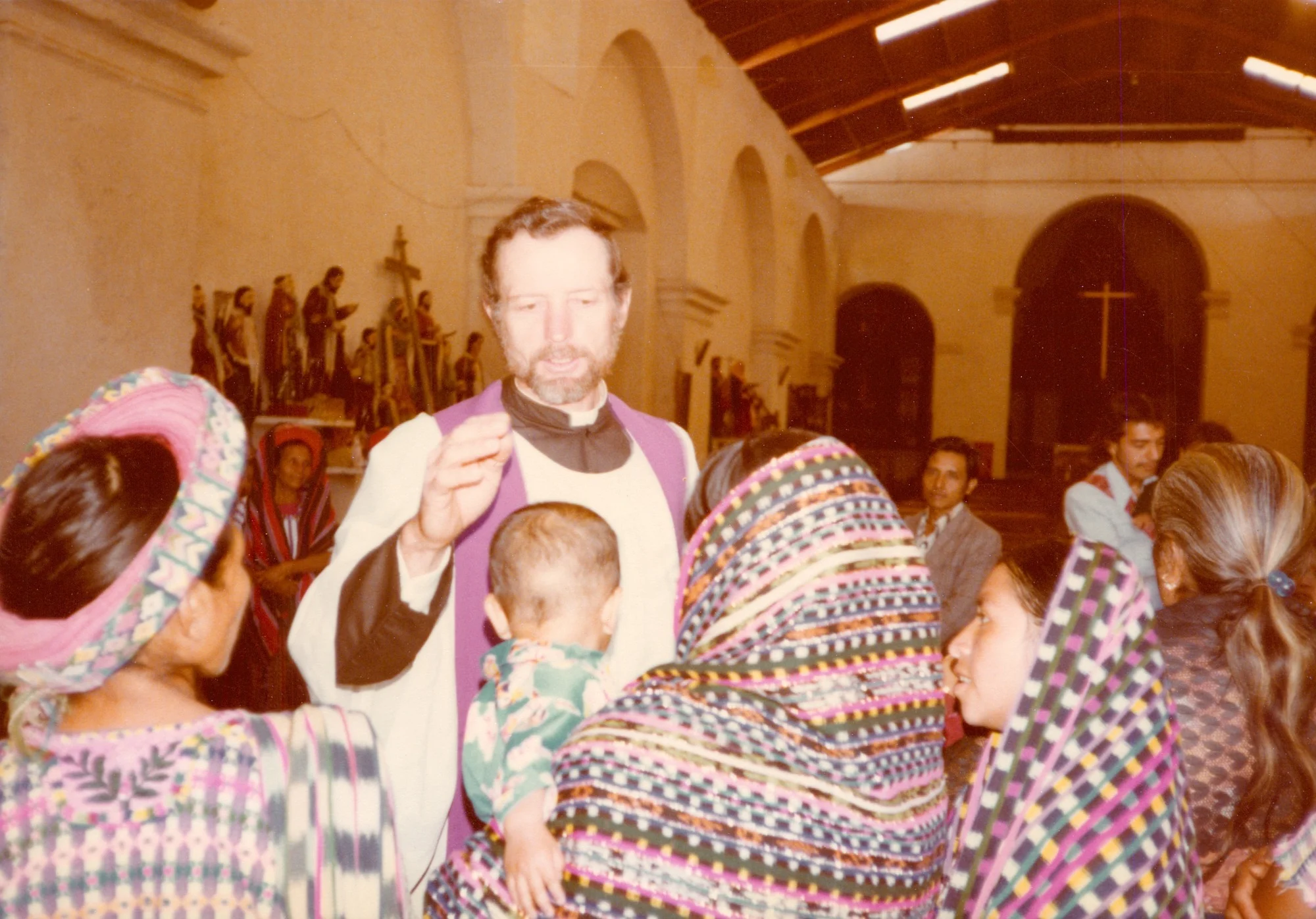
The documentary American Martyr: The Stanley Rother Story offers a beautiful and touching glimpse into the inspiring and holy life of Fr. Stanley Rother, a missionary priest from Oklahoma who was killed serving the people of Guatemala in 1981. The film threads together interviews from family members and fellow priests from Oklahoma as well as the indigenous people for whom he ultimately gave his life in Santiago Atitlán.
Like many of the blesseds, Stanley Rother hailed from humble beginnings. He grew up during the Dust Bowl in the small town of Okarche, Oklahoma, where the first seeds of his calling emerged. Not only was he raised in a strong and faithful Catholic family, but he learned from his family how to be a farmer (a gift and skill that God will later use in his missionary work). The young Stanley sensed a call to priesthood and entered seminary in San Antonio. However, since he studied agriculture in lieu of Latin in school, he found seminary to be difficult. He was certainly not the most academically gifted student, and eventually he was asked to leave. Thankfully, a bishop in Oklahoma saw that Stanley had a genuine call to the priesthood and eventually helped him earn a spot in a seminary in Maryland, where he finished his studies and was eventually ordained a priest. Fr. Rother’s resilience in the face of difficulties and his willingness to pursue what he understood to be a true calling from God serve as a prelude to the virtue, resilience, and courage he would later demonstrate in his priesthood.
Soon after Fr. Rother was ordained, he was sent as a missionary to Guatemala as a result of Vatican II’s call to American parishes to help evangelize Central and South America. Fr. Rother was drawn to serve these people out of a love for Christ, but he was also uniquely equipped to do so because of his skills as a farmer. His talent for farming and ability to serve as a plumber, mechanic, and electrician were immensely helpful to this poor farming community. Here we see that God’s ways are not always so obviously our own. What appeared at first to be a great misstep (his studying of agriculture over Latin) became an asset. God used Fr. Rother’s natural talents and love for the earth to pair him with a community in need of those very things.
We witness a simple and honest priest embrace his flock with self-sacrificial love. He admired the people’s simplicity of life, their hardworking nature, and their generous hospitality. Committed to loving them as the Good Shepherd does, he learned both Spanish and Tz’utujil, the native language spoken in Santiago Atitlán. This man with no great facility for language—one of the very reasons he was asked to leave the first seminary—undertook the great challenge of learning two languages. But he did so because he loved the people. In fact, he later translated the Bible into their native tongue. At one point, a couple arrived at his door with twin girls, explaining to Fr. Rother that they couldn’t afford to take care of them both. Fr. Rother took one of the baby girls into his own home and fathered her until he was able to find a suitable couple to take her in. These are but some of the many ways he lived a life of self-forgetful love, truly taking on the “smell of the sheep,” as Pope Francis would put it.
The film reminds us that what we honor most about the martyrs isn’t so much the way they died but rather the way they lived: with a total willingness to lay down one’s life for love.
However, as the political temperature heated up in the region during the late 1970s and early 1980s, the state became more and more hostile to indigenous peoples and foreigners like Fr. Rother. People were taken, tortured, and “disappeared,” a euphemism for “killed.” Priests were also being killed. Throughout all this, Fr. Rother remained committed to his people. He eventually went back to Oklahoma due to serious threats to his safety, but this was only a temporary reprieve from what Fr. Rother came to understand as his divine calling.
One of the most touching moments of the film is when a relative recounts what Fr. Rother told him during his brief stay in Oklahoma: “You have your family and I have my family. My family is down in Guatemala.” Fr. Rother eventually returned to Guatemala to celebrate Holy Week, despite the dangers. It was, of course, providential that he returned to lead his community through Christ’s paschal mystery, for it is a preparation for his own personal passion. A few months later, he was shot and killed. However, Tertullian’s famous claim once again proves true: “The blood of the martyrs is the seed of the Church.” And Fr. Rother’s blood indeed became the seed that sprouted spiritual fruit in both Guatemala and his native home of Oklahoma.
The film does a fine job of letting a holy man’s life speak for itself, drawing us into the inspiring, Christlike love of a simple American farmer who heeded the call to serve God. From the many powerful interviews, we witness how this man has affected so many lives. I was personally struck by God’s intricate providence at work in his life. What appeared to be an obstacle to becoming a priest—his training as a farmer at the expense of academic coursework—became the very thing that allowed his priesthood to flourish. The film offers us an example of how God ordains every detail of our lives, and when we offer our lives back to him, he will use them for our good and the good of others.
Some of the most powerful moments of the film feature the people who knew Fr. Rother in Santiago Atitlán. They speak of him with great love and reverence, and their eyes tell us of the affection they had—and still have—for him. They speak of him as a loving father who did not see them as the state often did: uneducated, poor, despised, and expendable. As one man shares: “What I felt about him, what I experienced with him, was that he had a heart of deep connection with people. He knew people deeply. He knew the lives of the children, what they eat, what they do . . . and that’s how he lived out his faith.”
Fr. Rother should be admired for much: his love for the poor, his humility and service, his courage in the face of grave danger and, perhaps most importantly, his desire to love his flock as God loves each and every one of us. He knew the people of Santiago Atitlán deeply, as we’re told, because he knew, first and foremost, the love of God. The film reminds us that what we honor most about the martyrs isn’t so much the way they died but rather the way they lived: with a total willingness to lay down one’s life for love. As we hear in the film, Fr. Rother “didn’t go back to Guatemala to die. He went back to Guatemala to live.” May we, too, increasingly learn how to live as this humble priest did.
Blessed Fr. Stanley Rother, pray for us.
American Martyr: The Stanley Rother Story is available in theaters August 25-26 in English and August 27 in Spanish.