
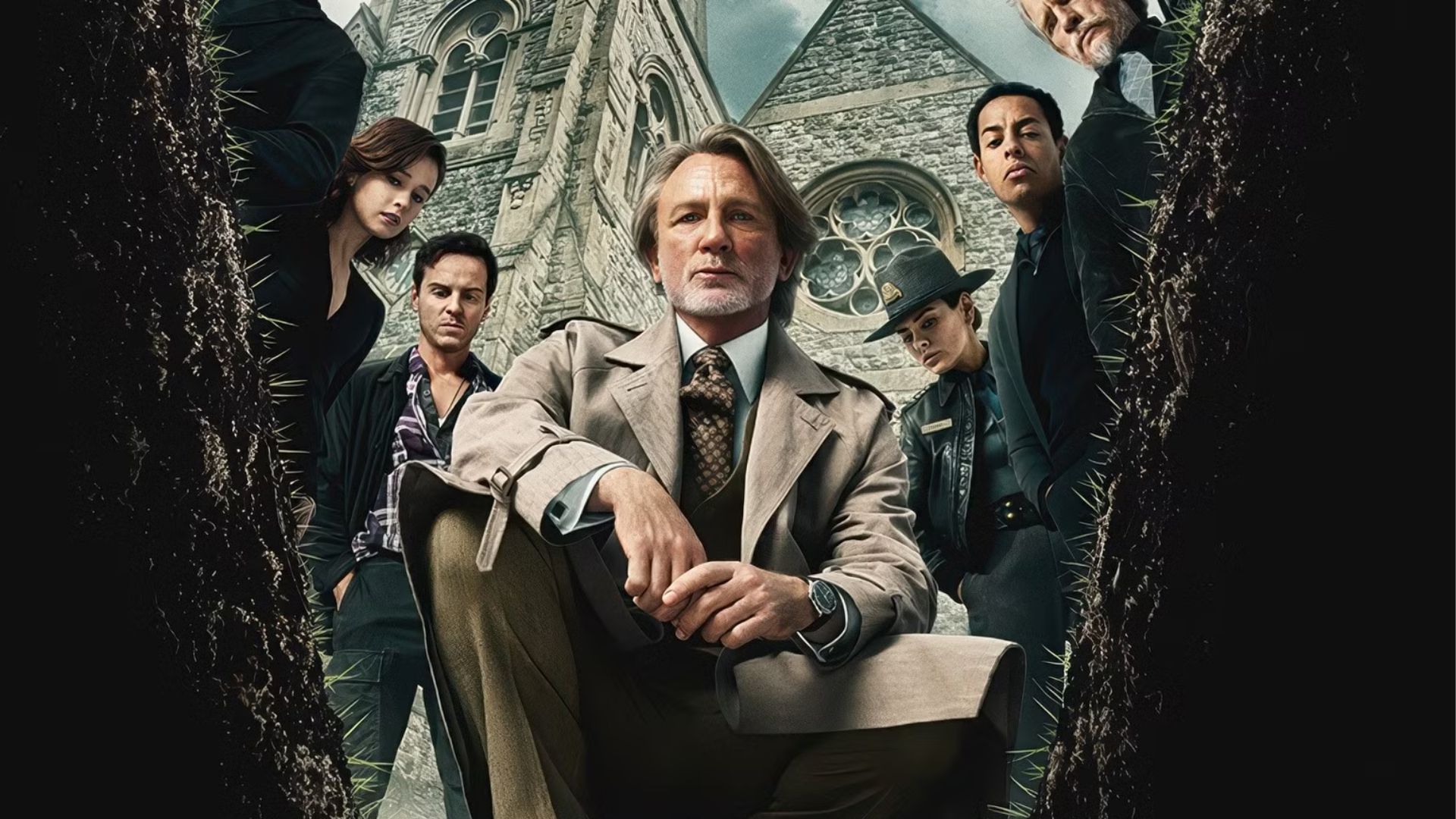
Something terrible has happened, but a man has arrived who has all the answers. Tell him the truth, and he’ll set things right. In Wake Up Dead Man, this savior could be detective or priest. Rian Johnson’s new film takes sin and sacrament seriously, and offers a good mystery to boot.
The co-leads are Benoit Blanc (Daniel Craig), a brilliant, ludicrously accented detective who is visibly uncomfortable in church, and Fr. Jud Duplenticy (Josh O’Connor), a young priest and a murder suspect. Blanc is what makes this a Knives Out mystery—the third in Rian Johnson’s series of Blanc stories—and Blanc’s in-world celebrity has grown over the trilogy. In the first film, Blanc was the recent subject of a New Yorker profile, but now he’s making appearances on The View. Fr. Jud, by contrast, is a profoundly ordinary man: a priest who might have lived a hidden life but for the murder of Monsignor Jefferson Wicks.
[This review will discuss themes and a few scenes in detail without spoiling the details of the whodunnit or howdunnit.]
Msgr. Wicks was killed during Mass in a variant of a locked-room mystery. It’s a good enough puzzle to draw Blanc to the sleepy town of Chimney Rock. Fr. Jud is the chief suspect. He didn’t quite have opportunity, but, in the eyes of Msgr. Wicks’s followers, he unquestionably had motive. Fr. Jud spent less than a year serving under Msgr. Wicks, but it was enough time for their pastoral differences to break into open conflict.
Johnson’s film succeeds as both a detective story and a portrait of faith.
Msgr. Wicks saw himself as a warrior shepherd, identifying and radicalizing a faithful remnant. He gave blistering sermons every week in which he detailed the sin of an individual parishioner, trying to goad the sinner into walking out. Fr. Jud became a priest because, before giving his life to Christ, he did something terrible in his former life as a boxer. He isn’t an “All Are Welcome” priest who denies the possibility of sin; it’s because he is deeply aware of his own sin and everyone’s need for Christ that Msgr. Wicks’s delight in driving seekers away enrages him.
Johnson’s film succeeds as both a detective story and a portrait of faith, because the director is willing to let Fr. Jud’s story overshadow Blanc’s. A detective story has a very particular logic and pacing. Clues are uncovered, blind alleys explored and rejected, and finally a culprit is confronted. Blanc pushes to get on to the next clue, eager for his eventual victory. To solve this mystery will be a particular joy, since it means proving himself greater than a murderer who committed an “impossible” crime, and, eventually, the prospect of surpassing an apparent miracle.
But Johnson allows Blanc’s hunt, and the whole structure of a murder mystery, to be interrupted by Fr. Jud’s calling. At one point, Fr. Jud and Blanc are perfectly aligned, with Fr. Jud on the phone trying to finagle a crucial lead out of a woman with access to secretarial files they need. The woman on the phone is discursive, while they’re strapped for time. Fr. Jud, mindful of Blanc’s “wrap it up” gestures, talks over her and lets his frustration show. But something in her voice catches him. He called her for a clue, but she knows she’s talking to a priest. “Will you pray for me?” she asks, and she stops him in his tracks.
In a different story, she would be a background character. In a video game, she would be an NPC, with a brief infodump to propel the real player character. Here, she’s Louise (Bridget Everett), and her mother is in hospice. Fr. Jud steps away from Blanc’s puzzle, from his own legal peril to listen to Louise and to pray with her over the phone. The threat of prison still hangs over him, but in this moment he is utterly, radically free. He is free to do good, even when suspected of evil. He will remain a priest even if he is sent to prison.
Louise does not know him personally as Fr. Jud, but because she knows him to be a priest, she trusts she can turn to him in persona Christi. She is not aware of the sort-of thriller, sort-of caper story he is part of. Louise is part of her own story. In Blanc’s world, some people are irrelevant, but not so for Fr. Jud. There are, as C. S. Lewis put it, “no ordinary people. You have never talked to a mere mortal. . . . It is immortals whom we joke with, work with, marry, snub and exploit—immortal horrors or everlasting splendors.” It takes a body to summon Blanc, but, every day, the Louises of the world experience their own, quieter emergencies.
In Wake Up Dead Man, as in his television show Poker Face, Johnson turns out to be interested in a deeper mystery than “whodunnit” or “howdunnit.” Even if a murderer is caught, what, if anything can be set right? Blanc can speak for the dead, but he cannot raise them and restore them.
It is Fr. Jud who is the miracle worker here. While other characters aim to stand in the Lord’s place and say “Vengeance is mine; I will repay,” Fr. Jud takes God at his word when he promises, “I will take away the stony heart out of your flesh, and will give you a heart of flesh.” While much of the mystery revolves around the possibility that a dead man has walked out of his tomb, it is Fr. Jud who is present when a heart, paralyzed by pride and contempt, begins to beat again.
The film isn’t for all ages (one character uses sexual crudity to attempt to humiliate a rival) and it isn’t a fully faithful portrait of Catholicism (there’s considerable license with the form of confession), but it is as serious spiritual stakes as any Catholic could ask of a mainstream film. It takes a notable murder to summon Benoit Blanc, but a Fr. Jud could (and should) be as close as the nearest confessional.