
“Semen est sanguis Christianorum.”
(“The blood of Christians is a seed.”)
—Tertullian, Apologeticus
Robert Royal has now published two separate volumes recounting the story of Catholic martyrdom in this century and in the last: The Catholic Martyrs of the Twentieth Century: A Comprehensive World History (2006), and The Martyrs of the New Millennium: The Global Persecution of Christians in the Twenty-First Century (2025).
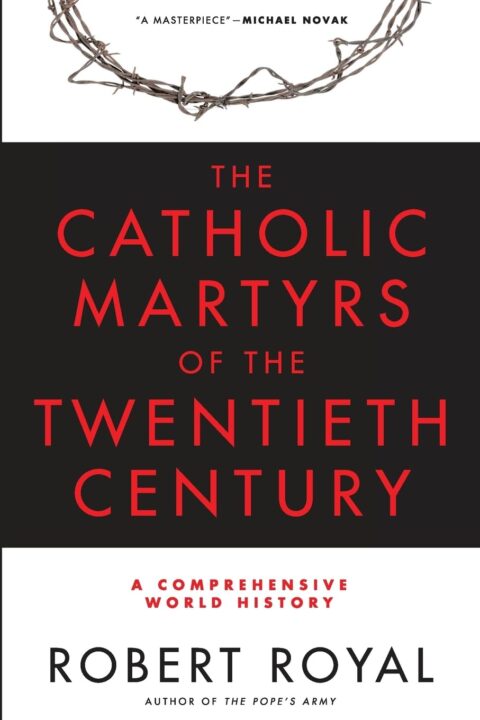
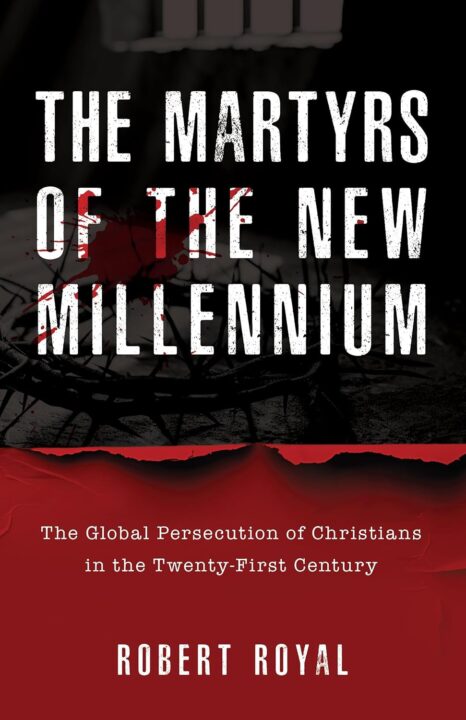
There may be a tendency for the reader selecting either of these gripping chronicles of Catholic martyrdom to expect two books with a dozen or so vignettes about interesting Catholic martyrs, peppered with a few gruesome details. They are that, but much more. Royal’s command of global politics, history, Church teaching, and theology is such that he is able to give considerable attention to the national and local contexts in which persecution occurs, and the tangled illogic that rationalizes killing Catholics, too often by the worst means possible. The time and travel Royal has devoted to researching his subject is hard to estimate, but it is beyond the ken of most of us, and for that we owe him a debt of gratitude.
One might think it too early for a sequel to Royal’s first book, however well the first book was received. But then again, a great deal has transpired over the last twenty-five years: Time flies, and sometimes it is disturbing flight. It seems only yesterday that we were wringing our collective hands as we awaited a Y2K apocalypse, yet the first quarter of the twenty-first century is now history. Given the progress of technology and the regress of faith, the frenetic pace may continue for the foreseeable future. (One fears that Royal’s third book may be needed in only a short five years or so!) The second book, The Martyrs of the New Millennium, was published only a few months ago, but the first book, The Catholic Martyrs of the Twentieth Century, should be read—or reread—with its sequel.
Martyrs of the Twentieth Century
There is a watershed that divides Royal’s first and second books—namely, the malignant ideologies that rationalize rabid violence against men and women of faith. For the twentieth century, communism has driven violent persecution. Royal writes, “In absolute numbers, the century’s martyrs far surpass those of any previous century. Among them, Catholics form a great, perhaps the greatest, part.” In the Introduction to his second book, Royal answers critics who complained that he did not give enough attention to Catholics killed by right-wing political leaders and paramilitary groups. He explains that the number of those killed by extremists on the right is miniscule compared with the exponentially larger number of murders inspired by Marxism.
There are “martyrs,” and then there are “Martyrs.” Traditionally, the Church offers two routes to official martyrdom. One occurs when an individual dies “for refusing to give up their faith” or “to deny their faith by refusing to perform some act inconsistent with faith or morals.” The second means occurs when the individual dies in odium fidei—that is, their murder is motivated by hatred of the faith. This of course requires some insight into the mind of the perpetrators. Both of these criteria lend themselves to considerable interpretation, and the final decision is made by the Holy Father. The timeline for making a decision in individual cases can take at least five years or more, although the pope can accelerate that investigation or waive it altogether.
Most shocking to the reader may be Royal’s account of persecution in Albania. Albania was the home of Saint Jerome, and Saint Teresa of Kolkata, though born in what is now North Macedonia, is of Albanian descent, so the awful accounts of martyrdom in the Balkan country may seem especially unsettling. Some of the means of torture and murder, Royal notes, seem to defy even Dante’s imagination. Although an independent Albania was recognized in 1912, the worst persecution began in 1946 when the Soviet Union, through its Albanian puppets, announced the People’s Socialist Republic of Albania. Eventually the country saw “the wholesale slaughter of the Catholic leadership, and an attempt to create ‘the first atheist state on the planet.’ . . . More Albanians died at the hands of the Communist government in peacetime than had died in World War II.” Important to communist success was the eradication of Albanian culture and the virtual communication blackout with the rest of the world. The martyrdom of one Franciscan is emblematic of the devious imagination of his executioners:
Lazer Shantoja was so badly tortured before he died, because his forearms and leg bones were broken, so that he could only “walk” around on his elbows and knees. His own mother asked his captors to kill him rather than continue the torment. (p. 236)
Royal offers the reader one of the most intelligent accounts of the Spanish Civil War (1936–1939) to be found. In Spain today, especially as long as the socialist PSOE (Partido Socialista Obrero Español) is in office, the politically correct account of the civil war holds that the Nationalists, led by Francisco Franco, were the violent oppressors. Further, this narrative romanticizes the Republican forces—made of communists, violent anarchists, and so-called democrats—as the heroic resistance. But the civil war was far more complex, and while Royal does not excuse the brutality of Franco’s forces and his post-war government, he explains that violence against Catholics was driven largely by the Republican side. He writes that the “number of priests and religious martyred was at least 6,832, including thirteen bishops.” He also cites reliable sources that the number of lay persons killed is “incalculable.” Moreover,
thousands of churches were burned, religious objects were profaned, nuns’ tombs were opened and the petrified mummies displayed to ridicule, and religious ceremonies were burlesqued. (p. 110)
In another instance, a seminarian was “forced to try eating a rosary.”
Martyrs of the New Millennium
Communism was the leading ideology of Christian persecution in the twentieth century; with the fall of the Soviet Union, it no longer is. China is still animated by what it calls “Marxism with Chinese characteristics,” and Marxism is solicitously kept on life support in university faculty lounges across the country. In the twenty-first century, however, the baton—or should we say truncheon?—has been passed to militant Islam.
“In absolute numbers, the century’s martyrs far surpass those of any previous century. Among them, Catholics form a great, perhaps the greatest, part.”
So as to distinguish Christian martyrdom from “martyrs” of other faiths, some of whom actively seek death in the pursuit of a twisted interpretation of their religion, Royal stipulates, “A Christian martyr is a person who is willing primarily to die, not to kill himself or others, for the faith. And that attitude is deeply rooted in Christian history because Jesus Himself, as Catholics believe, died to save the world.” Royal also notes that “modern conditions” prompted Pope John Paul II to recognize a new category of martyrdom: nuovi martiri (“new martyrs”). Someone declared a martyr by this criteria might, inspired by his or her faith, oppose injustice. In that case, the potential martyr is prompted by his Christian conscience to condemn injustice. For example,
Fr. Giuseppe “Pino” Puglisi, an anti-Mafia priest who lived in Brancaccio, a crime-infested neighborhood of Palermo, was assassinated in 1993, presumably by a mob “hit man,” for his efforts to protect his flock from criminals. Some might regard this as merely a kind of political or social clash, but the fact that Fr. Puglisi considered what he was doing as part of his ministry as a Catholic priest cannot help but be taken into account in an overall evaluation of his life and work. This is why Pope Francis beatified him in 2013. (p. 25–26)
Royal’s organization in this second volume has more global sweep than the first; he moves across continents, which are subdivided into select countries. His coverage of Mexico, so conspicuous for its Catholic flavor, is disconcerting, given our southern neighbor has been called “the most dangerous place to be a Catholic priest.” Some clergy fit into John Paul II’s new category: They have become martyrs for opposing the violence and corruption of Mexico’s government/drug cartel complex. In addition, clergy were martyred in El Salvador, Colombia, Peru, Nicaragua, and Venezuela. In Argentina, Fr. Carlos de Dios Murias’s eyes were gouged out and his hands cut off.
In Royal’s survey of martyrdom in the Middle East, he regards Islam respectfully, distinguishing it from radical Islamic fundamentalism. Israel is not spared from criticism, as extremist ultra-Orthodox Jews have persecuted Christians and disrupted Christian graves and defaced holy sites. Martyrs have emerged in Africa, including Nigeria, Sudan, and the Democratic Republic of the Congo. India and Pakistan are guilty as well.
China’s horrid Cultural Revolution began in 1966 and lasted a decade. It is difficult to summarize the insane depths to which Mao Zedong drove the country. The estimate of Christian deaths, and the deaths of others, in that period ranges from seventy million to more than one hundred million. It seems unfortunate that Pope Francis struck a 2018 accord with China, in which any Catholic bishops must be approved by the Chinese Communist Party in exchange for supposed tolerance for the Church. It has not gone well. Often violent persecution continues, and the Chinese have gone so far as to appoint bishops to the official Chinese Patriotic Catholic Association with no consultation with Rome at all. It seems that Pope Francis was outfoxed by President Xi Jinping. In fairness, neither John Paul II nor Benedict XVI were much more successful in negotiating the Church’s place in China.
It seems regrettable that Royal must conclude his book with a discussion of martyrdom in the West. As in other places, the greatest threat to Catholics in Western countries is militant Islam. This has been worse in certain European countries than in the United States, but if Americans do not regain their vision for the assimilation of immigrants and resist the country’s lazy slide into secularism, things may become worse.
In the UK, in 2024, in a criminal trial under the 2014 Anti-Social Behaviour, Crime, and Policing Act, Adam Smith-Connor was found guilty of violating the law by silently praying near an abortion clinic. He protested that he did nothing nor said anything and thus committed no crime.
The judge disagreed and, in an Orwellian flourish, said,
He was capable of being seen, he was engaged in prayer, and it would have been perceptible to an observer. He said he would not be looking at anyone so he could not breach their privacy, but I find his presence and the circumstances could cause detrimental impact. (p. 243)
In the US, now that the Democratic Party is thoroughly radicalized, there is tolerance for everything except disagreement. In a perverse irony, Christian principles are considered a threat to human dignity. For instance, during America’s 2024 presidential election, the Democratic candidate was asked whether she would allow religious “concessions” on abortion. She responded no.
An Afterword
Some time ago, in a comparative government class, I assigned my students How Soccer Explains the World: An Unlikely Theory of Globalization (2010) by Franklin Foer. The book is fascinating, and I daresay that my students learned more from it about the culture and politics of Spain, Brazil, Italy, England, Serbia, and Scotland than from anything I said or did. In a similar way, both of Royal’s books would be great additions to any senior high school or college class. Evangelization of the contemporary culture should include not only the transmission of tradition but also innovative pedagogy. Church-going students might find their faith strengthened and those without faith might find it.