

I recently took the personality test that Jordan Peterson developed, which is based on the Big Five personality trait scientific model. Sometimes summarized with the acronym OCEAN, this theory seeks to describe personality types along the following dimensions:
- openness — associated with creativity, intelligence, and artistic interest
- conscientiousness — associated with orderliness and industriousness
- extraversion — associated with sensitivity to positive emotions like hope, joy, and enthusiasm, as well as sociability and assertiveness in social situations
- agreeableness — associated with compassion and politeness
- neuroticism — associated with proneness to negative emotions like sadness, anxiety, anger, fear, and the like
It turns out that I am moderately high in openness, moderately low in conscientiousness, moderately high in extraversion, moderately low in agreeableness, and moderately low in neuroticism. I wasn’t sure what all of this meant when mashed together into one person, so naturally I plugged my data into an AI chatbot and asked it to synthesize the information and give me a summary of what such a person is like. This was its reply:
This person is best described as a charismatic free spirit who values authenticity and spontaneity over structure or propriety. They thrive in social, dynamic settings, bringing energy and curiosity, while avoiding emotional volatility. Others may find them refreshing and stimulating for their honesty and enthusiasm, though perhaps occasionally frustrating for their lack of organization or blunt communication style.
Conscientiousness has to do with orderliness and industriousness.
While I’m not sure how accurate the outcome of my test was—some of the questions used in psychometrics are simply too vague to yield accurate results—my wife tells me that the AI got the gist right. While I think I’m a bit more conscientious (and a bit more agreeable) than the test indicated, I would admit that conscientiousness isn’t my strength. Conscientiousness has to do with orderliness (following strict schedules, tightly organizing one’s time, emphasis on tidiness) and industriousness (focusing on work and work-related achievements, avoidance of procrastination and distractions, etc.). And being high in compassion, a feature of agreeableness, I suppose it isn’t surprising that I felt some empathy when I came across a recent study of the decline of conscientiousness and rise in neuroticism among young adults.
The data show clear trends among young adults, ages sixteen to thirty-nine (Gen Z and younger millennials), of steep declines in conscientiousness relative to the average of older generations, on a multiyear trend line, particularly along the lines of work ethic. Young adults report higher distractibility, less perseverance, less follow-through, more carelessness. At the same time, there is a clear trend line of higher neuroticism, less agreeableness, and less extroversion among young adults. The following chart is the analysis of John Burn-Murdoch at the Financial Times of the Understanding America Study:
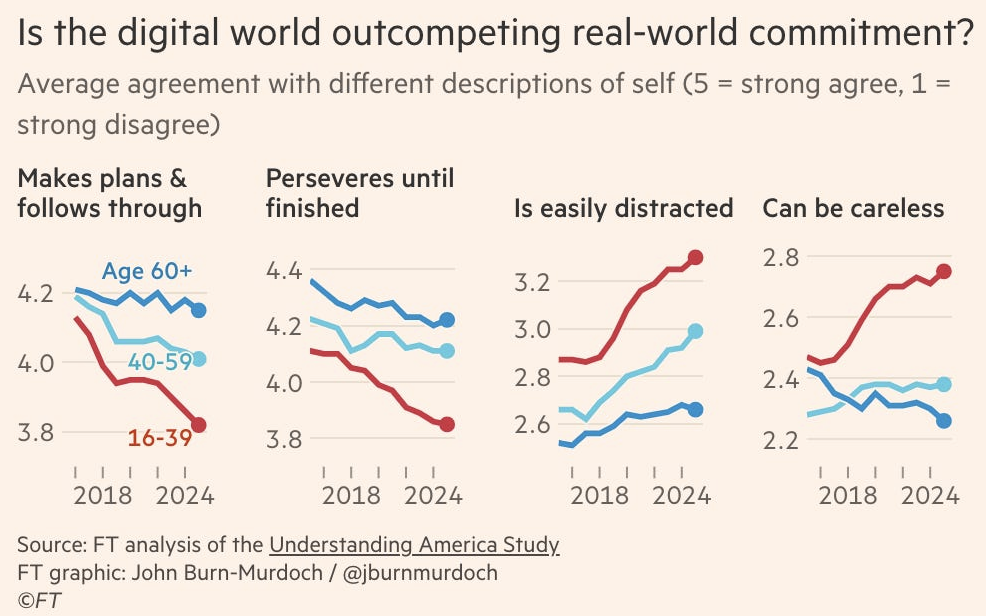
It is typically believed that the Big Five traits are normally distributed across large populations—i.e., few people have very high or very low scores on a trait. So it is striking that there is an emerging generational divide. While we can think about personality traits as biologically grounded tendencies, we know that genetics are not destiny; see, for example, studies of identical twins that identify differences in personality. All of this suggests that cultural factors play a role in the formation of personality.
So what cultural factors might have caused these personality changes? As Jonathan Haidt has argued, a sea change happened for many in this group who were children between 2010 and 2015, when smartphones and social media became more and more ubiquitous. Haidt calls this the “Great Rewiring” of our youth, from a “play-based” to a “phone-based” childhood, which caused rises in depression, anxiety, and desire to self-harm. (By “phone-based,” Haidt means, broadly speaking, the ubiquity of child access to and possession of internet-connected electronic devices.) Haidt’s work shows that phone-based childhoods are causal factors in the rise in neuroticism and the decline of extraversion among the “Anxious Generation.”

So also with the decline in conscientiousness. One of the effects of the phone-based childhood is what Haidt calls “attention fragmentation,” caused by the dozens to hundreds of buzzing alerts one receives on a daily basis from notifications from social media apps, emails, text messages, etc. Such distractions are catnip even to the most conscientious, a constant temptation to divert one’s attention away from one’s tasks. Meanwhile, the temptation to excessive video gaming has only increased in phone-based childhoods, and its distractive and isolating effects have been shown to prey upon the less conscientious and exacerbate low conscientiousness. It isn’t difficult to imagine how social media scrolling and video gaming can become addictions, fueling habits of distractibility, procrastination, sloth, and other vices opposed to studiousness and industriousness.
These trends are alarming because, in the scientific data, there is a strong correlation with higher conscientiousness and educational and professional success. Perhaps unsurprisingly, those who are habitually self-disciplined, organized, and focused on the orderly execution of tasks are likely to do better in the classroom and the workplace. Still, like any other of the Big Five personality traits, having it in great “excess” or “deficiency” comes with tradeoffs. Highly conscientious people are productive, but they may also be uptight workaholics who are overly fussy and unable to relax or engage in spontaneous play. Meanwhile, highly unconscientious people may be able to engage in free-spirited fun, but they may also be undependable, unorganized, distractable, and procrastinating hot messes. The trend toward the latter among Gen Zers is a cause for concern.
The aim in parenting ought always to be the cultivation of virtue, as the essential constituent of human flourishing.
There are a number of possible takeaways from all of this. As a father of ten children, including two young Gen Zers, I am inclined to focus on the takeaways for parents. Parents of Gen Z and Alpha should all agree that they don’t desire negative outcomes for their children. The aim in parenting ought always to be the cultivation of virtue, as the essential constituent of human flourishing. And each child has a unique personality and therefore a set of virtues that he or she will find easier or more difficult to cultivate.
Any parent of multiple children knows that the differences of personality are real and manifest early in life. But the virtues are universal and valid for all persons of all personality types. While scholars have not arrived at a consensus about how to integrate models of personality with virtue ethics, it is clear that one’s personality can be shaped or reshaped to some degree by acquisition and cultivation of virtues (or vices). Hence it may be helpful for parents to do a personality test with their children in order to know which virtues will come easier or harder for their children. For example, one of my daughters is very high in agreeableness. This is good in that she is very compassionate and caring. But she sometimes has a difficult time standing up for herself, in disagreeing, when it is good and right to do so. Being aware of her dominant personality traits helps me as a parent know that I need to find ways to help coach a prudent assertiveness.
Regardless of the personality type of the child, is it not obvious that parents ought to remove causes of vicious habits and cultivate the activities children need to develop normally? Some degree of conscientiousness is obviously necessary for normal human functioning. Therefore, parents who want healthily conscientious children should express a healthy tech-skepticism. Long before Haidt published his tech-skeptic conclusions as a secular social scientist, I came to similar judgments as a Catholic father who happened to be trained in the social sciences. In my home, my children are not allowed to have a smartphone. We keep a “dumb” family phone that does not have internet access; the older children may use it to communicate with parent-approved contacts for friendship, work, school, and sports events. They are not allowed to have social media accounts, nor do they have any interest in having them. We seek out like-minded families to befriend, which lessens the peer pressure to conform to the phone-based culture.

As Haidt argues, healthy childhood is in large part a play-based childhood because it is through play that children learn the sorts of desirable social behaviors to keep the game going, to be a desirable partner in play, and to encounter and learn to cope with adversities, bumps, and bruises, to cultivate antifragile souls. Parents should be intentional in fostering play. In addition to allowing for unstructured, spontaneous outdoor play, our emphasis is on outdoor and indoor sports and games with various degrees of risk-taking, including (but not limited to) soccer, baseball, football, wrestling, volleyball, kickball, swimming, biking, cornhole, rock climbing, running, gymnastics, ladder golf, Kubb, bocce ball, and pickleball. (For the winter months and bad weather, we keep a healthy stock of board games—and occasionally video games, but always as a multiplayer family activity.)
A big lesson throughout these games—whether it is a one-off game in the backyard or as a member of a local rec team—is that we don’t quit. My seven-year-old gave up a soccer goal recently during a family soccer game, and he was in tears and started to run off the field. No. Get back in position. We don’t quit in the middle of a game when it doesn’t go our way. In rec baseball, it is a commonplace each season that some bad bounces or throws of the baseball will strike my boys’ flesh and bone. Rub some dirt on it; we don’t quit. Such play cultivates stick-to-itiveness, the sort of perseverance and tenacity that is the germ of conscientiousness, checks excessive neuroticism, and teaches healthy competitiveness and sociability.
In the Summa contra gentiles, Thomas Aquinas points out that love, in the sense of communicating a good to another that the beloved lacks, would be impossible if not for diversity and inequality, in the sense of the unequal distribution of gifts among God’s creatures. In this light, I believe we can understand the diversity of personality types as a gift from God, who creates each person as both sharing a universal nature and as unrepeatably distinct, with a unique personality that is called to be godlike. And since God is love, this is a call to love, to will good to others according to the gifts one has been given. Parents carry forth God’s will when they are aware of the strengths and challenges associated with their children’s personalities and check the cultural and technological forces that would stunt those virtues that will make them the light of the world.