
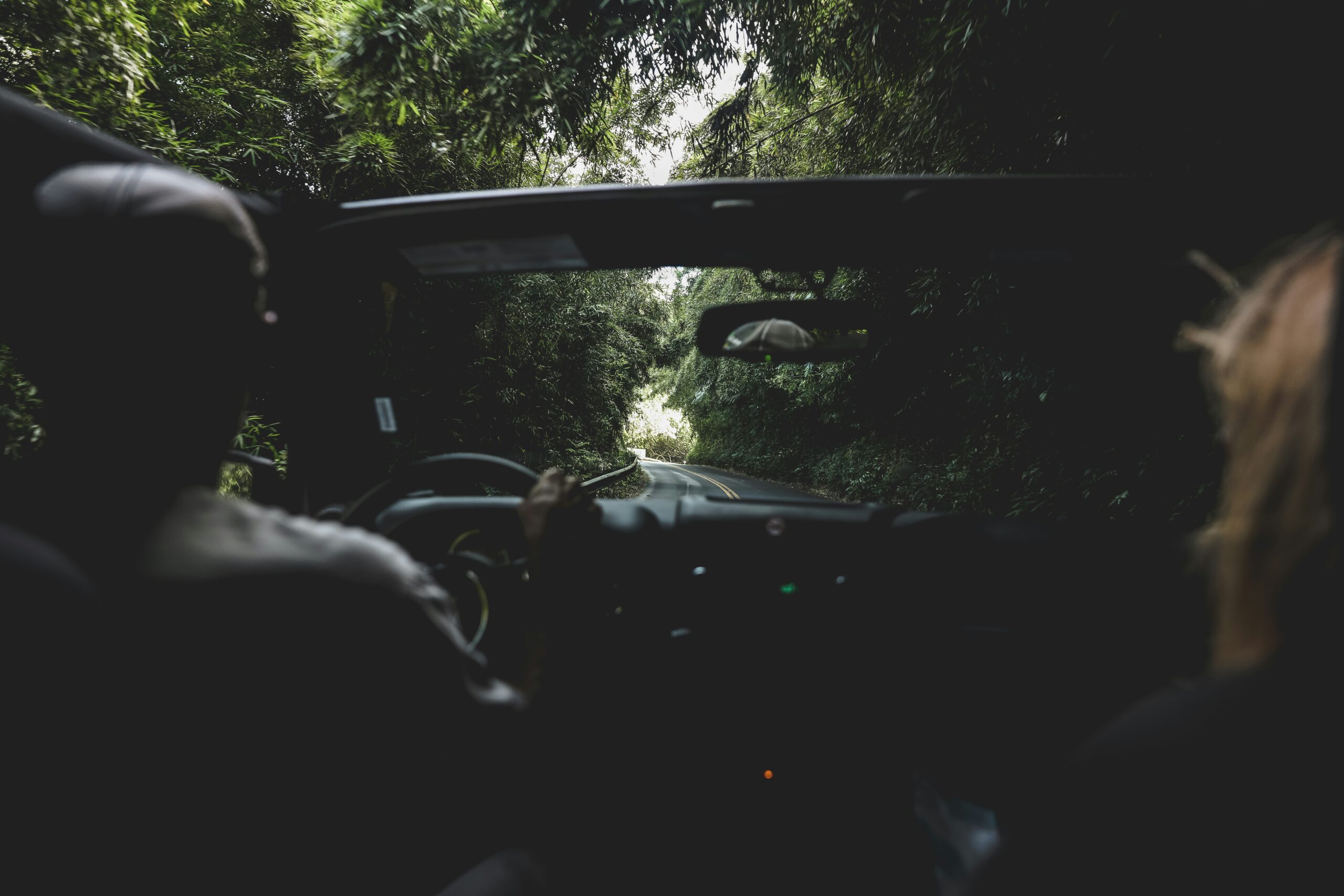
Earlier this summer, I was back in Texas, and a good friend of mine showed me a new song. “The European mind is ignorant and blind to the beauty of the USA,” croons Ricky Chilton in “Circle K.” He’s not thinking of the “amber waves of grain” or our “purple mountain majesties”; he’s thinking instead of the apparent pleasantries of energy drinks and sugary snacks prevalent at our gas stations. After going on pilgrimage in Eastern Europe this summer, some two and a half decades after the fall of communism, I can confirm that if these are the beauty of the USA, the convenience stores in Poland have caught up to us. But Chilton’s song does point us to a unique beauty of these United States, one strangely analogous to the long-standing Catholic practice of pilgrimage: the all-American road trip.
When I was in Ireland a few years ago, I drove about two hours from Dublin to the west coast, and the locals were shocked that “I drove such a long way.” Being from Texas, such a drive is equivalent to more than half of that from Dallas to my hometown of Austin, a drive which I made about once a month or so in order to see family. The difference in how we perceive driving distance surely has something to do with the great contrast in gas prices between Texas and the EU (somewhat obscured to the traveler by the measurements being in euro/liter), but likely more to the great expansiveness of the United States and the comforts of the interstate highway system. But more than that, we have had a culture of road-tripping, which preceded that system but was further enabled by it after it was built in the postwar period of the mid-century presidency of Dwight Eisenhower.
While certainly a matter of comfort when compared to the slower pace of premodern travel, or the restrictions of post-9/11 air travel, the road trip, like the pilgrimage, takes us out of our everyday reality, allowing us to see more clearly the world beyond our often narrow daily concerns. As political philosopher and motorcycle mechanic Matthew Crawford puts it, “On a road trip, you encounter landscapes and human types beyond the ken of your usual routines, and there is something rejuvenating about this. It reminds you that there are possibilities you hadn’t reckoned with,” and, I would add, actualities too.
The road trip, like the pilgrimage, takes us out of our everyday reality, allowing us to see more clearly the world beyond our often narrow daily concerns.
One of those actualities, one of the aspects of reality that road trips make clear, is contingency—that things could be otherwise, that we are not guaranteed a smooth, frictionless, pleasurable existence. It is this kind of existence the culture of expressive individualism wants to guarantee us, but against this beige, challenge-less way of life stands our need as human beings to risk and experience the precariousness of our being, because it is precisely through knowing that we are not gods, invulnerable and made simply for nectar and ambrosia, that we come to know the gift God gives us in the limitations of human nature, which make our freedom meaningful.
On my recent pilgrimage, the first few days were filled with ease. The hotels were comfortable, the distance to the shrines easily walkable, dinner full of European charcuterie and glasses of red wine. While we were beginning to know each other as fellow pilgrims in those days, we bonded when, in the small Hungarian town of Máriapócs, known for a miraculous weeping icon of the Mother of God, we were told upon our arrival at the pilgrim house that the electricity was out, which meant no elevators to move our luggage up a few floors (it turns out those elevators may not have existed at all), but the candlelit dinner which ensued ensured a beautiful atmosphere. The younger pilgrims helped the nuns and the seasoned pilgrims by carrying heavy bags up the stairs, and the apparent misfortune was lit by the smiles we now encountered on each other’s faces. Why were we so happy, being deprived? The hardship provided a new opportunity for charity, a virtue which cannot be optimized by technological means (unless it be by technological failure).
While wrong about a great deal, American progressives such as Woodrow Wilson correctly ascertained that the situation of the United States at the beginning of the twentieth century was particularly different than that of the founding fathers in the late eighteenth century. It is hard for us, now a quarter of the way through the twenty-first century, to imagine the pace of life in an America without cars, smartphones, credit cards, and many other electronic efficiencies we tend to take for granted. While in a few parts of the country, like eastern Pennsylvania and eastern Ohio, the testimony of the clop-clopping of horses pulling Amish buggies down rural roads tells of an older way, the rest of the country hums with the motors of vehicles with many more horsepower: the music of the automobile.
In Why We Drive (2020), Crawford takes the measure of this music, carefully surveying the multifaceted reality of American driving. He seeks to present what that activity means for the creatures who crafted the vehicles that allow them to so blissfully exceed their own native bipedal speed. That reality is threatened today by large multinational corporations, such as Google, through automated, driverless cars, designed to remove what Dr. Tod Worner called “the human factor.” Crawford’s book helps make clearer that which might be opaque to many of us who do not tend to focus on technological development, being rather caught up in the conveniences automobile companies make standard but which tend to make driving less an experience of deliberative freedom and more one of mind-numbing comfort.
Crawford’s work, a delightful blend of personal essay, investigative journalism into various automotive subcultures, and careful analysis of the connections between political philosophy and current technological development, is too capacious to be thoroughly explored in a few hundred words. What makes it particularly worth reading in this context is its examination of how a crucial aspect of contemporary American culture—driving—both embodies the spirit of American freedom and is under threat by a partnership between governments local and federal and large technology companies seeking to monetize our data as a way of making human life more predictable and profit easier for those with the capital to purchase large quantities of information. Such legibility would grant the power “to index, order, and control,” in the words of the Jonathan Nolan TV show Person of Interest, which seems to be proving prophetic.
Crawford sees the risk of such a system’s success as “dispossess[ing] us not only of a home, but of that elusive thing that we seek in a road trip or a backpacking trip,” or a pilgrimage: “moments of discovery that cannot be anticipated, purchased, or gotten cheaply through a screen.” That drive for discovery is what fuels traditional Christian pilgrimages throughout Europe, like that depicted in Geoffrey Chaucer’s Canterbury Tales, as pilgrims sought God, communion with others, and experiences of beauty, as well as the American road trip, undertaken by families seeking to educate their children or by young people seeking to see their country. Such journeys will present difficulties, but the search for God always does; as Pope Benedict XVI said to pilgrims from Germany who came to meet him shortly after his election, “The ways of the Lord are not easy, but we were not created for an easy life, but for great things, for goodness.”
Pope Leo XIV’s recent references to AI, both at the very beginning of his papacy and at a recent conference in Rome, suggest that technology will be a new and renewed focus of the Church’s social teaching in years to come. Particular questions should be investigated: How can technology be made so as not to simply reduce the difficulties that benefit man in his quest for God, the challenges he places in our path to stir us toward greater solidarity? Can technology be designed to remind us of our call to the great good of communion, rather than to turn us inward toward the frenetic glow of the palantír-like screens in our palms? Reflecting on Crawford’s book and the Church’s rich history of pilgrimage will provide us with a starting place to engage these and like questions.