
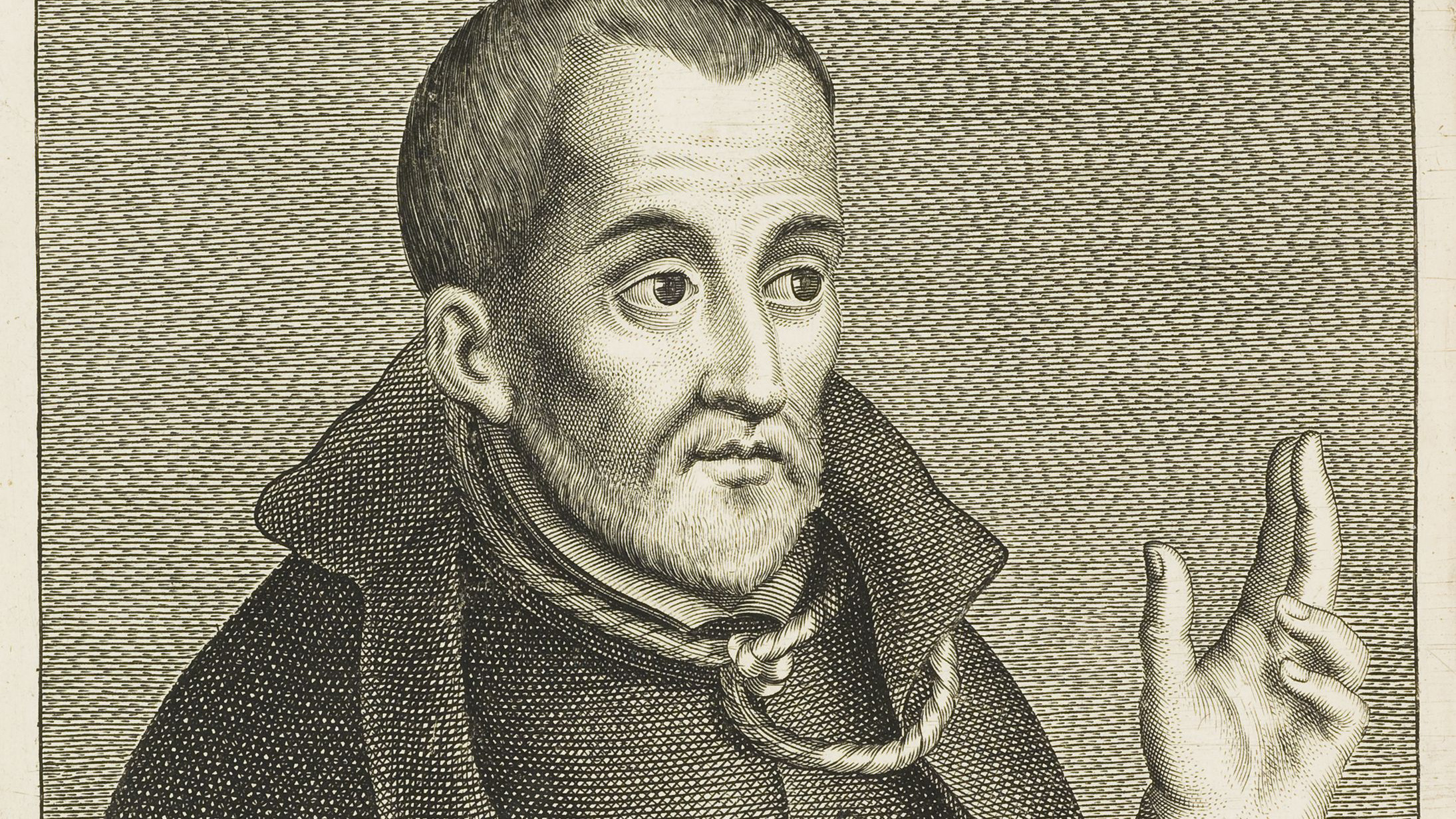
“So the faith was planted: so it must be restored.” This is the most famous line from the tract commonly known as “Campion’s Brag,” written hastily on the road in 1580 at the request of Thomas Pounde, a Catholic recusant. Pounde sought Campion out shortly after his return to England to suggest he set down an explanation of his mission, motives, and convictions to be circulated by English Catholics in the event of his capture. Once it happened (as everyone expected it would), the Crown was sure to circulate slanderous rumors depicting Campion as an apostate, foreign spy, or other shameful figure, and at that point he would have no opportunity to respond in his own voice. Campion wrote his “Brag” in full anticipation of his eventual torture and execution, intending that his words should stand as a sincere articulation of his purpose in submitting to that fate.
“So the faith was planted.” He’s clearly referring to martyrdom. Though he does not quote him directly, Campion was surely thinking here of the ancient writer Tertullian (AD 160–240), who wrote in his Apologeticus that “the blood of the martyrs is the seed of the Church.” In sixteenth-century England, the Church needed reseeding. Christians seem to need perpetual reminders that, living in a fallen world, defeat can be the most lasting form of victory.
Campion sacrificed everything to restore the faith to his native land.
It’s an uncomfortable subject for citizens of a mostly-peaceful-and-prosperous West. Though there are still places in the world today where Christians are dying for Jesus, we rarely think about them. It’s not to our credit, and yet the reasons are understandable enough. Those Christians’ cultural and political situation seems so different from our own. It’s hard for us to relate. But Campion is not like this. He was brilliant, highly educated, and richly “promising” in ways that would bring a gleam to the eye of any modern parent. His superlative gifts in rhetoric and oratory truly distinguished him as an Elizabethan-era “master influencer.” The world was his oyster. But he sacrificed everything to restore the faith to his native land.
What sacrifices will be asked of us? Martyrdom seems like an outside possibility (though who can say?), but as Campion’s life clearly shows, that road runs through a range of other sacrifices and mortifications that can certainly be asked of Christians today. No one dies for Jesus without first being willing to sacrifice riches, fame, worldly honors and status, common comforts, friends, and reputation. Campion’s life can be read as a tutorial in that process. There are certain martyrs, like the Roman slave Blandina, who demonstrate a more mysterious kind of courage and faith, belonging to the simple and pure of heart. Campion shows something else: how a man with everything to lose goes about losing everything, for the sake of his people and his Lord.
On his feast day, it’s worth revisiting a few scenes from his story. I will draw primarily on Evelyn Waugh’s Edmund Campion: A Life (1935), a book that should be on every Catholic’s shelf.
Campion was raised nominally Catholic, as everyone was at the time, but there is no reason to think he was specially devout in youth. At 30, living in newly Protestant England, he was everything one would expect in a brilliant and charming young man: ambitious, witty, sociable, highly visible within the Oxford community, favored by powerful patrons. Coming from the middle class, not the aristocracy, his presumptive path to influence went directly through the Anglican Church. Initially he seemed resigned to this, taking the Oath of Supremacy and accepting ordination to the Anglican diaconate. When his studies forced him into a deeper and more intimate acquaintance with the Church Fathers, Campion found himself at an uncomfortable impasse. The case for Anglican authority seemed utterly unsupportable. What was to be done? Waugh writes,
Campion loved his country and his countrymen; the way was easy for him to live among them in honor and authority; the ancient Cathedrals were still standing, scarred and scoured perhaps, but fine prizes in the Government’s gift–massive, visible tokens of unity with the past; titles of honour were still to be won which had been borne by the saints and scholars of antiquity. In a world where everything was, by its nature, a makeshift and poor reflection of reality, why throw up so much that was excellent, in straining for a remote and perhaps unattainable perfection?
It was an argument which might be—which was—acceptable to countless decent people, then and later, but there was that in Campion that made him more than a decent person; an embryo in the womb of his being, maturing in darkness, invisible, barely stirring; the love of holiness, the need for sacrifice. He could not accept.
When the situation at Oxford became impossible, Campion settled his affairs in civilized fashion and decamped to Ireland. He returned to his scholarly work there, more discreetly but with hope that he might in time play a role in the formation of an Irish university. English Catholics in this period still harbored some hope that a change in political fortunes might improve their situation. Those hopes were to be sorely disappointed.
As the government began progressing from fines and occasional imprisonment to torture and death, Ireland ceased to be a safe refuge for Campion. He fled, finding his way to Douai, where he was welcomed by William Allen, president of the English College there. Allen recognized early that it would be necessary to train English exiles abroad so that they could return to their native country and minister to English Catholics. He anticipated also that the effort was likely to provoke violent resistance. From the very beginning, the English College at Douai was intentionally ordered as a school for martyrdom, preparing men in heart and mind for a harrowing ministry and a terrible death. In this company, Campion’s heart was transformed. Waugh writes,
The faith of the people among whom he was now placed was no fad or sentiment to be wistfully disclosed over the wine at high table, no dry, logical necessity to be expounded in the schools; it was what gave them daily life, their entire love and hope, for which they had abandoned all smaller loyalties and affections; all that most men found desirable, home, possessions, good fame, increase, security in the world, children to keep fresh their memory after they were dead. Beside their devotion Campion saw a new significance in the evasions and compromises of his previous years. At Oxford and Dublin he had been, on the whole, very much more scrupulous of his honor than the majority; he had foresworn his convictions rarely and temperately; when most about him were wantonly throwing conscience to the winds and scrambling for the prizes, he had withdrawn decently from competition; but under the fiery wind of Douai these carefully guarded reserves of self-esteem dried up and crumbled away.
Two years of this spiritual reawakening persuaded him that he needed something further. He proceeded to Rome to seek admission to the newly founded Jesuit Order, frontline soldiers of the Counter-Reformation. They accepted him, gave him five years of formation, and sent him to Prague to help with their educational efforts there. The Jesuits were not yet operating in England; it seemed entirely possible that his activities in Bohemia would keep him occupied for the remainder of his life. To human eyes, the reasons this did not happen look somewhat mundane, largely a matter of competing personalities and juggling personnel. But divine providence has its ways.
Six years after his arrival in Prague, Campion received a letter from Allen, the man who had first put him on the path to priesthood and a life of total sacrifice. He had been reassigned to the English mission. As when he left Oxford, he made no fuss over the change of situation. He discharged his remaining duties and settled his affairs in civilized fashion, teaching three more months until his local provincial could spare him. But everyone understood the significance of the assignment. One fellow priest painted a garland of roses and lilies over his bed, a symbol of martyrdom. Another (an ecstatic) wrote “P. Edmundus Campianus, Martyr” over the door of his room.
The world had always admired him. Now it stood in awe.
From this point, the story of St. Edmund Campion’s moral formation seems to end, and his heroic quest begins. The workaday educator in Prague becomes a brazen English outlaw, fearlessly challenging the tyrants of his age, enraging his pursuers with his feints and tricks, bringing wild hope to the hearts of the downtrodden English Catholics. Charming and eloquent as ever, he now appears as a superhero, his gifts magnified a hundredfold in God’s service. The world had always admired him. Now it stood in awe. But he was not always that man. It took time for the grain of wheat to die and the new plant to grow.
Living in an age of flattery, false compassion, demagoguery, endless posturing, “fake news,” and empty ambition, Campion’s story feels like water on parched soil. For me, Waugh’s biography of Campion is one of a handful of books that sits ready for those moments of deepest demoralization, when my spirit feels especially parched. It’s a blessed reminder that displays of courage are not always feigned, nor does every eloquent tongue speak lies. Even in the darkest hours, the faith can be reseeded, grown again from the soil of sacrifice.
Sacrifice can be difficult, however. Exceedingly few of us have gifts requisite to Campion’s, and yet we give them only grudgingly, or not at all. Reflecting on his life, we can make renewed efforts to place everything we have in God’s service, repeating the Jesuit prayer that surely inspired him:
Take, O Lord, and receive my entire liberty, my memory, my understanding, and my whole will. All that I am, all that I have, Thou hast given me, and I give it back again to Thee, to be disposed of according to Thy good pleasure. Give me only Thy love and Thy grace; with these I am rich enough, and I desire nothing more.
St. Edmund Campion, pray for us.