
The welcoming of Shabbat at Jerusalem’s Western Wall is a wonderful thing to see. Crowds gather as the sun goes down, and the normally solemn atmosphere becomes lively and festive. Snatches of song can be heard from different directions, mingled with the murmur of prayers in various languages. As the dusk thickens, people begin to dance. It is a beautiful expression of hope in a place that has seen unimaginable grief. A perfect opening to a holy day of rest.
Twenty-five years ago, as a student studying abroad in Jerusalem, I loved this scene. It opened wells of emotion in me that I struggled to understand. The searing juxtaposition of hope and pain, the mingling of so many people, and the real-life connection to a place that had featured in the Bible stories of my childhood, all inspired a certain yearning to race down and join in the singing and dancing. But I never did. However intense the experience, I was keenly aware that I was watching something from a different faith and tradition. It felt wrong to intrude. So I simply watched, struggling to make sense of those disparate strands of thought and feeling that seemed to intersect in that place. What did the Wailing Wall mean to these joyful throngs of people? Or to me?
At that point in life, I was an almost-Christian, a disaffected cradle Mormon warily eyeing the Tiber. I spent seven months exploring the Holy Land, feeling the weight of history, and reflecting on how odd it was that after all these centuries, Christianity still felt like a shadow in its own country of origin. Wars of religion still rage there, and yet we are mainly a sideline presence. We went forth from the Judean soil, explored continents, built empires, spread the Gospel to every land. A third of the world now adheres to our faith. Yet I felt like a curious interloper in the streets that Jesus once walked.
All of those memories came flooding back as I read Barry Strauss’s Jews vs. Rome, a broad-ranging history of the Jewish-Roman wars of the first two centuries. The book covers the period from 63 BC through AD 136, with a particular focus on the three Jewish revolts that rocked Judea in AD 66, 116, and 132. If you’re not entirely clear on how the Wailing Wall became the last standing monument to the Second Temple, or how the Jews dispersed across the world in a millennia-long diaspora, this book will fill in those gaps. Strauss tells the story well, but it’s grim history, with few happy moments to alleviate the gloom. As on those evenings in Jerusalem, I read this book with a sense of watching from the outside, and there are, in obvious ways, some very great gulfs to be bridged—time, space, religious belief. Somehow it still feels very fresh. Again and again, the Jews shocked the Romans with the strength and ferocity of their defense. Each time the Romans ultimately prevailed, with catastrophic consequences for the people of Israel.
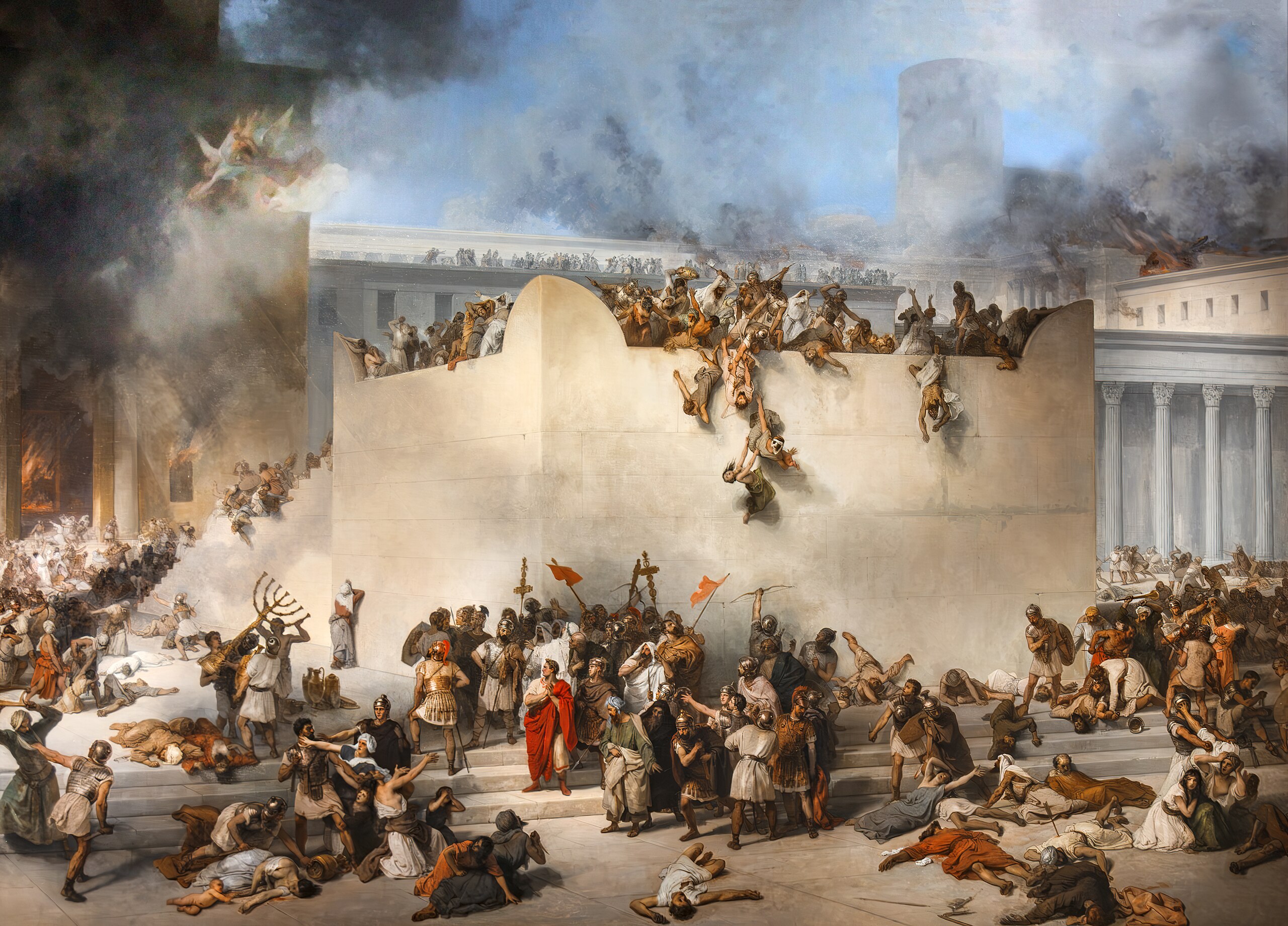
In Jesus’s lifetime, Jews represented a significant minority spread across the empire, perhaps approaching 10 percent of the population. Their elites could be found in Roman halls of power, and their communities attracted numerous converts, as well as “God fearers,” people who believed in the Hebrew God but were unwilling to adopt the faith in its entirety. Thirty years later the wars began, and the following eighty-year period saw the destruction of Jerusalem, the sacking of the temple, horrific mass slaughter, and the expulsion of most surviving Jews from their ancestral lands. After the final Jewish defeat in AD 135, Jews were forbidden to enter Jerusalem, except for one day a year, on the anniversary of the destruction of the Second Temple. Then they were permitted to come to the Wailing Wall to weep for their lost city.
This is history that Christians ought to know.
Though the subject is heavy, it’s a very readable book, detailed enough at least to inform reflections on faith and the movement of history, though we should recognize humbly the limits of our understanding. Strauss is Jewish, but also an academic specialist in ancient military history, who treads lightly on the deeper providential questions that these tumultuous events inevitably raise. However one thinks about the place of the Jews in salvation history, it’s simply a fact that the period Strauss narrates was absolutely pivotal to the development of both Judaism and Christianity, and indeed all of Western civilization. This is history that Christians ought to know.
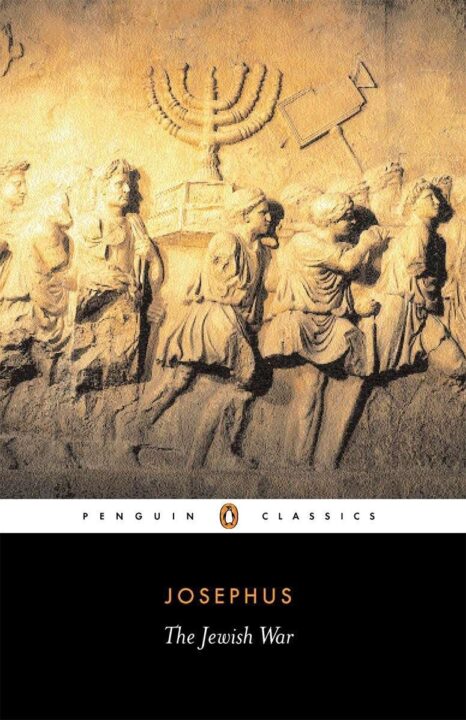
In fact, the part of the story we do tend to know best is the first of the three great conflicts, sometimes called the Great Revolt, narrated by the Jewish-Roman historian Josephus in his Bellum Judaicum (The Jewish War). It began in AD 66, starting small with a riot provoked by the Roman procurator Gessius Florus, who overextended his powers of taxation by demanding a large payment of silver directly from the temple treasury. Many Jerusalemites regarded this as a sacrilege, and responded with scornful, mocking protests. Enraged, Florus retaliated with deadly force, violently suppressing the protests and crucifying many participants. That seems to have been the turning point. His brutality gave a massive rush of oxygen to anti-Roman sentiments that were already both widespread and deep-seated across Judea. Many Jews already felt it was unfitting to submit to the rule of pagans. (We see those same sentiments bubbling up at various points in the Gospels, for instance when the Pharisees try to trap Jesus by asking whether it is permissible to pay taxes to Caesar.) Recognizing the grim possibilities of full-scale war, elite Jews and pragmatic Romans both made energetic efforts to avert it, but at that point the die was cast. The Zealots and Sicarii (Jewish “dagger men,” known for their skill as assassins and their commitment to expelling the Romans) had the people’s widespread support.
The Great Revolt ultimately led to the siege of Jerusalem, the destruction of the Second Temple in AD 70, and massive casualties, amounting to perhaps a quarter of Judea’s Jewish population. The final chapter, in 73, is also the most famous: Having retreated to a well-fortified fortress close to the Dead Sea, the surviving Sicarii and their families held out for several weeks against a Roman siege, which finally ended in a mass suicide once it became clear that defeat was imminent. The defenders of Masada are famous in the West today thanks to Josephus, who romanticizes their final hours with a stirring speech from their leader, Eleazar Ben-Yair, on the importance of serving God alone (not pagan overlords), and on the privilege God had given them to die “nobly and as free men.” This is particularly interesting given that Josephus himself clearly viewed the Great Revolt as a serious error. He made aggressive efforts to persuade his countrymen to submit in the future to Roman rule, and yet his admiration for the Sicarii’s strength of conviction is very clear. It is truly difficult at times to discern the proper meeting place between the kingdoms of God and men.
The “Diaspora Revolt,” in AD 116 and 117, is recounted far more briefly, primarily because sources are far fewer; there was no Josephus at that point to tell the story with pathos. Nevertheless, this chapter was also noteworthy, both for its devastating impact on diaspora communities and for its role in entrenching hostilities between Jews and Romans. Taking advantage of a moment when the Emperor Trajan was away fighting the Parthians, Jews in many diaspora communities, especially Cyrenaica (modern-day Libya), Egypt, and Cyprus, seized ships and waterways, burned public buildings and monuments, and attacked farms and military garrisons. Some speculate that the Parthians might have had a hand in instigating this conflict as a proxy war. Ethnic tensions surely played a role too. But whatever the precise mix of motives, Trajan was forced to divert troops from the front to deal with unrest at home. Predictably, this triggered a savage response. Jews of these regions were slaughtered indiscriminately, with their lands and properties seized. In Cyprus, they were thenceforth forbidden even to set foot on the island.
Judea itself moved back to center stage in 132, when a charismatic military leader named Bar Kokhba declared an independent Jewish state in a portion of Judea. Using guerilla tactics and a network of underground tunnels and caves, the rebels managed to hold their state against Roman assault for close to three years. They minted their own coins, celebrating the freedom of Israel. Bar Kokhba seems to have been regarded by many as the long-awaited Messiah. After the final Jewish stronghold fell, at Betar in 135, the Jews of Judea were killed and enslaved in large numbers, and the practice of their faith was harshly suppressed. Jerusalem was rebuilt as an explicitly pagan city, and the entire region was renamed “Palestine” in a literal effort to erase the Jews from Roman maps. Some Jews managed to resettle in Galilee, and others fled east into Asia. Survivors of the Bar Kokhba war, both refugees and enslaved people, thus became the ancestors of Jewish communities across the ancient world.
These were people who cared deeply about freedom and the will of God, for many of the same reasons that I do.
These were terrible events. Why did they happen? We can’t expect to understand fully, and yet it’s impossible not to ask. It’s particularly frustrating in that the Roman side of the equation is so readily understandable. Though monotheistic religion was somewhat strange to them, the Romans generally showed at least some level of tolerance toward long-standing ancestral faiths, so long as people paid their taxes and didn’t make trouble. That was fundamentally their approach to Judea also. Then the Jews did make trouble, and the Romans made an example of them. This bend-but-don’t-break approach was exactly what one would expect from the Romans. So what did the Jews expect? Why did they keep fighting when, by a sober this-worldly reckoning, they had almost no chance of success?
It would be nice to have a collection of sympathetic firsthand sources, but we simply don’t. Elite Jews like Josephus were mostly pro-Roman. The normal folk didn’t keep personal journals. But we can reflect on their choices in light of the stories they must have told their children. As it happens, those probably included many of the same ones that were told to me, since I too grew up with Moses, Joshua, Gideon, David, Judith, Daniel, and Judas Maccabeus. I can appreciate why their calculations may not have been entirely this-worldly. These were people who cared deeply about freedom and the will of God, for many of the same reasons that I do. Maybe that’s why I wanted to weep with them on Shabbat, and why revisiting the stories of Masada and Betar still feels like a gut punch.
After Bar Kokhba was crushed, the survivors began searching for a different path, which they found in rabbinic Judaism. The rabbis guided their people to a recognition that there were other ways to resist injustice and to maintain their fidelity to God. Jews have passed on that tradition for nearly two millennia now, weathering immense suffering and persecution and still finding themselves able to stand at the Wailing Wall, welcoming Shabbat with joy. This is an extraordinary thing, which naturally inspires a deep respect. We don’t know what coming chapters may hold, either for the Jews or for the Church. But I’m glad we can now stand together on ground that is holy for Christians and Jews alike, and pray for God’s grace.
Two millennia ago, that same wall witnessed a young couple entering the temple, carrying their infant son. It was a pivotal moment in human history, but it mostly passed unnoticed, except by a very few. Even today, the blessed name feels like a whisper in the holy city. Nevertheless, as Christians we know. His grace is boundless. His love fills the world. We needn’t grasp all the details to say with confidence: There is a plan.