
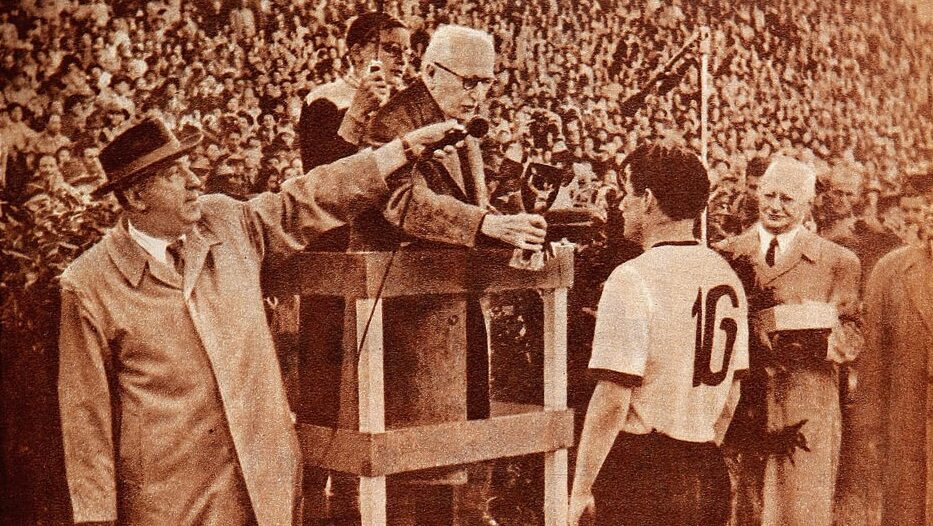
Not many people know that the history of the World Cup starts in 1891, in a village in eastern France so small it currently has a population of 105—Theuley. Right there, at the ripe age of seventeen, Jules Rimet, the son of a grocer raised by devout Catholic grandparents, read Pope Leo XIII’s Rerum Novarum when it was still warm off the press. Jules went on to become a lawyer and started a magazine called La Revue de la Jeunesse (The Youth Review), and this publication was focused on further discussing the (at the time) progressive vision of a new world order as laid out in Rerum Novarum. This journal is the clearest evidence of the impact this encyclical had on him, but the World Cup is a truly precious fruit.
Fast forward to 1930: Rimet boarded an Italian steamship at Villefranche-sur-Mer with a gold-plated trophy tucked inside his suitcase. He set route to the first ever World Cup, a project that had been his brain child since his teen years. Most of the European players on board had never been to South America, but the promise of the first international soccer tournament was worth the trip. This was a quite rudimentary start, but reading Rerum Novarum planted a seed, and Jules Rimet was determined to bring it to reality. He had worked toward this moment for the better part of three decades, and it was all for reasons that went far beyond the sport.
Ninety-six years later, the World Cup he created is the most watched sporting event in human history. Five billion people engaged with the 2022 tournament. The 2026 edition, happening right now in North America, is expected to add even more. The FIFA World Cup causes cities to pause and whole countries hold their breath in unison. A sport most Americans treat as another little league option becomes, for about a month every four years, the axis around which the world turns.
How Rerum Novarum Sparked the Concept of the World Cup
Rerum Novarum is Latin for “Of new things,” and its purpose was to address the social and economic problems of the time. The Industrial Revolution had taken apart the old order, and workers had lost the protective guilds of earlier centuries. The void it left was causing serious pain, and the Church could not stay quiet to this. Jules grew up to become a soccer executive and president of FIFA (Fédération Internationale de Football Association; in English: International Association of Football Federation); and undoubtedly, Pope Leo XIII’s points on the value of associations among people left a lasting impact.
The misery and wretchedness pressing so unjustly on the majority of the working class. . . . Working men have been surrendered, isolated and helpless, to the hardheartedness of employers and the greed of unchecked competition. (3)
Jules already knew what poverty looked and felt like when he read that letter and perhaps consequently felt a sense of responsibility toward applying it. His grandson Yves would later describe him in the book A History of the World in 100 Objects as “a humanist and idealist, who believed that sports could unite the world. Unlike many others in his time, he realised that, to be truly democratic, to truly engage the masses, international sport must be professional.”
That belief was inspired by the papal encyclical.
Rimet understood that the classes need each other and that those lines can be blurred in the name of something more important: patriotism.
His first attempt to bring the vision of solidarity and union through soccer was local. In 1897, Rimet cofounded the Red Star Sporting Club in Saint-Ouen, a working-class suburb of Paris. This club was open to anyone regardless of class at a time when that was a radical thing to say about a sports club. Anyone could show up and play. Once on the field, it’s a matter of equals playing under the same conditions. Rimet’s Red Star still exists today.
The New Philosophy and FIFA
When Rimet became president of FIFA in 1921 and began pushing seriously for a global tournament, the main obstacle wasn’t logistics or money. It was about the philosophy behind this new concept. The dominant figure in international sport at the time was Baron Pierre de Coubertin, founder of the modern Olympics, and de Coubertin’s entire project was built on what he called the “amateur ideal,” the belief that sport belonged to those who did not need it to pay the rent. The gentleman athlete. The man who had the time to train and play for the love of the game rather than a wage. He strongly opposed anything related to the commercialization of sports. Under these terms, being an athlete was the privilege of the few.
On its face, this turned sports into just another sophisticated social club. In practice, it was a class filter, and since there was no desire to mix the classes or offer opportunities to others, many weren’t open to Rimet’s dream for an all-inclusive World Cup. Rimet understood that the classes need each other and that those lines can be blurred in the name of something more important: patriotism.
Just as the symmetry of the human frame is the result of the suitable arrangement of the different parts of the body, so in a State is it ordained by nature that these two classes should dwell in harmony and agreement, so as to maintain the balance of the body politic. Each needs the other: capital cannot do without labor, nor labor without capital. (19)
Despite the resistance, Rimet maintained conviction over Pope Leo XIII’s invitation. He was determined to bring the principles of union and relationship among classes; and emphasizing the dignity over one’s work, gifts, and talents. For the first time, for soccer players willing to don their craft and become professionals, this became the cornerstone of the World Cup and what made it so different from the existing soccer tournaments.
At the 1928 FIFA Congress in Amsterdam, the member nations voted, and Rimet’s vision came to life. Just two years later, Rimet crossed the Atlantic with the trophy in his bag and thirteen national teams. A small but quite interesting fact is that Romania, France, Yugoslavia, Belgium, a few referees, and Rimet himself crossed the Atlantic together aboard the Conte Verde. They later picked up the Brazilian delegation on their way to Uruguay. And why Uruguay? Because they offered to pay for the whole tournament, since Europe had no funds for sports and was recovering from the tragedy of World War I. Uruguay even paid for the European players’ travel expenses. Small details that showcase the camaraderie, solidarity, and team effort that still characterize the World Cup.
I can only imagine what that voyage must have felt like, and had they known that almost a hundred years later, the tradition would carry on and the vision would expand to touch 5 billion people. The World Cup continues, mainly because people want it to continue; and the recognition of its positive impact in the world has not gone unnoticed. Jules Rimet was nominated for the Nobel Peace Prize in 1956 in recognition of his work bringing people together over sports and bridging divides at a time when the world was struggling through its worst wars and the Great Depression. Rimet retired from his role as FIFA’s president just a few months before his 81st birthday and continues to be its longest-serving president.
Catholic Identity and the World Cup Heroes
To this day, soccer remains one of the most democratically accessible sports in the world. You only need a ball and sometimes not even that: a bottle, a bundle of rags, or a rolled-up shirt can get the job done. Because the barrier to entry is almost nonexistent, it produces stars from every corner of the world. No creed, race, or economic background excludes participation. Many of the athletes who have come to define this tournament came from very little, and a striking number of them are practicing Catholics.
Luis Díaz grew up in Barrancas, Colombia, one of the most remote corners of the country. The first time he was signed to a professional club, his new coaches decided to give him some time. They worried not about his ability but his weight. Luis grew up in such a serious state of poverty that he was simply not used to three meals per day, and it was showing. Once his professional career started, he was able to access proper nourishment and today he is one of the best players in the world. He makes $16.1 million per year as a base salary, and he married his school sweetheart at a Catholic ceremony in their home town. They are the proud parents of three children.
We can’t discuss the World Cup without mentioning Cristiano Ronaldo, who grew up on the island of Madeira in a house where money was scarce. His mother was a maid and his dad an alcoholic who sadly lost his life too soon to be able to see his son’s success. In an interview with Piers Morgan, Cristiano described going to McDonald’s during closing hours as a teenager, hoping an employee would feed him. He is now the first billionaire footballer in history and a practicing Catholic who has publicly stated he attends Mass weekly and has a devotion to Our Lady of Fatima.
Luka Modrić, a war refugee from Croatia who learned to play football on a concrete parking lot while air raid sirens sounded, has the Virgin Mary and Jesus Christ on his shin guards. He is one of the greatest midfielders the sport has ever seen.
The World Cup worked not because it declared or imposed anything but because it became an invitation to practice solidarity.
And then there is Lionel Messi, Catholic and Argentine, the man who finally won his World Cup in 2022. Similar to Luis Diaz, Messi married his school sweetheart in the Church and they have three children. He’s been outspoken about his Catholic faith and family values. His father has been his agent since he was fourteen and other family members, including his mother and brothers, handle his schedule and the charitable Leo Messi Foundation with which they carry out social work across Argentina.
It is heartwarming to know that once they reach success, most of these players do two things:
- Buy a home for their mothers. Since most of them grow up in poverty, gifting a home to their parents is not only a sign of gratefulness and appreciation but a dream that was otherwise too far-fetched for these families.
- Establish a charitable foundation to give back to their community.
Aside from these Catholic superstars, there’s the incredibly talented Sadio Mané, who grew up in Bambali, Senegal, a small village without running water and a place he has not forgotten despite his immense acquired wealth. He is Muslim and has been open about the role his faith has in everything he does. He has donated millions to build a hospital and a school in Bambali, and famously told a journalist asking about his modest lifestyle: “Why would I want ten Ferraris, twenty diamond watches, or two planes? What would that do for the world?” and “I starved, I worked in the fields . . . but today, thanks to what I earn from football, I can help my people. I built schools, a hospital, we provide clothes, shoes and food. . . . I prefer that my people receive a little of what life has given me.” The World Cup Rimet built made room for Mané and the goodness and opportunities that have flowed from that are the whole point.
A Healing World
The first World Cup was also a product of a world that was healing from the Great War, and there was a conscious effort to ensure that no other war would occur. Rimet himself was a war veteran, and he earned the Croix de Guerre for his service to the French Army. The World Cup was not just about the sport, it was about what the sport could do for people and the world as a whole. Simultaneously, the League of Nations, founded in 1920, was a political attempt to guarantee peace through declarations, covenants, and the intricate architecture of international law. Whatever it took to prevent the nations of the world from destroying each other again.
Only one of these attempts for peace survived the test of time.
What allowed the World Cup to not only survive but thrive was the concept of solidarity emphasized in Rerum Novarum. It was the idea that participating toward peace could not be manufactured or imposed on the people through institutions. Instead, via our free will, people must seek, practice, and embody the charity and love for neighbors required to achieve peace. While it would be a stretch to say that the World Cup has prevented wars, it is impossible to ignore how it has brought the world together.
The most important of all are workingmen’s unions, for these virtually include all the rest. . . . [They] are designed to protect the interests of working people and to afford them the means of providing for their own welfare and that of their families. (48)
The World Cup worked not because it declared or imposed anything but because it became an invitation to practice solidarity. It dignified the work of athletes who were previously unable to participate in professional sports, and it developed an unprecedented language and understanding among countries. It gave its aspirants and participants a shared grammar and one that continues to be spoken. Now, forty-eight nations—the most that have ever participated in a single World Cup—sent their top players to represent their countries and compete for a trophy once known as the Jules Rimet Trophy. The pitches will be filled with one billionaire, multiple millionaires, and some players in their debut. Once the ball starts rolling, their skills, hard work, and dedication become the equalizers and anything can happen.
When Rimet boarded that ship in 1930 with a trophy in his luggage, he had no guarantee it would work, but he had a theological conviction that it should. This grocer’s son from a village in eastern France read a letter from the pope at seventeen and spent the next sixty years putting it to practice. Now, almost a hundred years later, we get to experience the rich fruits of Pope Leo XIII’s Rerum Novarum and Jules Rimet’s vision for it. The World Cup continues to bring together the whole world irrespective of religion, race, or social classes. It allows for patriotism and competition to coexist not only peacefully, but with plenty of enjoyment.