
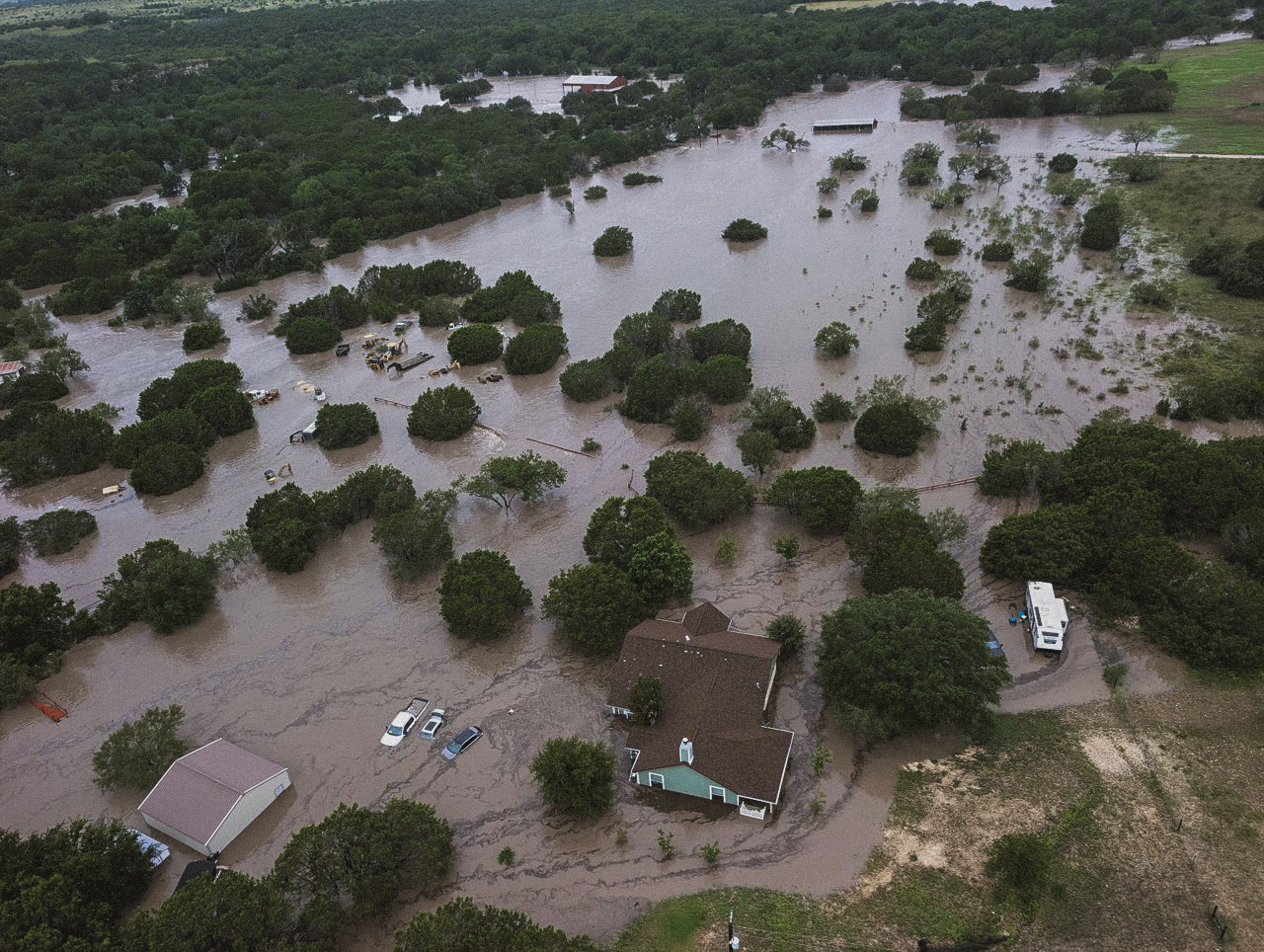
I’ve startled awake the last few nights with nightmares of the Texas floods. I don’t live there and do not know anyone affected, but images of that wall of water swelling the Guadalupe by thirty feet in forty-five minutes remain with me. It’s difficult to conceive the force of that torrent, let alone imagine the terror of those engulfed.
I’m horrified by the immensity and power of the waters. Usually we can understand and thus, in a way, manage our suffering and fear. We know what it is to wait for the biopsy results or learn of an accident. Those are within our range of possibilities and appear less awful.
But the strength and irresistibility of the surge? To me, at least, this is awful and beyond imagination. It seems malevolent, repellent, beyond my ability to conceptualize and order. I know this isn’t true, that floods are natural, but still the video is unfathomable, as if God allowed something uniquely evil.
As it happens, last evening I watched the new Stephen King movie, The Life of Chuck. It’s not a horror film, like much of King’s work, and one review describes it as “A Wonderful Life for this generation.” Indeed, the film is presented as sweet and life affirming, full of the wonders of being human and alive. Still, the first third of the movie is apocalyptic, the literal end of the world, with a shocking moment when the North Star stops existing as the rest of the stars, accompanied by small popping sounds, then disappear into nothingness. The end of the universe, like a flash flood, is awful because it is inconceivable, unimaginable, not something we can wrap our minds around because it is too immense and final, too total. I found the scene almost unbearable, and for basically the same reason the flood waters frighten me—I cannot organize it into a rationally coherent, controllable structure.
I’m to take hope in nothingness and find wonder in moments and memories inevitably turning into nothing?
In the movie, however, it is not the universe that is ending but only a universe—namely, the death of one person and his world. The stars have not ceased and returned to the nihil but only neurons firing in a final memory before the darkness and unceasing silence of death.
This, King suggests, makes life wonderful, a comfort, and a source of hope. After the deluge: nothing. This is hopeful? I’m to take hope in nothingness and find wonder in moments and memories inevitably turning into nothing? No; nothingness, like the flood waters, is inexplicable and awful.
We often observe a false notion of hope in the face of tragedy, what Alice von Hildebrand, borrowing from Gabriel Marcel, terms “hope that.” We hope that our sister will recover, or that the warnings will be received in time to move to higher ground. Often this is merely wishful thinking, or optimism, or a sort of naïve and sunny disposition. But given the immensity and horror of actual evil and death, optimism is inadequate and trite, even improper and morally offensive. Are we to tell the parents of missing children to “keep hoping that their daughter will be found,” even though we know she will almost certainly not be found alive, if at all?
Instead, as von Hildebrand rightly notes, authentic hope includes a “clarity of vision as to the drama of a situation. I have no illusion. I see with pitiless clarity that, humanly speaking, a situation is desperate; I experience all the anguish inherent in this despair, but I rely on an extra-mundane factor and thus refuse to see tragedy as the last word.” Such “hope in” is always grounded in God, and nothing other than God, knowing, no matter how much we might have loved the lost daughter, that God loves her even more than we do. The situation might be truly desperate, with no source of optimism or easy solace, but there is an “infinite love” transcending the enclosed “circle of immanent causalities” and the “pitiless unfolding of immanent laws.”
To the skeptic, the distinction between hope that and hope in might seem quaint or self-serving. Nothing has changed in the facts, after all: the glioblastoma remains, the child is still missing, the friend unresurrected. It’s not at all obvious that hoping in is notably better or worse than hoping that; if anything, hoping in God could be viewed as more naïve and passive than positivity or refusing despair by hoping that good news will arrive. Even more, if the tragedy is especially extensive or intense, appeal to God might seem an inversion of the painful reality—the pain is immense, so we’ll appeal to the biggest power that can be conceived; we don’t understand so we’ll appeal to the all knowing for comfort.
If there is no God, it follows that appeals to an almighty and infinite goodness are of no importance or weight; if there is a God, then appealing to infinite goodness corresponds to reality as it actually is—namely, a universe governed by more than matter and force, cause and effect, but ordered to our well-being and joy. How are we to accept such a notion of order in the face of tragedy, especially of the sort defying our categories and logic? This cannot be a sheer act of will and still be reasonable, but it can be our free cooperation with a reasonable trust in revelation and remain a sensible and profoundly human act. Given what we take to be the best account of reality, a reality including a transcendent God and the immanence of his providential creation, it cannot be the case that our judgments of the truly good turn out to be meaningless and false. Since it cannot be, it is not.
Hope, then, as Marcel suggests, is a kind of prophecy. It is not ignorant of the immanent facts, it does not pretend that all the young campers will miraculously be found unharmed and well, since prophetic hope looks reality full in the face. But in the face of that reality, as harsh and horrible as it appears, hope neither blinks nor turns away. Instead, it looks through to the other side, as it were, to see that transcendent goodness who remains unchanged in his mercy and care.
Stephen King turns away, as if there were beauty as stars and neurons fade to black. Wishful thinking blinks, in that sort of childish thinking in which the monster cannot see us if we cannot see him; if we close our eyes, the waters will not soon be upon us.
In hope, we look the darkness, the abyss, right in the face, seeing it for the darkness it is, and knowing that it should not be this way, and that there is another, far greater than us, who agrees, who also knows and wills that it should not be this way, and thus it will not end this way, for he has acted and worked to restore and repair all things to their fullness in the kingdom of God.
Hope remembers and proclaims, in the words of Gerard Manley Hopkins, that while there is “no waving off of these most mournful messengers,” and that “no, nothing can be done / To keep at bay . . . drooping, dying, death’s worst, winding sheets, tombs and worms and tumbling to decay,” God has not forgotten. We need not be “so haggard at the heart, so care-coiled, care-killed . . . so fashed, so cogged, so cumbered,” for we are “kept with fonder a care, / Fonder a care kept than we could have kept it, kept / Far with fonder a care.” Where are we kept? Yonder, in the memory and heart of God: “Yonder, yes yonder, yonder, / Yonder.”