
One of my favorite Advent hymns is Lo, He Comes with Clouds Descending. To my great delight, we got an early preview in our parish on the feast of Christ the King. Advent is such a beautiful season, and it’s easy for its themes to get lost in the midst of all the distractions as we prepare for Christmas.
The first part of Advent is now behind us, and the Christmas novena has begun. But even as we turn our attention to the birth of Christ, the eschatological sense remains in the liturgy. Jesus came as a child for a purpose that is fulfilled in the resurrection and the hope he left us when he ascended into heaven after suffering his passion and death.
The liturgical year begins again as it ended, with Christ in glory. After the feast of Christ the King, the first part of Advent focuses on Christ’s return “with power and great glory” (Gospel from the First Sunday of Advent). The hymn that I mentioned above is perfectly suited to the season. The music is strong and elegant and it beautifully emphasizes the repetition of the text in the second half of the hymn.
1. Lo! he comes with clouds descending,
Once for favored sinners slain!
Thousand, thousand saints attending,
Swell the triumph of his train.
Alleluia!
Alleluia!
Alleluia!
God appears on Earth to reign.2. Ev’ry eye shall now behold him,
Robed in dreadful majesty,
Those who set at naught and sold him,
Pierced and nailed him to a tree,
Deeply wailing,
Deeply wailing,
Deeply wailing,
Shall the true Messiah see.3. The dear tokens of his passion
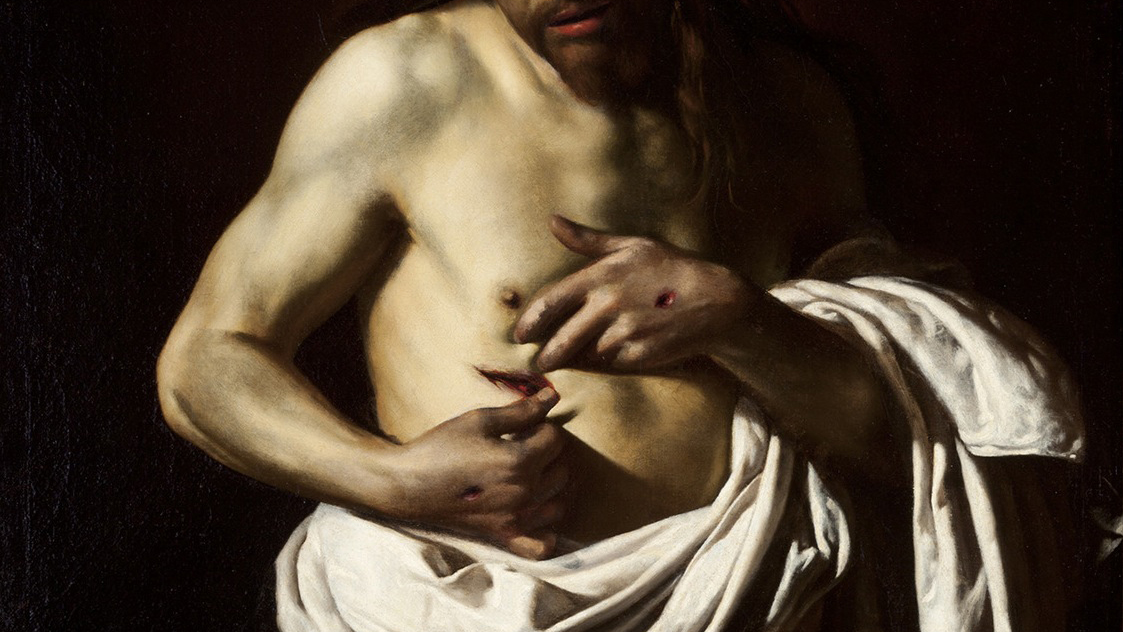
Still his dazzling body bears,
Cause of endless exultation
To his ransomed worshipers;
With what rapture,
With what rapture,
With what rapture
Gaze we on those glorious scars.4. Yea! Amen! let all adore thee
High on thine eternal throne!
Savior, take the pow’r and glory,
Claim the kingdom for thine own.
Alleluia!
Alleluia!
Alleluia!
Everlasting God come down.
The third verse of this hymn struck me in an especially poignant way this year. Everyone who has a loved one with a disability wonders at some point what of their earthly life will carry over into the resurrection. What will their judgment be? Will they still have their disability? Will their body or mind be healed? Will they have a special place in heaven? Maybe this hymn text and what we know about Jesus’s resurrected body hints at an answer.
What will their judgment be? Will they still have their disability? Will their body or mind be healed? Will they have a special place in heaven?
I’ve just completed a book on Down syndrome for Word on Fire’s Dignity Series and in the epilogue, I reflect on that question about disability and the resurrection. The words of the third verse, “With what rapture gaze we on those glorious scars,” seem to me to offer hope to families of what the resurrection holds for our loved ones with physical or cognitive impairments.
Of course, we can’t know for certain what the resurrection will bring for any of us, but a reasonable case can be made to say that just like the glorified scars of Jesus, the marks of disability will remain, but in some mysterious, perfected way.
In book 22, chapter 19, of the City of God, Saint Augustine addresses the question of imperfections in the body that mar its beauty, and claims that while those things shall be removed in the resurrection, the natural substance of the body will remain. “Imperfections” and things that “mar” the body’s beauty are dependent on one’s sense of perfection; however, toward the end of the chapter he turns to the martyrs and writes that “in the heavenly kingdom the marks of the wounds which they received for the name of Christ . . . will not be a deformity, but a mark of honor, and will add luster to their appearance, and a spiritual, if not a bodily beauty.”
Would Augustine, then, believe that only those who willingly suffered for Christ will bear the marks of their wounds, but all others will rise “perfected” in body and mind, absent the marks of their disability? Many in our current time reject the notion that the marks of disability are imperfections and believe that they’re inseparable from their identity so they will necessarily be present in heaven.
Remember we’re speculating here, and from scant scriptural evidence.
In 1 Corinthians 15, St. Paul tells us that in the resurrection, we’ll be changed in the “twinkling of an eye,” and our resurrected body will be entirely different from the one we have now—perfectly integrated with our soul and free from any defect of sin. We know the corrupting influence of original sin and how it introduced vulnerability, sickness, and death into our human condition. All those things that limited us in life will be overcome. The first coming of Christ in Bethlehem offered this hope, but the brutality of his passion was necessary for it to be fulfilled in the resurrection. The perfect, spotless body of the child in the manger was vulnerable to injury and death, but the same Jesus’s wounded body was glorified after the resurrection. In faith and hope, we know that is our path too. His life, death, and resurrection is vivid proof that the promise of eschatological hope will be fulfilled in glory. Hope is what gives Christians a counterpoint to the nihilistic culture in which we live—a culture that sees no value in suffering and views death as a final end.
Drawing from the teachings of St. Thomas Aquinas, the Church tells us that our glorified bodies will have certain qualities. Regardless of our physical, cognitive, and emotional state in this life, in eternity they will be incorruptible, agile, subtle, and glorious (Thomas Aquinas, Summa theologiae 3, suppl. 82-85). If we think that Jesus walking through doors after his resurrection was amazing, we can assume that we—by grace—will also possess subtlety, as well as impassibility, clarity, and agility, reflecting the radiance of his glory. But can a person with a congenital defect of body or mind be reunited with a glorified body and still retain their identity that was marked throughout life by their disability? The theologian Father Terrence Ehrman, CSC, thinks so. He writes that “congenital diseases and chromosomal abnormalities shape the history and personality of those with disabilities, but these impairments and disabilities are not of our essence and hence may be healed without compromising identity.”
Disability is significant in the way it molds and shapes lives over time, but it does not define the core of who one is.
That phrase “not of our essence” might need some explaining. Very simply, our “essence” is how we exist in God’s image—the union of our immortal soul with our body. Disability is significant in the way it molds and shapes lives over time, but it does not define the core of who one is. Because the soul and body together constitute the unique human person, the soul’s beatific perfection in eternity—its vision of God—will be shared by the glorified body made incorruptible, agile, and subtle, fully participating in divine union. The corruptibility of the body will have been healed through the gift of the resurrection—but can bodily integrity be restored and the individuating features of the unique person retained. Maybe.
Ultimately, we’re stuck in our speculation. We can’t know for certain the answer to that question, but what we do have is Gospel testimony of the resurrected Lord, with his dazzling body bearing the “dear tokens of his passion.” In those wounds, we proclaim with the blessed Doubting Thomas, “My Lord and my God.”
As Catholics, we live in faith and are comfortable with mystery because we know that in the end, all things will be known. The Pastoral Constitution on the Church of the Second Vatican Council, Gaudium et Spes, in article 22, used a phrase that I quote often. It says, “The truth is that only in the mystery of the incarnate Word does the mystery of man take on light.” This Advent season places us in the heart of this mystery of the Incarnation. When we look into the manger on Christmas morning and see the image of the perfect Christ child, we already know the end of the story of his life and the ultimate price he will pay for our salvation. We don’t yet know the end of our earthly life. Our mystery is ongoing, but his is now known. With that knowledge, we anticipate the glory of the resurrection and live in hope.
We might choose, or not, to think that just as our Lord’s “glorious scars” were visible in his resurrected body, the signs of our loved one’s disability will be present in their resurrected body. Whatever the reality will be, when that day comes there will be no more speculation. Our hope will be fulfilled, and we will be overcome with joy—questions will disappear in knowing as we are known.
Come, O come, Emmanuel, hope of the ages. With rapture we long to behold your glorious scars.