
What do a Queens rapper and music mogul, a fourth-century monk in the Egyptian desert, and a Serbian model-turned-director inspired by Dostoevsky have in common?
The answer is Moses the Black, a graphically violent but spiritually potent new film in which worlds collide—both horizontally and vertically.
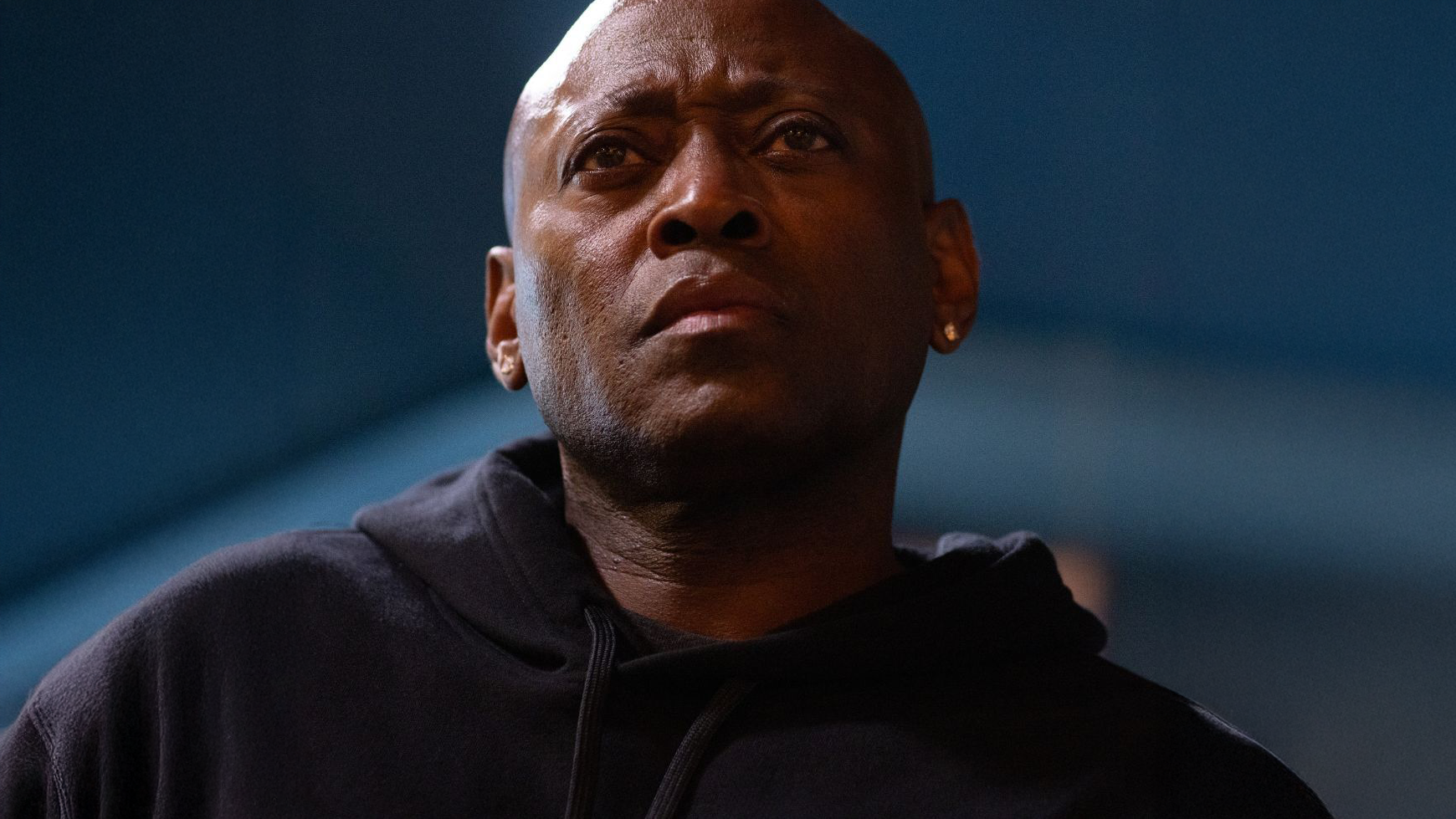
The project—produced by 50 Cent and starring Omar Epps and rappers Wiz Khalifa (who gives a standout performance) and Quavo—began as the brainchild of producer, writer, and director Yelena Popovic. On the heels of her film Man of God about Orthodox archbishop Nectarios of Aegina, Popovic set out to make a new film on St. Moses the Black, the ancient Ethiopian monk counted among the “Desert Fathers”—heroic souls who lived lives of self-denial and simplicity in the wilds of Egypt.
Fr. Josh Johnson, in his book On Earth As It Is in Heaven: Restoring God’s Vision of Race and Discipleship, offers this summary of the life of Moses, who’s venerated as a saint in both the Orthodox and Catholic traditions:
One of the greatest African saints was a fourth-century monk who came to be known as Saint Moses the Black. In his early life, he was an outlaw and alleged murderer. The exact circumstances surrounding his conversion are unknown, but, at some point, he encountered the love of Christ and became a monk and eventually a priest. In the early Church, it was unusual for a monk to be ordained a priest, so this was a rare honor. He would become the leader of a small group of hermits in the western desert of Egypt. Around the year 405, at the age of seventy-five, Moses and his fellow hermits were martyred by the Berbers because of their commitment to Christ. To this day, monks continue to be inspired by the example of Saint Moses the Black.
But as Popovic sought out to tell Moses’s story, she stalled out for over two years, writing and rewriting the script, which always seemed to fall short. “Something is wrong,” she recalls telling her husband. “This is not the story I’m supposed to tell.”
That story, she later realized, wasn’t centered on fourth-century Egypt at all but on present-day Chicago. And her lead character wouldn’t be Moses the Black but Malik (played by Epps), a gang leader who—after doing a bid in prison and setting out to avenge the death of his friend—undergoes a spiritual crisis. Moses would still be present, but now as a kind of Virgil to Malik, whose ongoing descent into the hellishness of gang life coincides with stirrings of grace—and a longing for redemption.
“He who lives by the sword shall die by the sword.”
That breakthrough begins with a dinner table conversation between Malik and his grandmother, a pious woman who raised him. They talk about his life, his death, and the afterlife—but Malik remains, as he does throughout most of the film, Stoic, hardened by so many years of brutality and struggle. He can only offer empty platitudes in response: “If I die tomorrow, I ain’t got no regrets. . . . Don’t matter if there’s a heaven or hell. My fate is my fate.” But then Malik’s grandmother hands him a prayer card of St. Moses the Black—once a gang member himself, she tells him. “Take it and keep it with you.”
He does. And this “seed of the Word” planted in Malik’s life by his grandmother will, it turns out, change everything. Before, Malik had slipped effortlessly back into his old life: He gives handshakes and hugs on the street, and orders the first of many shootings to avenge his friend’s life. “Retribution is at hand,” he remarks coldly. He’s a man of this world—so much so that his love interest, a tattoo artist, is steadily etching the globe onto his shoulders.
But after receiving this prayer card, that old life is almost immediately invaded by the presence, the example, the mystery of Moses the Black (played by the Nigerian-British actor Chukwudi Iwuji), so dear to this woman who was so dear to Malik. And the first word Moses has for him—the words of Jesus—grip him and never let go: “He who lives by the sword shall die by the sword.”
For the rest of the film, Malik finds himself caught between what the Didache calls the “two ways”: the way of Life, suggested by Moses, and the way of Death—that “fate” he had so blithely accepted and now struggles to wrest himself from. The conflict is underscored beautifully by the motif of train tracks running in polar opposite directions: Every move Malik makes now matters, and is a matter of life and death. Deeds that Malik wouldn’t have thought twice about now fill him with dread; his old companions look at him with mounting distrust and suspicion; and all the while, Moses—praying the psalms and the Jesus Prayer, doing penances in the desert emptiness, crying out with tears of compunction—opens up a path Malik never thought possible: a machismo of self-oblation.

Be warned: Moses the Black is not a soft-focus, sugarcoated morality tale. It’s a stubbornly authentic portrait of life in the underbelly of this “valley of tears,” one riddled with street lingo and drug references, flying bullets and f-bombs. And Malik’s conversion isn’t a sudden, clean-cut one-eighty, but a gradual, messy turn toward the light, one shot through with sadness and hurdling toward tragedy. But it is a turn to the light, and reflects how God, in Christ, saves humanity: not by snapping away sin but by entering into it with us, transforming human nature from within. Indeed, God comes to turn even the worst of sinners into his saints.
Toward the climax of the film, Malik looks at an icon of Moses the Black and asks him: “What’s your secret?” He hears back one of the great lines of Moses quoted in the Sayings of the Desert Fathers: “Go and sit in your cell, and your cell will teach you everything.” Bishop Erik Varden, meditating on this passage in his recent Desert Fathers in a Year series, reflects, “The cell in this story represents the place to which God’s providence assigns us. For some it will be a monastic enclosure; for some, it will be marriage. For others it will be a task: a needy person to look after, a sickness to bear, a reconciliation to effect. . . . What matters is to let God act as he sees fit and not to miss his visitation.” In telling a story of one man not missing his visitation amid the violence and volatility of the streets, Moses the Black is sure to get people talking—maybe even, God willing, to the saints.
Moses the Black releases in theaters nationwide on January 30, 2026.