
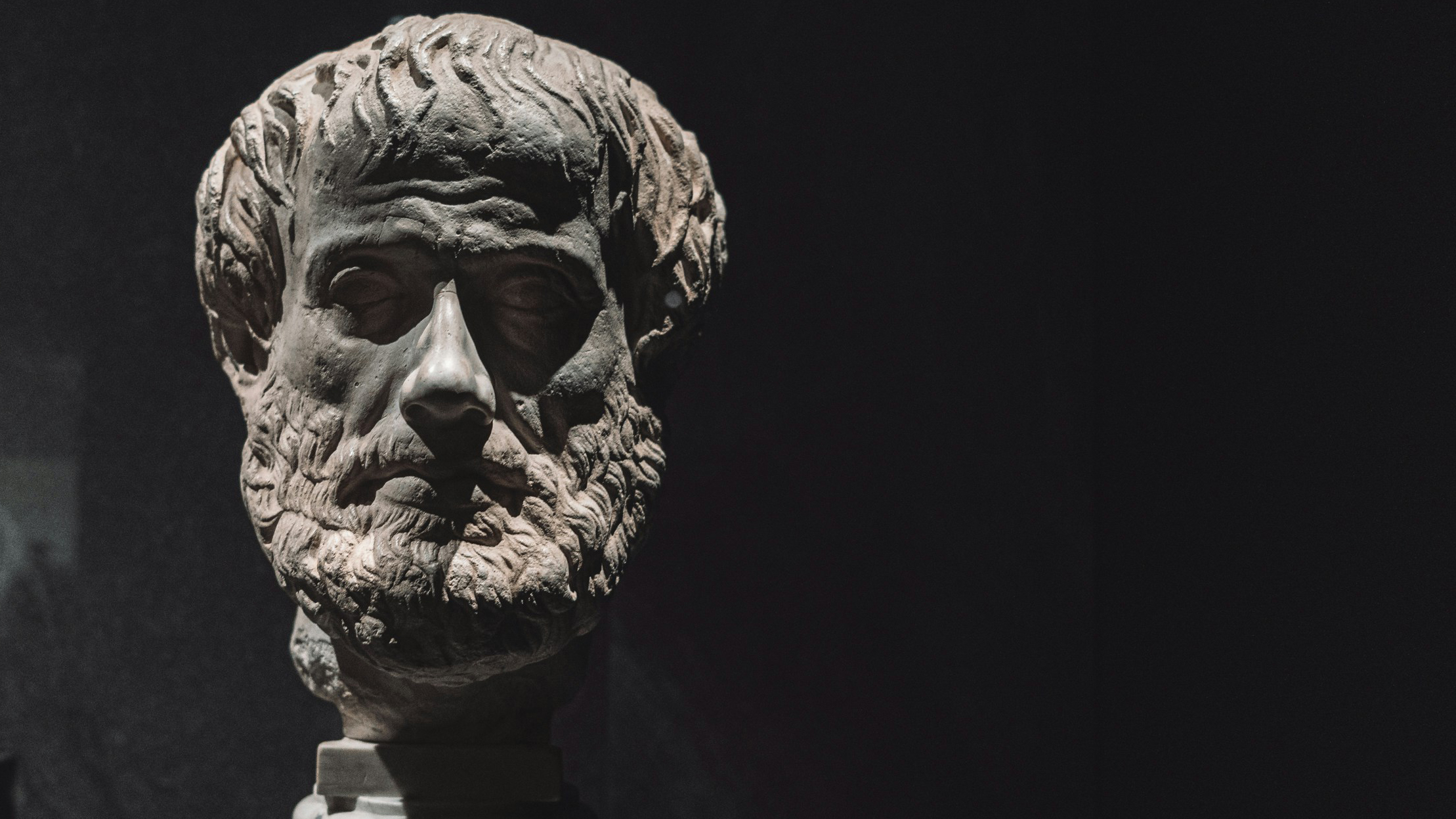
Advancing technologies are nothing new. However, the influence of artificial intelligence (AI) does seem unprecedented: Its power, influence, and capacities are growing each week, and there are purportedly no areas of life we are told it will not impact. Therefore, understanding what AI is and how it is not able to replace the human person is critical. To do so, we can find tremendous aid from our old friend Aristotle.
AI is a tool, a form of technology. Merriam-Webster Dictionary defines technology as “a manner of accomplishing a task especially using technical processes, methods, or knowledge.” Encyclopedia Britannica defines the word as “the application of scientific knowledge to the practical aims of human life—or, as it is sometimes phrased, to the change and manipulation of the human environment.”
This is precisely what the creators of AI have been attempting to accomplish. The efficiency of these advanced computers is being proposed to humanity as the path forward for a better life—free from the mundane and arduous tasks of creating, learning, and intellectual hard work. If AI has and will continue to replace the labors of the human person, we must also investigate who the human person is and what we are made for.
Understanding humanity means we have a grasp of the soul: Knowing what the soul is impacts everything. “The knowledge of the soul,” Aristotle claimed in his seminal work De Anima (On the Soul), “admittedly contributes greatly to the advance of truth in general, and, above all, to our understanding of nature, for the soul is in some sense the principle of animal life.”
If AI can accomplish the faculties of intellect, sensation, and will more efficiently and more effectively than human beings, is it more human than we are?
The soul is the form of the body. It is the animating principle of a being that is alive. The question is: Does AI have a soul if it can accomplish the same tasks (learning, speech communication, etc.) that separate the human soul from all other beings that are alive?
First, artificial intelligence is a computer—an advanced computer compared to the original creation, but a computer nevertheless. Therefore, AI is not alive. In their work Artificial Intelligence: Reflections in Philosophy, Theology, and the Social Sciences, editors Benedikt Paul Göcke and Astrid Marieke Rosenthal-von der Pütten define computer as “a machine that can manipulate formal symbols according to syntactic rules and thus works algorithmically, i.e. by the step-by-step transformation of a sequence of characters according to a certain scheme.”
The difference between the genesis of computers and the rise of artificial intelligence is the ability for AI to compute an exponentially greater amount of data, as well as the capacity to organize that data and convey it, apparently on its own. The advancements in artificial intelligence can be seen most vividly in the subset of robotics and evolutionary programming. Robotics seems to be artificial intelligence coming to life.
Margaret Boden writes about the different genres of AI in the Encyclopedia of Philosophy’s section on the topic. She notes that “situated robots are described by their designers as autonomous systems embedded in their environment. Instead of planning their actions, as classical robots do, situated robots react directly to environmental cues.” It appears that the new generation of AI thinks (intellect), responds to what it senses (sensory powers), and makes choices (will).
If AI can accomplish the faculties of intellect, sensation, and will more efficiently and more effectively than human beings, is it more human than we are?
To answer this question fully would take a large treatise. For our sake, however, we can refute such a claim by clarifying that AI is not alive and AI does not know anything.
Artificial intelligence is created by programmers who write language into the machine in order for that computer to act on. At face value, one might examine the way ChatGPT, DeepSeek, Brisk, or another AI tool responds to questions or provides information and conclude it is having a conversation with you: It knows data and is able to communicate it in a human manner.

The soul, however, is not the result of merely physical operations and functionality. We know this to be the case when examining the human mind. For example, a person knows what a tree is by abstracting its form from the individual appearance that presents itself to the mind. The essence of the tree is immaterial and the mind of the person—also immaterial—can receive the form and know its essence. Artificial intelligence cannot do this. Aristotle understands the intellect’s power to be the gaining of knowledge by abstracting the essence of things from their individual existence. In this way, the human power to know has an immaterial quality, whereas AI is a strictly mechanical being that assigns numbers to letters and regurgitates a response based on algorithms assigned to those numbers (letters) to form words and sentence structures. It is not alive and it does not know anything. But what if it could advance to some quasi-form of consciousness—could it know like human beings?
Aristotle’s distinction between the different levels of knowledge can answer this final question. In book 3, chapter 4 of De Anima, Aristotle notes that there is a difference between being a man of science and one who has knowledge of science. Aristotle says that the man who executes the knowledge “is now able to exercise the power on his own initiative,” demonstrating that “the mind too is then able to think itself.” This human choice leads to deep knowledge and actual contemplation.
Man can use his reason to know things for purposes of utility, but also simply for no other reason than to know the truth. This is what contemplation seeks at its core. Aristotle notes that “the philosopher . . . can contemplate truth . . . and this activity alone would seem to be loved for its own sake; for nothing arises from it apart from the contemplating.” No matter the advancement of artificial intelligence, it can never perform the “use-less” art of contemplation that makes the human person most human.
Therefore, it is clear that AI has no soul, is not alive, and cannot know; Aristotle’s explanation of the soul quashes these assertions over two thousand years later. Human beings remain irreplaceable for their capacities to know, to choose, and to contemplate the truth. In a time when the grandeur of such abilities is threatened to be replaced by a tool, we would do well to learn from Aristotle—and be enamored with the human enterprise of knowledge for knowledge’s sake.